Managed submission service controls
Directory Submission Services: Scope, Evidence, and Risk
Buy a transparent service scope and evidence trail—not a promised directory count. Keep product truth, authority, accounts, material approvals, verification, and the right to correct or leave under buyer control.
- Reviewed by
- SubmitForBacklinks Editorial Team
- Published
- Updated
- Checked
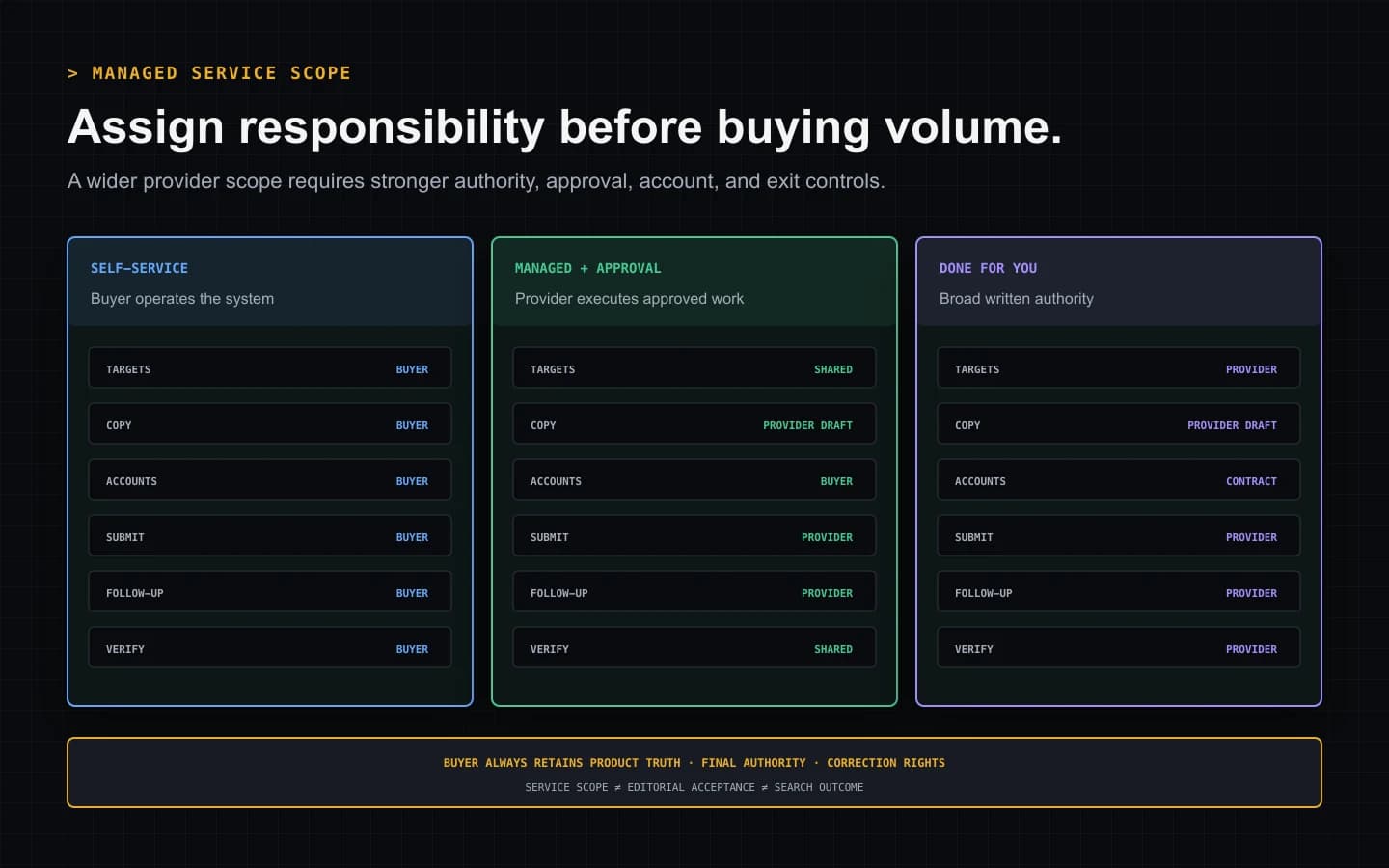
Direct answer: buy evidence, not a directory count
A directory submission service is worth evaluating when it can turn a defined scope into a reviewable record. The contract should name how targets are selected, which work the provider performs, which decisions remain with the buyer, what counts as delivery, which evidence is returned, how mistakes are fixed, and how accounts and access are handed back.
Do not buy “300 submissions” as an outcome. A count hides whether the directories fit the product, whether the provider had authority, whether the copy was true, whether a form accepted the request, whether an editor published it, and whether the live page delivered the agreed destination and relationship. One well-documented submission may be more useful than a large opaque batch.
No managed, automated, or self-service provider can guarantee acceptance, publication, permanence, crawling, indexing, rankings, traffic, customers, authority, or link equity. Procurement should make the work and evidence inspectable; it cannot purchase an editor's decision or a search outcome.
Define the service before comparing providers
“Directory submission service” can describe three different contracts. Name the one being purchased before comparing a price or destination count.
| Service scope | Provider owns | Buyer retains | | --- | --- | --- | | Self-service software | Interface, supported integrations, transport mechanics, and system records | Target research, accounts, product facts, approvals, submission, follow-up, and verification | | Managed with approval | Agreed research, draft preparation, approved submission, and status tracking | Product truth, authority, account policy, destination and copy approval, commercial decisions, and acceptance of terms | | Done for you | Specifically authorized account work, forms, follow-up, and evidence collection | Final responsibility for truthful claims, written authority, approval rights, access limits, account transfer, corrections, and offboarding |
This is a contract comparison, not a verdict about manual or automated execution. A self-service system may be carefully controlled. A done-for-you engagement may be opaque. The useful distinction is who may make each decision and what evidence survives.
Managed with approval is a strong default when the provider can remove repetitive research and entry while the founder still sees material choices. Broader done-for-you authority can be reasonable, but it needs stronger account, approval, reporting, and exit terms.
Write a statement of work that can be tested
The statement of work should define units that can pass or fail. Include:
- target-selection criteria, exclusions, product stage, audience, geography, and category fit;
- research, account, drafting, media, submission, verification, correction, and follow-up tasks;
- buyer approval gates and actions the provider may take without another approval;
- directory fees, provider fees, reciprocal requirements, sponsorship, and other material relationships;
- required deliverables for attempted, submitted, pending, published, rejected, corrected, removed, or blocked work;
- correction ownership, unresolved-item handling, account transfer, data return, retention, and access revocation.
Avoid a scope defined only by a minimum number of directories. Ask for a small sample record before the full engagement. The provider should be able to show how a single target enters the register, receives approval, produces a receipt, reaches a terminal or pending state, and gets corrected.
NIST SP 1305 is a cybersecurity supply-chain guide, not a directory-marketing rule. Its broader acquisition principle is still useful here: a buyer becomes more capable by defining and communicating supplier requirements. The NIST publication supports the discipline of explicit requirements; this article applies that discipline to a submission service without treating it as a legal mandate.
Demand a sourced target register before submission
The provider should disclose every proposed destination before it acts. For each target, require:
- directory name, public URL, official contribution route, and source-check date;
- audience, category, eligibility, and a written reason the product fits;
- account requirement and expected account owner;
- known directory fee, provider markup, sponsorship, reciprocal condition, or other material relationship;
- planned destination URL, category, copy variant, and media needs;
- current state, responsible person, approval, and next action.
Reject an unnamed “network” or a list whose only evidence is an authority metric. The SaaS directory shortlist shows how to start from official sources and product fit. The directory quality framework helps inspect the exact source page and editorial context.
Google's spam policies include low-quality directory links, paid links intended to manipulate rankings, excessive exchanges, automated link creation, forced contractual links, and low-value distributed content among link-spam examples. A managed provider does not make those arrangements safe merely by putting a person between the buyer and the form.
Keep authority and account custody visible
Written authority should identify the company, product, authorized actions, approved destinations, commercial limits, approver, start date, and end or revocation condition. A public website does not authorize a provider to accept terms, create accounts in a founder's name, buy placements, or represent unsupported claims.
Prefer client-owned accounts and company-controlled email addresses where the directory permits them. Do not share a founder's primary password. Use a provider-specific account or minimum necessary role, record recovery ownership, and keep a revocation path. CISA's ransomware guide addresses third-party and managed IT risks, so it is not a directory-service standard. Its principles—contract requirements, least privilege, and separation of duties—are sensible access controls for any outside provider.
The contract should say who retains accounts, profiles, messages, receipts, assets, and correction rights after the engagement. Decline a provider that will not transfer a client-funded account or reveal where credentials and recovery factors are held.
Approve truth, fit, and commercial choices
The buyer should approve the exact destination, product identity, claims, copy, category, tags, media, destination URL, price, reciprocal condition, and terms before a provider sends them. The provider may draft; it should not invent awards, customers, usage counts, integrations, results, reviews, or founder experience.
The FTC says endorsements and testimonials must be truthful and not misleading and that material connections that affect evaluation should be disclosed. Its Consumer Reviews and Testimonials Rule Q&A also explains potential liability for agencies, review brokers, and reputation-management companies involved in fake reviews, sentiment-conditioned incentives, review suppression, or fake social indicators. Decline any submission service that bundles fabricated ratings, testimonials, votes, awards, or user identities.
Use the SaaS directory submission checklist to prepare buyer-owned facts and media. The service contract begins after that source record exists; it does not replace it.
Require a ledger, not a completion dashboard
For every destination, the returned ledger should preserve:
- account owner and authorized operator;
- exact product-record and copy version;
- category, tags, media, destination, anchor request, and commercial relationship;
- submission date, confirmation, receipt, request identifier, and responsible person;
- state: prepared, approved, attempted, submitted, pending review, needs changes, published, rejected, removed, duplicate, or blocked;
- live profile URL, observation date, correction ticket, and next owner.
“Attempted,” “submitted,” and “published” are different states. A confirmation email can prove that a request entered a workflow; it cannot prove that a public listing exists. A live page can prove observed delivery at a date; it cannot prove permanence or a future search result.
When software sends the request, record a durable request identity. SubmitForBacklinks uses UUID idempotency for authenticated mutations: an identical retry can reuse its recorded outcome, while changed intent needs a new identity. That product behavior is one example of a delivery control, not a claim that every external directory provides the same feature.
Verify the live source and delivered relationship
For a published state, inspect the source page rather than accepting a
provider screenshot alone. Record the public URL, visible product name, copy,
category, surrounding context, destination href, redirects, final URL,
anchor, rel, commercial relationship, and check date.
Google says a generally crawlable link uses an <a> element with an href.
Its outbound qualification guidance
recommends sponsored for advertisements and paid placements, accepts
nofollow for that purpose, and describes ugc for user-generated links.
Verify the delivered relationship; do not demand an optimized anchor or
unqualified link as a service success metric. The
dofollow and nofollow guide covers
that source inspection in detail.
Search Console can be supporting evidence, but not a provider acceptance
certificate. Google's Links report documentation
says the report is sampled and limited, may contain historical links, groups
data by canonical URL and root domain, and does not report nofollow.
Contract corrections and failure handling
The engagement should define what happens when the provider chooses the wrong category, publishes stale copy, creates a duplicate, uses an unapproved destination, loses account access, receives a rejection, finds a removed listing, or discovers that the directory changed its rules.
Require the original record, detected error, correction request, owner, submitted date, response, final state, and unresolved next step. Do not let a failed or rejected item disappear from a headline completion percentage. Specify which mistakes the provider corrects within its fee and which changed requirements need a new approval.
Immediate stop conditions include:
- guaranteed acceptance, permanence, ranking, indexing, traffic, customers, authority, or link equity;
- an undisclosed target list, payment, reciprocal arrangement, or provider relationship;
- fake reviews, votes, testimonials, awards, identities, or engagement;
- forced keyword anchors, copied low-value profiles, or irrelevant bulk directories;
- shared credentials, unauthorized terms acceptance, untransferable accounts, no evidence bundle, or no correction and removal route.
Score delivery and offboard cleanly
Evaluate a provider using facts under its control: approved targets, complete records, truthful drafts, authorized submissions, receipts returned, live pages verified, errors corrected, open items explained, accounts transferred, and access revoked. Keep acceptance, publication, search visibility, referrals, and customers as separate observed outcomes, not guaranteed service outputs.
At offboarding, export the target register, ledger, exact copy and media versions, receipts, live evidence, unresolved items, directory contacts, and account inventory. Transfer client-owned accounts, rotate or revoke provider access, remove unnecessary data, and name the internal owner for future edits.
SubmitForBacklinks demonstrates the boundary on one first-party route: a provider can scan a public site and prepare a draft, but the owner must review the generated fields, confirm authority, accept the guidelines, and authorize submission. The request then remains separate from moderation, payment, publication, badge verification, and later changes.
Current owner-selected product behavior gives standard-link treatment to approved paid Featured listings and active verified reciprocal Free listings; other Free listings use nofollow. Featured does not bypass editorial review, and the policy is not Google endorsement or an outcome promise.
Review the current submission guidelines, then submit one accurate product as a controlled test. Preserve the request, state, and live evidence. That record is the standard a managed directory submission service should be able to meet.
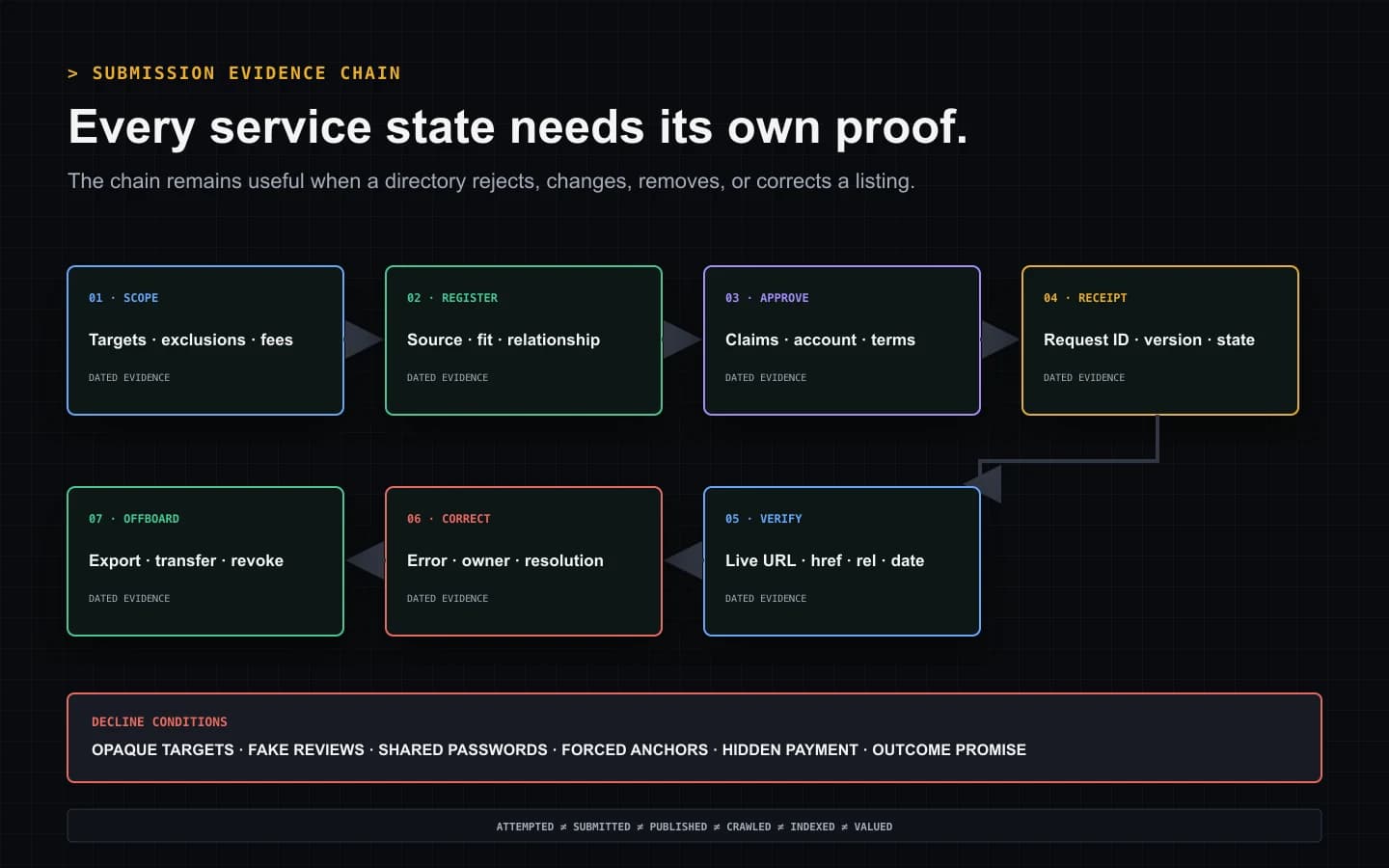
How to Review a Directory Submission Service
A 24-second control sequence for scoping a managed service, authorizing access, approving material decisions, verifying delivery, and offboarding safely.
Video transcript
Name target-selection criteria, exclusions, tasks, prices, relationships, deliverables, and failure states before work begins. Record who may represent the product, use client-owned accounts where possible, grant minimum access, and preserve revocation. Show the founder the exact destination, claims, copy, category, media, destination URL, and commercial choice before submission. Return a ledger and inspect the live source, copy, category, anchor, destination, redirects, rel tokens, relationship, state, and date. Correct errors, export open items and evidence, transfer accounts, revoke provider access, and name the next owner.
Sources and verification
Product behavior was checked against the current implementation and automated tests. External policy sources are linked directly.
- Google guidance for creating helpful content — checked July 30, 2026
- Google guidance for crawlable links — checked July 30, 2026
- Google Search spam policies: link spam — checked July 30, 2026
- Google guidance for qualifying outbound links — checked July 30, 2026
- Google Search Console Links report documentation — checked July 30, 2026
- FTC advertising endorsements guidance — checked July 30, 2026
- FTC Consumer Reviews and Testimonials Rule Q&A — checked July 30, 2026
- NIST SP 1305: Cybersecurity Framework 2.0 Quick-Start Guide for Cybersecurity Supply Chain Risk Management — checked July 30, 2026
- CISA ransomware guide for third-party and access controls — checked July 30, 2026
Put the workflow into practice
Use the guided terminal flow or review the supporting documentation before submitting a product.
Related resources
Manual vs Automated Directory Submission: Choose the Right Workflow
Compare manual, automated, and hybrid directory submission by control, repetition, consent, exceptions, review quality, and traceable evidence.
Open resourceThe SaaS Directory Submission Checklist
Prepare a SaaS directory submission with accurate copy, categories, tags, media, URLs, ownership, launch timing, and a policy-aware final preflight.
Open resourceHow Automated Backlink Submission Should Work
Learn which backlink submission tasks to automate, which controls need human review, and how idempotent retries prevent duplicate actions.
Open resourceHow to Use a Backlink Submission API
Build an owner-scoped SaaS listing integration with OpenAPI 3.1, reviewed fields, UUID idempotency keys, structured errors, and badge follow-up.
Open resource