Link attribute comparison
Dofollow vs Nofollow Backlinks: What Actually Changes
The visible click can stay the same while the publisher declares a different relationship. Read the anchor first, then keep markup facts separate from search predictions.
- Reviewed by
- SubmitForBacklinks Editorial Team
- Published
- Updated
- Checked
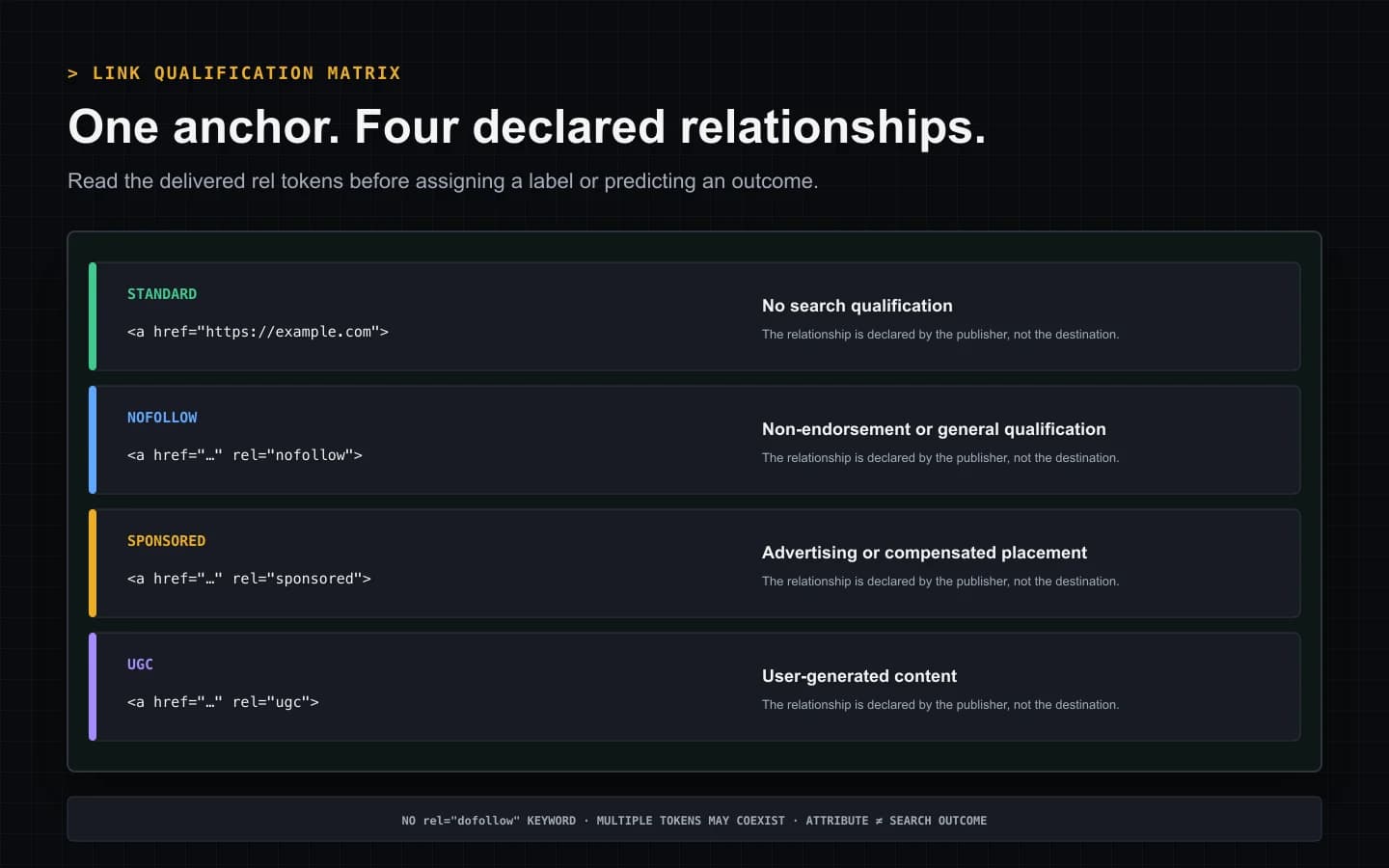
The direct difference is in the link relationship
A dofollow backlink is industry shorthand for an ordinary crawlable anchor that
does not contain nofollow, sponsored, or ugc in its rel attribute. A
nofollow backlink contains rel="nofollow". The visible link can look identical
in both cases; the distinction is in the HTML chosen by the page publisher.
There is no standard rel="dofollow" keyword. The HTML standard defines
nofollow, while an anchor with an href can form a normal hyperlink without a
qualifying relationship value. Calling that link “standard” or “unqualified” is
more precise, although this guide uses “dofollow” where it helps readers connect
the explanation to common search terminology.
That one markup difference does not settle the link's value. Relevance, placement, anchor text, the linking page, editorial context, crawlability, indexing, and a search engine's own systems remain separate questions. No HTML inspection can prove that a backlink will improve rankings, pass a measurable amount of authority, appear in a report, or cause the destination to be indexed.
Compare the four common anchor forms
Start with the smallest useful examples. Each anchor below sends a visitor to the same URL, but the publisher communicates a different relationship.
An ordinary editorial link needs no search-specific rel value:
<a href="https://example.com/research">Read the research</a>
A publisher can add nofollow when the more specific values do not apply and it
does not want to imply endorsement:
<a href="https://example.com/resource" rel="nofollow">
  External resource
</a>
Google recommends sponsored for an advertisement, sponsorship, or other
compensated placement:
<a href="https://example.com/offer" rel="sponsored">
  Sponsored offer
</a>
For a link placed by a user in a comment, profile, or forum post, ugc
communicates user-generated content:
<a href="https://example.com/profile" rel="ugc">
  Member website
</a>
Values can be combined. A forum may emit rel="ugc nofollow", and an older
publishing system may retain nofollow alongside sponsored. The presence of
multiple tokens is not itself an error. Read every token before classifying the
link rather than stopping at the first word.
Relationship tokens do different jobs from security tokens
The rel attribute also carries values that do not qualify a link for search.
noopener, for example, prevents a newly opened page from controlling the
original browser context. noreferrer suppresses referrer information and also
implies the relevant opener protection. Those are navigation and privacy
behaviors, not substitutes for nofollow, sponsored, or ugc.
This anchor is still a standard link in the narrow comparison used here:
<a href="https://example.com" target="_blank" rel="noopener">
  Example
</a>
Seeing any rel attribute therefore does not make a backlink nofollow. Split
the value into tokens and look specifically for the qualifications that matter
to the relationship. A link with only noopener is materially different from
one with noopener nofollow.
The reverse mistake is adding rel="dofollow" and assuming that it overrides
another token. It does not create a standard-defined link type, and it does not
cancel nofollow. The publisher should remove an inappropriate qualification
or apply the correct specific value rather than add unofficial vocabulary.
Google describes qualifications as hints
Google's current documentation says regular links that it should fetch and
parse without qualification do not need a rel value. It recommends
sponsored for paid placements, ugc for user-generated links, and nofollow
when the other values do not apply and the publisher would rather not associate
with or crawl the destination.
Those values are hints to Google, not commands that prove a universal crawler
outcome. Google announced that nofollow, sponsored, and ugc help its
systems decide which links to consider or exclude. It also changed nofollow
to a hint for crawling and indexing in 2020. A qualified backlink therefore
does not make the destination invisible: another page, sitemap, prior crawl, or
different discovery path can still expose that URL.
The same boundary applies to ordinary links. Omitting a qualification allows a regular link relationship, but does not require Google to crawl it immediately, index the destination, or use it as a ranking signal. “May be considered” and “will create an outcome” are different claims.
The publisher controls the markup
The site hosting the source page decides which rel values appear in its
delivered anchor. The destination owner can request a correction or choose
whether to participate in an arrangement, but cannot change HTML on someone
else's page.
That distinction matters when evaluating a backlink:
- A genuinely editorial citation can be a standard link without special markup.
- A paid placement should use
sponsoredornofollowunder Google's guidance. - A visitor-created profile or comment fits
ugc, optionally combined withnofollow. - A reference the publisher does not want to endorse can use
nofollow. - An internal link normally should not use these tokens as a replacement for crawling or indexing controls.
The category comes from the real relationship, not the outcome a recipient
wants. Removing sponsored from a compensated link does not turn the
arrangement into an editorial citation. Similarly, adding nofollow does not
make weak, misleading, or irrelevant content useful to readers.
Inspect a backlink without relying on a toolbar
Use the linking page and the exact anchor as primary evidence. A repeatable manual inspection takes a few minutes:
- Open the source page in a private window and locate the visible link.
- Confirm that the destination is the expected URL, including any redirect.
- Inspect the anchor element in browser developer tools.
- Read the complete
relvalue from the rendered element. - Compare it with the raw page source when JavaScript or a plugin may rewrite the element.
Classify the delivered link only after those checks. No nofollow, sponsored,
or ugc token means standard treatment for this comparison. Record the exact
token when one is present. If the source and rendered DOM differ, save both
observations because the crawler-visible result can depend on when and how the
element is produced.
Also verify that the link is an actual <a> element with an href. Google says
that is the generally crawlable pattern. A styled span, a click handler
without an anchor destination, or a broken URL may behave like a link to a
visitor while failing the basic markup test.
Do not inspect only the destination page. Backlink qualification lives on the source anchor. A destination's canonical tag, robots directive, or redirect can affect crawling and indexing, but none of those changes the source publisher's relationship annotation.
Search Console cannot answer every qualification question
Google Search Console's Links report can show sampled linking sites, source
pages, target pages, and link text. Google explicitly notes that the report is
not a comprehensive list and does not specify whether a link is marked
nofollow. It can also include links discovered in the past that have since
changed or disappeared.
Use the report to find candidates, then inspect the current source page. A missing row does not prove that Google has never seen a backlink. A present row does not prove that the current anchor still exists or has standard treatment.
Third-party backlink tools may add their own follow/nofollow classification, freshness date, authority metric, or crawl status. Those fields can help manage a review queue, but they are observations from that provider. Keep the source URL, inspection date, delivered HTML, and redirect target beside any vendor metric so a later reviewer can reproduce the factual part.
Judge the opportunity before the attribute
A standard link is not automatically a high-authority backlink, and a nofollow link is not automatically worthless. Ask whether a real person would benefit from the source page and the reference.
Relevant editorial coverage can send qualified visitors, explain a product, and support discovery regardless of one token. A nofollow link from useful documentation may be more meaningful to customers than a standard link hidden on an unrelated page. Conversely, an unqualified link from a low-quality, automatically generated, or manipulative page does not become trustworthy because a tool labels it dofollow.
Avoid prescriptive ratios such as “70 percent dofollow.” Google does not publish a required backlink mix, and a universal percentage ignores how the links were earned. Document relationships accurately, prioritize useful and relevant mentions, and evaluate suspicious acquisition methods against current spam policies.
Google lists paid links that pass ranking credit, excessive exchanges, automated link creation, required links without a qualification choice, and low-quality directory links among link-spam examples. The appropriate response is not to rename the link. It is to assess the underlying arrangement and qualify, remove, or decline it where necessary.
How SubmitForBacklinks renders the distinction
SubmitForBacklinks has three explicit outbound policies in its current code.
FOLLOW renders rel="noopener", so the security token remains while no
nofollow, sponsored, or ugc qualification is added. NOFOLLOW renders
rel="noopener nofollow". Advertising placements use
rel="noopener sponsored". A unit test guards all three outputs.
For product listings, an approved Free listing defaults to nofollow unless a verified reciprocal badge is inside its active follow window. The current paid Featured entitlement uses standard treatment after approval and successful payment. These are owner-selected product rules, not evidence that Google will approve, count, index, or reward a link.
That distinction carries material policy risk. Google's spam documentation specifically addresses compensation, required unqualified links, and excessive exchanges. Review those rules and the site's current pricing and link options before choosing a path. If you are using the Free workflow, the separate badge verification guide documents installation, rechecks, and the fixed follow window without turning verification into a ranking promise.
Record what the evidence actually proves
A defensible backlink record can be short:
- source page and final destination;
- visible anchor text;
- exact delivered
reltokens; - relationship category and who placed the link;
- inspection date plus any source/rendered difference.
From that evidence you can state that an anchor was standard, nofollow, sponsored, or UGC when checked. You cannot state how much PageRank moved, when Google will crawl the source, whether the target will be indexed, or how rankings will change without separate evidence that supports that narrower claim.
Use the HTML classification as one field in a broader quality review. Keep useful editorial context, accurate product information, visitor relevance, and policy fit ahead of the dofollow label. For SubmitForBacklinks-specific eligibility and moderation boundaries, read the submission guidelines before creating or updating a listing.
Dofollow vs Nofollow Link Attributes
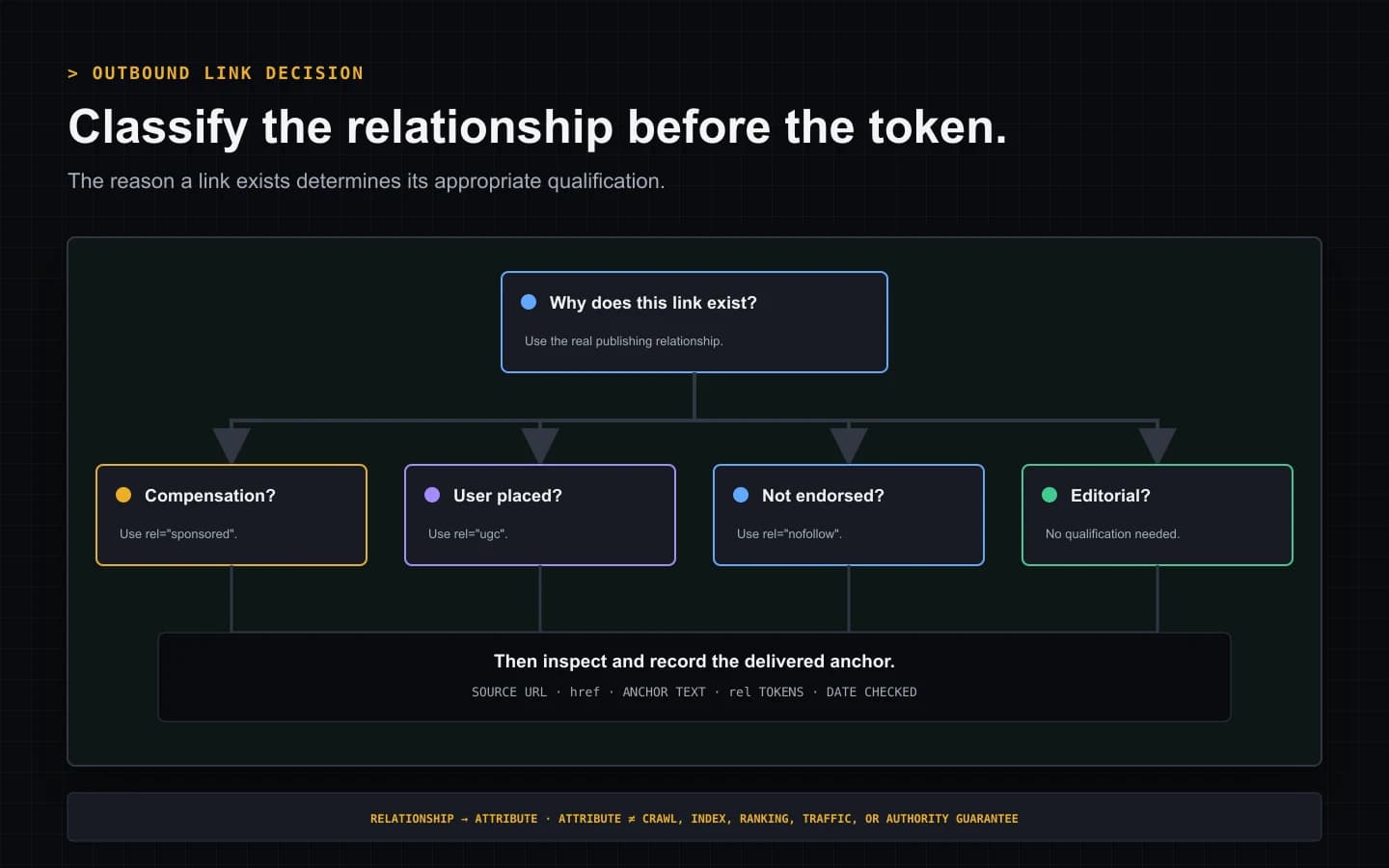
A 21-second visual comparison of standard, nofollow, sponsored, and UGC link markup followed by a source-inspection decision.
Video transcript
Inspect the delivered anchor and read its complete rel value. A standard link has no nofollow, sponsored, or UGC qualification; dofollow is shorthand, not a standard rel keyword. Nofollow communicates non-endorsement when a more specific value does not apply, sponsored identifies compensation, and UGC identifies a user-placed link. Use the real origin of the link to select the relationship. Treat link reports as discovery leads because Search Console samples links and does not identify nofollow. Save the source, destination, anchor text, rel tokens, and inspection date. Those facts do not prove crawl timing, indexing, ranking change, traffic, or authority.
Sources and verification
Product behavior was checked against the current implementation and automated tests. External policy sources are linked directly.
- SubmitForBacklinks submission guidelines — checked July 30, 2026
- Google guidance for qualifying outbound links — checked July 30, 2026
- Google guidance for crawlable links and anchor text — checked July 30, 2026
- Google explanation of nofollow, sponsored, and UGC hints — checked July 30, 2026
- Google Search Console Links report — checked July 30, 2026
- Google Search spam policies: link spam — checked July 30, 2026
- WHATWG HTML standard: link type nofollow — checked July 30, 2026
Put the workflow into practice
Use the guided terminal flow or review the supporting documentation before submitting a product.
Related resources
How to Verify a Dofollow Backlink for a Free Listing
Install the reciprocal badge, verify the live page, diagnose failures, and understand the fixed 60-day dofollow window and daily rechecks.
Open resourceHow to Use a Backlink Submission API
Build an owner-scoped SaaS listing integration with OpenAPI 3.1, reviewed fields, UUID idempotency keys, structured errors, and badge follow-up.
Open resource