Backlink indexing evidence
How Long Do Backlinks Take to Index?
A live backlink proves publication, not when a search engine will discover, crawl, index, report, or use the source page. Diagnose the exact state instead of resetting an imaginary clock.
- Reviewed by
- SubmitForBacklinks Editorial Team
- Published
- Updated
- Checked
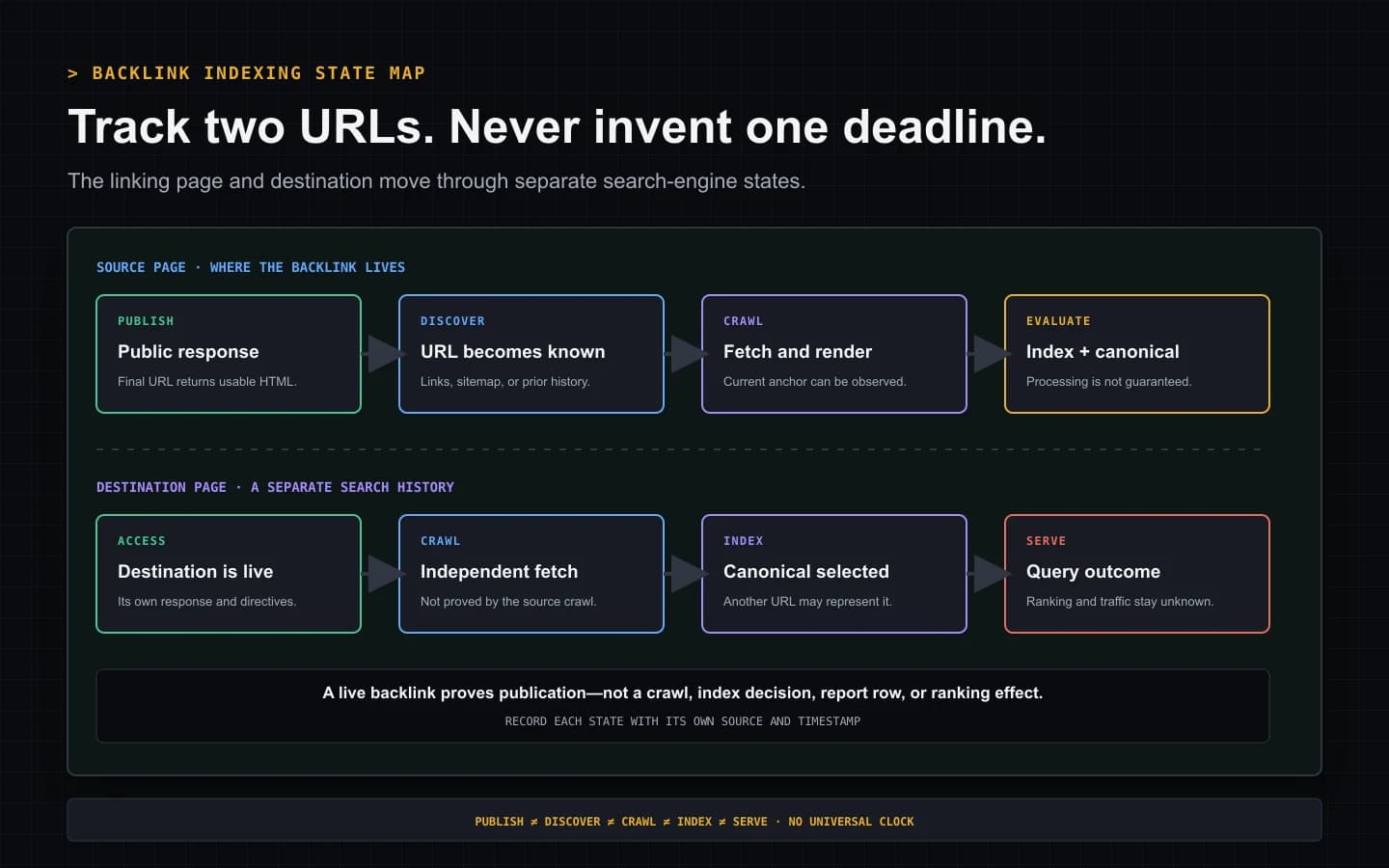
There is no universal backlink-indexing deadline
A backlink does not have its own independent “indexed” switch. The link exists inside a source page. A search engine first has to know that source URL, fetch the page, process its current content, and decide what to index. The destination page has a separate crawl, canonical, index, and ranking history.
Google describes discovery, crawling, indexing, and serving as distinct stages, and says that not every page advances through all of them. Its URL Inspection documentation says a requested indexing attempt often takes about a day but can take a week or two or longer. That is guidance for a request, not a service-level deadline. Google also states that a request does not guarantee inclusion.
So the honest answer is: a newly published backlink may be observed after the source page is recrawled, but there is no fixed wait that applies to every site. Track the source page’s state and the date the link appeared instead of starting a countdown that the evidence cannot support.
Decide what “indexed” means in your question
People use one phrase for several different events. Name the event before trying to measure it:
- The source page is live. A browser can fetch the publisher’s URL and the current HTML contains the backlink.
- Google knows the source URL. The URL has been discovered through an earlier crawl, an internal or external link, a sitemap, or a request.
- Google has processed the updated source. A crawl after the publication time could expose the new anchor.
- The source page is indexed under a canonical URL. Google selected and stored a representative version of that content.
- A report exposes the link. Search Console or another crawler includes it in a sampled or recent-links view.
Those events are not interchangeable. A live link can predate the next crawl. A crawler can fetch a page without indexing it. Google can index a different canonical URL from the one you checked. A report can omit a link that its underlying system knows, and an old report row can outlive a changed page.
“My backlink is not indexed after three days” therefore does not identify a failure. It describes elapsed time without saying which state was tested, who owns the source page, or what the most recent evidence shows.
Track two URLs, not one backlink
Write the linking page and the destination in separate rows. The source lane answers whether the publisher made the reference discoverable. The destination lane answers whether your own page is eligible to appear in search.
For the source page, record:
- final URL and HTTP response;
- publication or last-change time, if the publisher exposes one;
- delivered anchor destination, text, and complete
relvalue; - robots access, page-level indexing directive, and declared canonical;
- latest crawl and Google-selected canonical, when the source owner can inspect them.
For the destination, record its response, index directive, declared canonical, Google-selected canonical, and current URL Inspection result in your own property. A healthy destination does not prove that Google has seen the new source anchor. A processed source page does not require Google to index or rank the destination.
This two-lane record prevents a common mistake: checking only your destination and calling the backlink missing. The evidence for the backlink begins on the publisher’s page.
Publication comes before search processing
Confirm the source page outside the publisher’s logged-in dashboard. Open it in a private browser window, follow redirects, and inspect the delivered anchor. A draft, preview, scheduled revision, or account-only page is not equivalent to a public response that a crawler can fetch.
Check the simple technical boundary first:
source URL → final 200 response → public HTML → real <a href> → expected target
A 401, 403, redirect loop, server error, or soft-404 response changes the
diagnosis. So does an anchor injected only after a user action a crawler may not
perform. Save the rendered element and raw source when JavaScript or a plugin
can change the link.
Then inspect the relationship separately. The
dofollow and nofollow comparison
explains standard, nofollow, sponsored, and ugc anchors. Those values can
affect how Google interprets a relationship, but none supplies a recrawl date or
an indexing guarantee.
Discovery does not guarantee crawling or indexing
Google says it commonly discovers URLs by following links from known pages or by reading submitted sitemaps. Strong internal navigation can help a crawler reach an important source page. A current sitemap can identify a canonical URL and its meaningful last modification.
Neither mechanism is a receipt for indexing. Google’s sitemap documentation explicitly says inclusion does not guarantee that an item will be crawled or indexed. Discovery only moves the URL into the set a crawler may consider.
Recrawl timing varies because Google chooses which sites and pages to fetch, how often to revisit them, and how much load to place on a host. A frequently updated, useful page may have a different history from a deep, rarely changed profile. Server errors, slow responses, duplicated URL inventories, and low crawl demand can lengthen the path.
Do not try to turn those factors into a formula such as “one authority link equals a 48-hour crawl.” Google publishes no such conversion, and a third-party authority score is not a crawl appointment.
Only the source owner can inspect the source in Search Console
URL Inspection requires the complete URL to belong to the currently opened Search Console property. If a directory or publisher hosts the linking page, the backlink recipient normally cannot inspect that third-party URL in its own property or submit it through the tool.
The source owner can compare two useful views:
- Indexed result: what Google reports about the most recently indexed version, including the last crawl and Google-selected canonical when available.
- Live test: whether the current URL is accessible and appears indexable at test time.
A successful live test does not mean the current version has entered the index. Google notes that the live test does not evaluate every indexing condition and cannot predict duplicate or canonical selection. It is a present-tense fetch, not proof that Google processed the new backlink.
If you own the source property and made a substantial update, you can request indexing after a successful live test. Use the request once as a notification, then monitor evidence. Repeated clicks do not convert a queue into a guaranteed deadline.
Check exclusion and canonical states before waiting longer
When the source owner has Search Console access, the Page indexing reason is more useful than a generic elapsed-time benchmark.
Start with access. A robots rule can prevent Google from fetching the content.
A login requirement or blocking response can make the page unavailable. A
noindex meta tag or HTTP header tells Google not to include the page after it
is crawled. These controls solve different problems; hiding noindex behind a
robots block prevents the crawler from reading that directive.
Next check duplication. Google groups substantially similar pages and selects a canonical representative. Redirects, declared canonicals, sitemap inclusion, and other signals can influence that choice, but the declared canonical is a hint rather than a command. If the source URL is an alternate, Google may index the chosen canonical instead.
Finally read the reported state literally:
- Discovered, currently not indexed: Google knows the URL but has not crawled it yet.
- Crawled, currently not indexed: Google fetched the page but did not add it to the index at that time.
- Alternate or duplicate: another URL is the representative.
- Indexed: the page is stored, but that still does not prove when a specific link was first processed or how it will be used.
These states call for different responses. Waiting cannot remove an accidental
noindex. Resubmitting cannot repair a redirect loop. Rewriting a useful unique
page is not justified merely because a recent-links export has not refreshed.
Treat public search and link reports as partial evidence
A precise site: query can provide a quick public clue, but Google says the
operator is not exhaustive and does not guarantee that every indexed URL will
appear. A missing result is therefore not a reliable stopwatch for the backlink.
For a URL you own, URL Inspection is the narrower evidence source.
Search Console’s Links report answers another question. Its exports include a recently discovered set and a sampled set rather than a complete real-time inventory. A new backlink missing from the report has not been proven unseen. A listed backlink has not been proven unchanged on today’s source page.
Third-party backlink crawlers have their own schedules, URL inventories, and classification rules. Their “first seen,” “last checked,” or index flag records that provider’s observation. It does not establish Google’s crawl time, canonical choice, or use of the link.
Keep each observation labeled:
publisher evidence | Google property evidence | public search clue | vendor crawl
Combining those labels into one status discards the most useful diagnostic information.
How a SubmitForBacklinks page enters the public surface
SubmitForBacklinks keeps submission state separate from public discovery. A
draft or review result is not a published product page. Once a listing is
approved and published, the current application exposes its /product/<slug>
page, marks that product page noindex, follow, keeps it out of the sitemap,
emits a self-canonical, and renders the clean destination URL in the outbound
anchor.
Those are verifiable publication controls. Internal links keep the page
crawlable so a crawler can read the noindex directive and a reviewer can
reproduce the link in delivered HTML. The product page is not intended to enter
search results. These controls do not send an authenticated URL Inspection
request, reserve crawl capacity, or prove how a third-party search system has
processed the URL.
The distinction also applies to paid and reciprocal options. Featured placement or a verified badge can affect the product’s disclosed link treatment under current policy. Neither purchases a faster crawl or a guaranteed index outcome. Review the badge verification workflow when the product-specific question is whether the published anchor has the expected treatment.
Use a dated evidence ledger instead of a countdown
Create one row when the backlink is published and add observations without overwriting earlier facts:
| Field | What to save |
| --- | --- |
| Source publication | URL, response, anchor, rel, declared canonical, checked time |
| Source-owner evidence | Indexed result, live result, last crawl, selected canonical |
| Destination evidence | Response, directive, selected canonical, URL Inspection state |
| Report evidence | Report name, export type, observation time, matching row |
| Decision | Fix a technical blocker, ask the publisher, monitor, or close |
Use exact timestamps and time zones. Preserve the previous state when the link changes, disappears, redirects, or moves to a different canonical. That history can establish when the evidence changed even when it cannot reveal the search engine’s internal processing time.
Stop when the decision is supported. Fix access, directives, canonicals, responses, and missing anchors when you control them. Ask the publisher for source-property evidence only when the question justifies the request. Otherwise monitor at a reasonable interval and keep “not reported” separate from “not discovered.”
The final record should never say that the backlink will be indexed on a certain date, pass a measured amount of authority, improve rankings, or produce traffic. It should say what was public, what Google reported for a property you own, what remains unknown, and what action follows. For the directory’s publication and eligibility boundaries, use the listing guidelines.
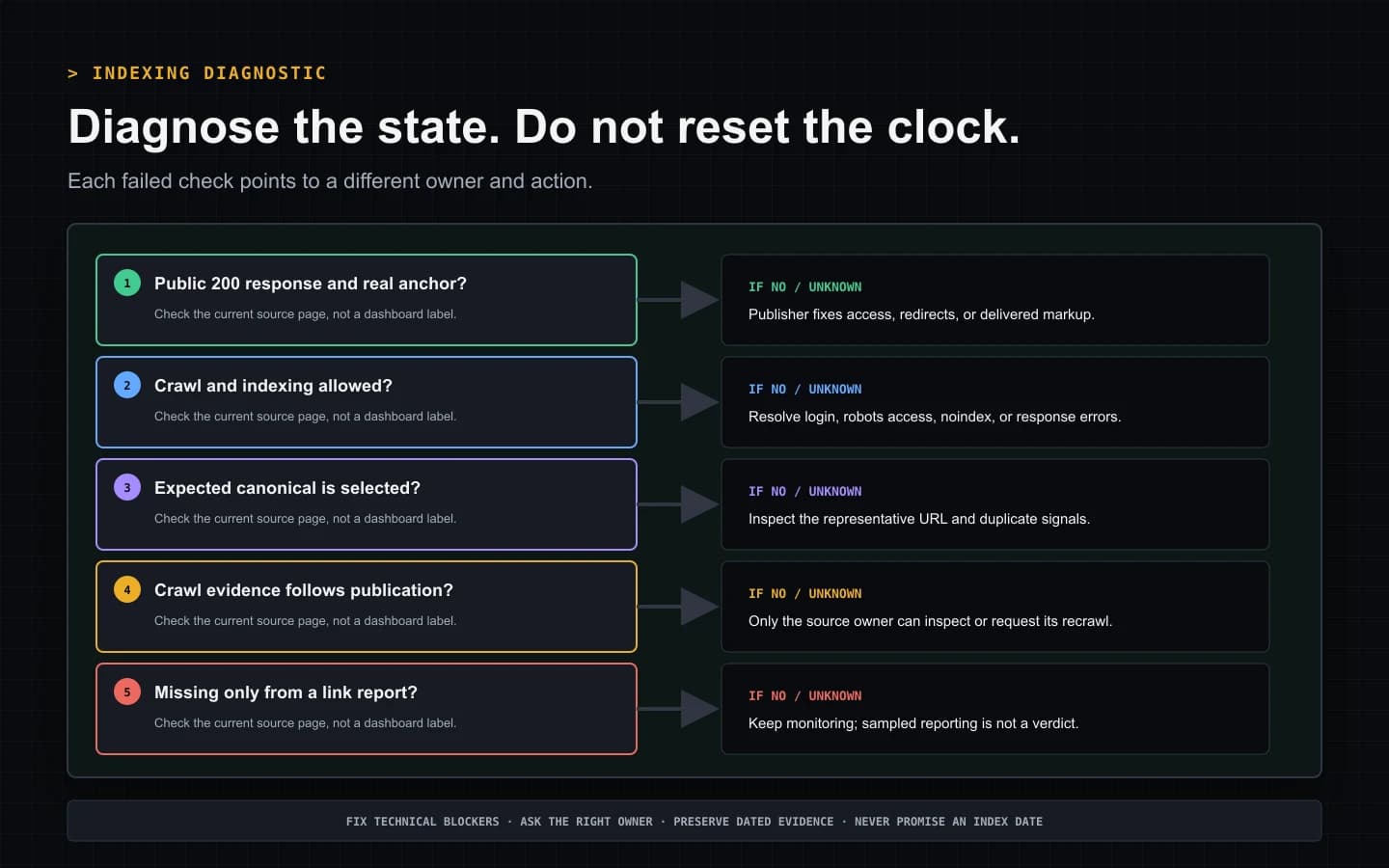
Backlink Discovery and Indexing Evidence
A 20-second source-versus-destination walkthrough from publication and discovery through crawl, index evaluation, and an evidence record.
Video transcript
Start when the backlink is public, with a final source URL, usable response, and delivered anchor. Discovery through a known link, sitemap, or prior crawl only makes the URL available for consideration; it does not promise a fetch. On recrawl, check access, indexing directives, rendered anchor markup, and canonical evidence. Keep the source page’s last crawl, anchor, canonical, and index state separate from the destination page’s own crawl, directives, canonical, and query outcomes. Record each observation with a timestamp. Publication can be proved; recrawl, a sampled report row, rankings, and traffic remain unknown until narrower evidence supports them. Leave the universal deadline blank.
Sources and verification
Product behavior was checked against the current implementation and automated tests. External policy sources are linked directly.
- Google Search: how crawling, indexing, and serving work — checked July 30, 2026
- Google Search Console URL Inspection documentation — checked July 30, 2026
- Google sitemap documentation — checked July 30, 2026
- Google Search Console Page indexing report — checked July 30, 2026
- Google guidance for canonicalization — checked July 30, 2026
- Google guidance for the site search operator — checked July 30, 2026
- Google Search Console Links report — checked July 30, 2026
- SubmitForBacklinks public directory — checked July 30, 2026
Put the workflow into practice
Use the guided terminal flow or review the supporting documentation before submitting a product.
Related resources
Dofollow vs Nofollow Backlinks: What Actually Changes
Compare dofollow and nofollow backlink HTML, sponsored and UGC values, Google’s hint model, and a repeatable way to inspect real links.
Open resourceHow to Verify a Dofollow Backlink for a Free Listing
Install the reciprocal badge, verify the live page, diagnose failures, and understand the fixed 60-day dofollow window and daily rechecks.
Open resourceAre Directory Backlinks Good for SEO? Use This Quality Test
Learn when directory backlinks are useful, how to inspect relevance, editorial controls, crawlability, paid-link treatment, and spam risk.
Open resource