Directory backlink quality
Are Directory Backlinks Good for SEO? Use This Quality Test
A directory label does not decide link quality. Inspect the audience, review process, profile substance, delivered page, and reason the listing exists before choosing it.
- Reviewed by
- SubmitForBacklinks Editorial Team
- Published
- Updated
- Checked
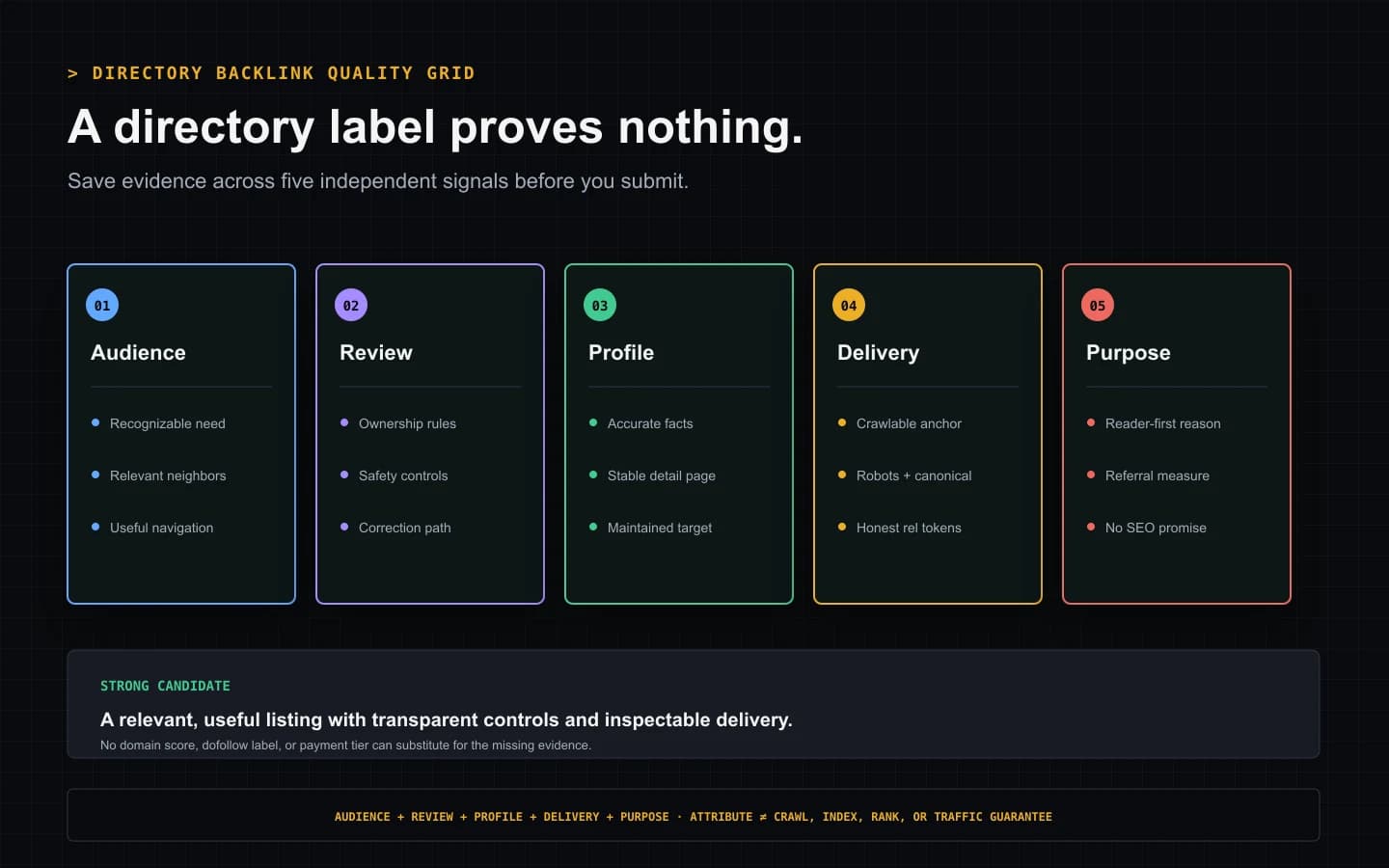
The answer depends on the directory, not the label
Directory backlinks can be useful when the directory serves a relevant audience, publishes substantial profile pages, reviews submissions, and delivers a crawlable link whose qualification matches the real relationship. They can help a customer discover a product, verify basic facts, and navigate to its website. Google also says links help it find new pages and are one signal used to determine relevance.
None of that makes every directory backlink “good for SEO.” Google explicitly lists low-quality directory or bookmark links among its link-spam examples. A listing does not guarantee that Google will crawl the directory page, index it, count the link, improve the destination's rankings, or send traffic. Evaluate the particular directory and profile page instead of accepting an authority score, a dofollow label, or a sales promise as the answer.
The useful question is therefore: would this listing still be worth maintaining if no ranking change could be promised? If it gives the right people accurate, findable information about the product, it has a reader-first purpose. If its only pitch is a scalable link, the risk is materially different.
Separate three possible kinds of value
A directory listing can create value in three ways, and they should not be collapsed into one SEO score.
First, it can send referral visits. A person browsing a focused software category may click a profile because the product matches the task at hand. Those visits can be measured with referral analytics, attributed links, and conversion events.
Second, it can provide discovery and context. A crawlable anchor gives people and crawlers a path to a destination. Descriptive profile copy, a relevant category, and a clear anchor explain what the product does. Discovery is still not indexation: a crawler may find a URL and decide not to index or rank it.
Third, a search engine may consider the link within a much larger ranking
system. That treatment is not exposed as a per-link score, and it cannot be
proven by inspecting rel, checking a third-party metric, or seeing the source
in Search Console. Keep this possible search treatment separate from outcomes
you can observe directly.
Signal one: the directory serves a real, relevant audience
Start with the directory's purpose. A focused SaaS, developer-tool, AI-product, or local-business directory can help a visitor compare options within a known problem space. A catalogue that accepts every topic and exists mainly to sell links offers a weaker reason for a relevant visitor to arrive.
Inspect the category that would contain your product:
- Does the category describe a recognizable visitor need?
- Are neighboring listings genuinely related?
- Can visitors filter or compare useful product facts?
- Do profile pages answer more than “what is the URL?”
- Is there evidence that listings are maintained after publication?
Topical fit is not a guarantee that a link influences rankings. It is evidence that the citation has a plausible audience and context. Google recommends descriptive anchor text that is relevant to both the source and destination; the same reader-first logic makes a directory category more useful.
Do not substitute a domain-level authority metric for this inspection. A score can summarize a vendor's crawl, but it cannot tell you whether the intended category is useful, whether your profile will remain live, or whether the directory's visitors match your customers.
Signal two: selection and review are visible
A strong directory explains who may submit, what information is required, and what can trigger changes or rejection. Look for ownership or representation requirements, a public content policy, a working correction path, and evidence that payment does not bypass review.
Review has several layers. A service can validate field lengths and URLs. It can screen public destinations for malware, fraud, or other safety risks. It can require a human to inspect unusual domains. A separate editorial review can judge whether descriptions are accurate, useful, and in the right category. Those controls are not interchangeable.
This distinction prevents a common overclaim. “Moderated” does not necessarily mean that an editor independently tested every product or endorsed every claim. Read what the directory actually promises. Useful evidence includes a named policy, visible update controls, clear ownership, and a review state before publication. A generic “premium listing” badge is not evidence by itself.
Automatic acceptance is not automatically harmful either. The concern rises when mass acceptance combines with thin pages, irrelevant categories, keyword-rich anchors, no removal process, and a pitch centered on manipulating rankings. Google lists automated link creation and low-value content made to manipulate linking signals among its spam examples.
Signal three: each profile is useful on its own
Open several live profiles, not just the directory homepage. A useful listing should give a visitor enough accurate information to decide whether to continue: product name, concise proposition, fuller description, category, pricing or platform facts where relevant, and a stable destination. Current screenshots or tags can add context when they are accurate.
Watch for pages made from one repeated sentence and a button. Thousands of near-identical profiles with copied vendor text provide little independent value. Google's people-first guidance asks whether content is original, substantial, useful to an intended audience, trustworthy, and produced with care rather than spread across many pages without attention.
This does not require every directory to write a long independent review. Structured, verified facts can be useful. The test is whether the page helps a person complete a real evaluation task and whether incorrect information can be corrected. A short accurate profile can be better than an inflated “review” that merely repeats marketing claims.
Also check maintenance. Visit older profiles, follow their destinations, and look for a visible way to update or remove a listing. Broken targets and abandoned copy weaken referral value even if the original link remains in the HTML.
Signal four: the profile and link work technically
Inspect the exact profile URL proposed for your product. It should load without
authentication, repeated errors, or an interstitial that prevents access to the
content. Check the raw response and rendered page for a noindex robots rule.
Google documents that noindex prevents a page from appearing in its search
results.
Then read the canonical link. A self-canonical is straightforward. A canonical pointing to a category, search page, or different profile tells Google that another URL is the preferred representative. Canonical selection is ultimately Google's, but a conflicting declared canonical is still material evidence when you evaluate the page.
Find the outbound link in browser developer tools. Google's generally
crawlable pattern is an <a> element with an href that resolves to a real web
address. Record:
- the public profile URL;
- the delivered destination after redirects;
- the visible anchor text;
- every
reltoken; and - the date checked.
A JavaScript click handler, an image without meaningful alternative text, or a redirect through an unrelated domain deserves closer inspection. These checks show what was delivered. They do not prove when a crawler will visit the page or what ranking treatment it will apply.
Signal five: payment and qualification are transparent
Ask why the link exists. An editor-selected citation, a user-submitted profile, an advertisement, and a reciprocal arrangement are different relationships even when the anchors look identical.
Google recommends rel="sponsored" for advertisements and paid placements;
nofollow remains acceptable for paid links. It also identifies buying or
selling links for ranking purposes, excessive exchanges, automated link
creation, and required unqualified links as link-spam patterns. A directory
should disclose what payment changes and qualify links in line with the real
relationship.
Price alone does not decide whether a directory is useful. A paid profile can buy legitimate advertising, placement, support, or media space. The risky claim is that payment buys ranking credit. Likewise, a free listing is not automatically editorial, and a standard link is not automatically better than a qualified link from a page that sends relevant visitors.
Use the separate link-attribute comparison guide to inspect standard, nofollow, sponsored, and UGC markup. Return to the directory-quality decision only after you have recorded the relationship accurately.
Red flags that justify a skip
Skip or investigate further when several of these signals appear together:
- guaranteed rankings, indexing dates, traffic, or authority increases;
- a price list based mainly on dofollow links or keyword-rich anchor text;
- instant mass acceptance without ownership, safety, or correction controls;
- unrelated categories filled with repeated or scraped descriptions;
- profile pages blocked from indexing or canonicalized somewhere else;
- hidden destinations, unexplained redirects, or unstable listing URLs;
- no disclosure of payment, reciprocal requirements, or link qualification.
One red flag is not a mathematical penalty score. It is a reason to identify the underlying relationship and decide whether a useful reader purpose remains. Avoid universal rules such as “all directories are bad” or “high-DR directories are safe.” Google's policy names low-quality directory links, which makes quality and acquisition method central to the review.
Run a five-minute pre-submission audit
Use one row per directory in a decision log:
| Check | Evidence to save | Pass condition |
| --- | --- | --- |
| Audience | Category URL and neighboring profiles | A relevant visitor has a clear reason to browse |
| Review | Guidelines, ownership, and correction process | Publication has disclosed controls |
| Profile | One current and one older listing | Pages contain useful, maintained facts |
| Delivery | Status, robots, canonical, anchor, redirect, rel | The exact page and relationship are documented |
| Measurement | Referral and conversion plan | Success is observable without a ranking promise |
Mark unknown evidence as unknown instead of turning it into a zero or a pass. Then write one sentence: “We are submitting because…” A defensible answer names the audience, category, and information the profile will provide. “Because it is a dofollow backlink” is not enough.
After publication, verify the live page rather than relying on the sales page.
Search Console's Links report can help find source pages, but Google says the
report is sampled, can include links found in the past, and does not specify
whether a link is nofollow. Save your own current inspection and measure
referral behavior separately.
How SubmitForBacklinks fits the test
SubmitForBacklinks requires structured product fields, a primary category, tags, accurate descriptions, representation, reviewed generated content, and acceptance of its submission guidelines. The guidelines require a real safe product, people-first copy, accurate media, and moderation. Featured does not bypass review.
The automated path checks ownership signals, public destination safety, and whether a preferred listing destination remains on the product's registrable domain. Cross-domain behavior routes to human review. Importantly, the current safety prompt explicitly does not judge design quality, writing polish, category fit, product maturity, or whether a product is impressive. Those limits matter: automated approval is a safety and publication control, not an independent product endorsement.
Published profiles expose structured facts and an outbound link policy. Current Free listings default to nofollow unless a verified reciprocal badge is inside its fixed follow window. Current paid Featured entitlement uses standard link treatment after approval and successful payment. Those are owner-selected product rules, not proof that Google will count, index, approve, or reward a link. Google's paid and reciprocal link policies remain relevant.
You can inspect live directory profiles with the same five-signal audit before deciding whether the audience and format fit your product. If the reciprocal Free path is relevant, the badge verification guide documents the implemented workflow and its policy caveat.
Keep the decision evidence-based
A directory backlink is worth pursuing when the profile serves a real audience, adds accurate context, survives basic technical inspection, and reflects the commercial relationship honestly. That conclusion is stronger than either “directories work” or “directories are spam” because another reviewer can reproduce it.
Record what you can verify, measure referral outcomes you can observe, and leave
search-engine decisions unpromised. Directory quality is not a domain score or
one rel token. It is the combined evidence from audience, review, page,
delivery, and purpose. Apply those checks to the current sourced SaaS
directory shortlist.
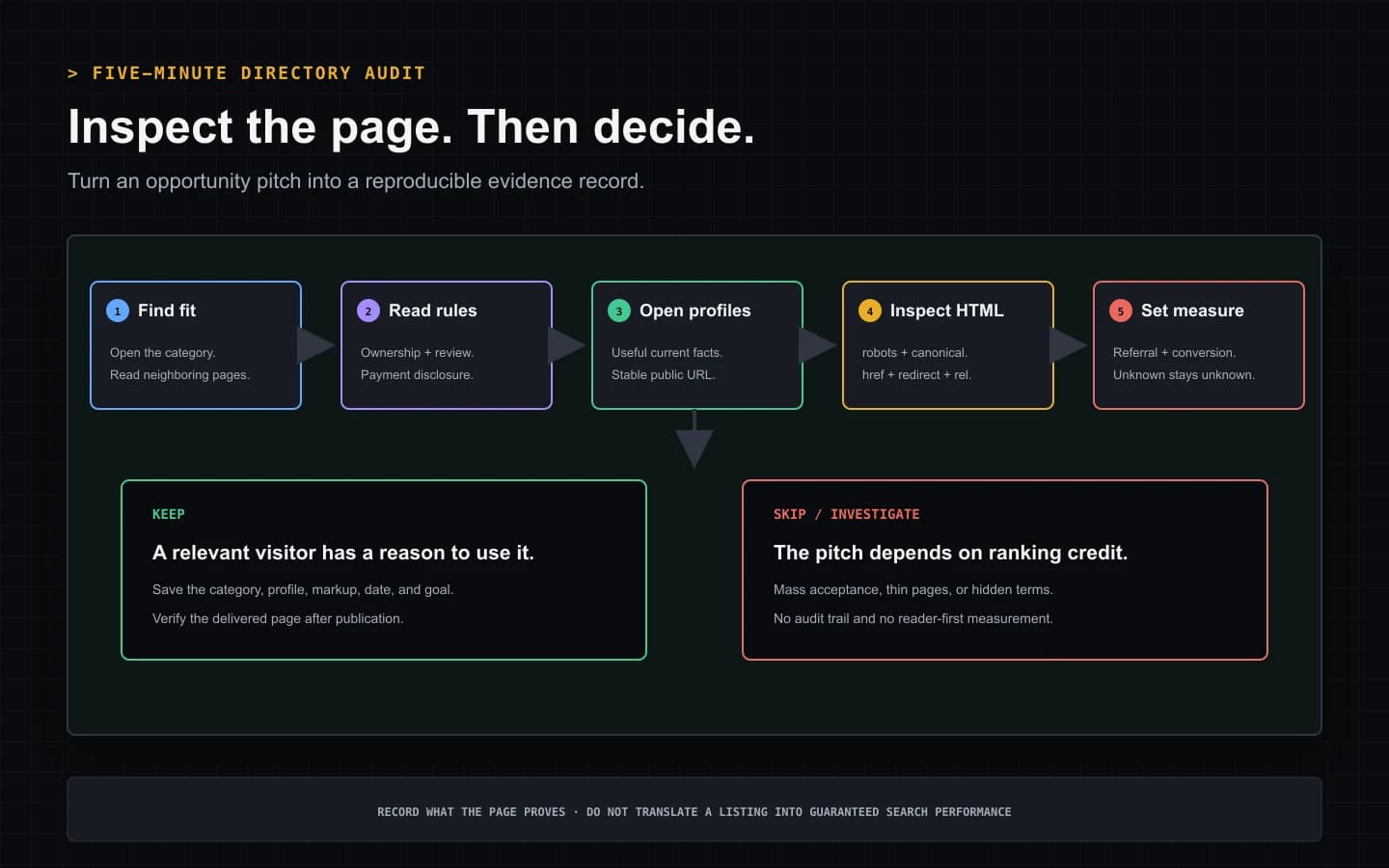
Directory Backlink Quality Audit
A 22-second audit of directory audience fit, review controls, listing-page quality, link delivery, and measurable outcomes.
Video transcript
Start with the directory’s users and ask whether a relevant visitor would use the category or profile. Inspect the selection process, remembering that ownership and safety checks are not the same as a full editorial endorsement. Open a live profile and confirm useful current information, a stable public URL, and no visible noindex or conflicting canonical. Inspect the outbound anchor and commercial relationship by recording its href, anchor text, redirects, and every rel token. Keep the opportunity only when it has a reader-first purpose, then measure referral visits and conversions separately from any crawl, index, ranking, or authority outcome.
Sources and verification
Product behavior was checked against the current implementation and automated tests. External policy sources are linked directly.
- SubmitForBacklinks submission guidelines — checked July 30, 2026
- Google guidance for crawlable links and anchor text — checked July 30, 2026
- Google Search spam policies: link spam — checked July 30, 2026
- Google guidance for qualifying outbound links — checked July 30, 2026
- Google guidance for controlling indexed content — checked July 30, 2026
- Google guidance for canonicalization — checked July 30, 2026
- Google Search Console Links report — checked July 30, 2026
Put the workflow into practice
Use the guided terminal flow or review the supporting documentation before submitting a product.
Related resources
Dofollow vs Nofollow Backlinks: What Actually Changes
Compare dofollow and nofollow backlink HTML, sponsored and UGC values, Google’s hint model, and a repeatable way to inspect real links.
Open resourceHow to Verify a Dofollow Backlink for a Free Listing
Install the reciprocal badge, verify the live page, diagnose failures, and understand the fixed 60-day dofollow window and daily rechecks.
Open resource