Current SaaS directory shortlist
Best SaaS Directories: A Current, Sourced Shortlist
Match a real product to a current official discovery surface, audience, taxonomy, eligibility path, and maintenance owner. This sourced shortlist ranks no directory by invented traffic, authority, acceptance, or search outcome.
- Reviewed by
- SubmitForBacklinks Editorial Team
- Published
- Updated
- Checked
The best directory is the one your product can truthfully fit
There is no universal “best” SaaS directory. A useful shortlist starts with four questions: Does the directory reach people comparing this kind of software? Does its taxonomy describe the product accurately? Can the product meet the current eligibility rules? Can someone maintain the profile after it is published?
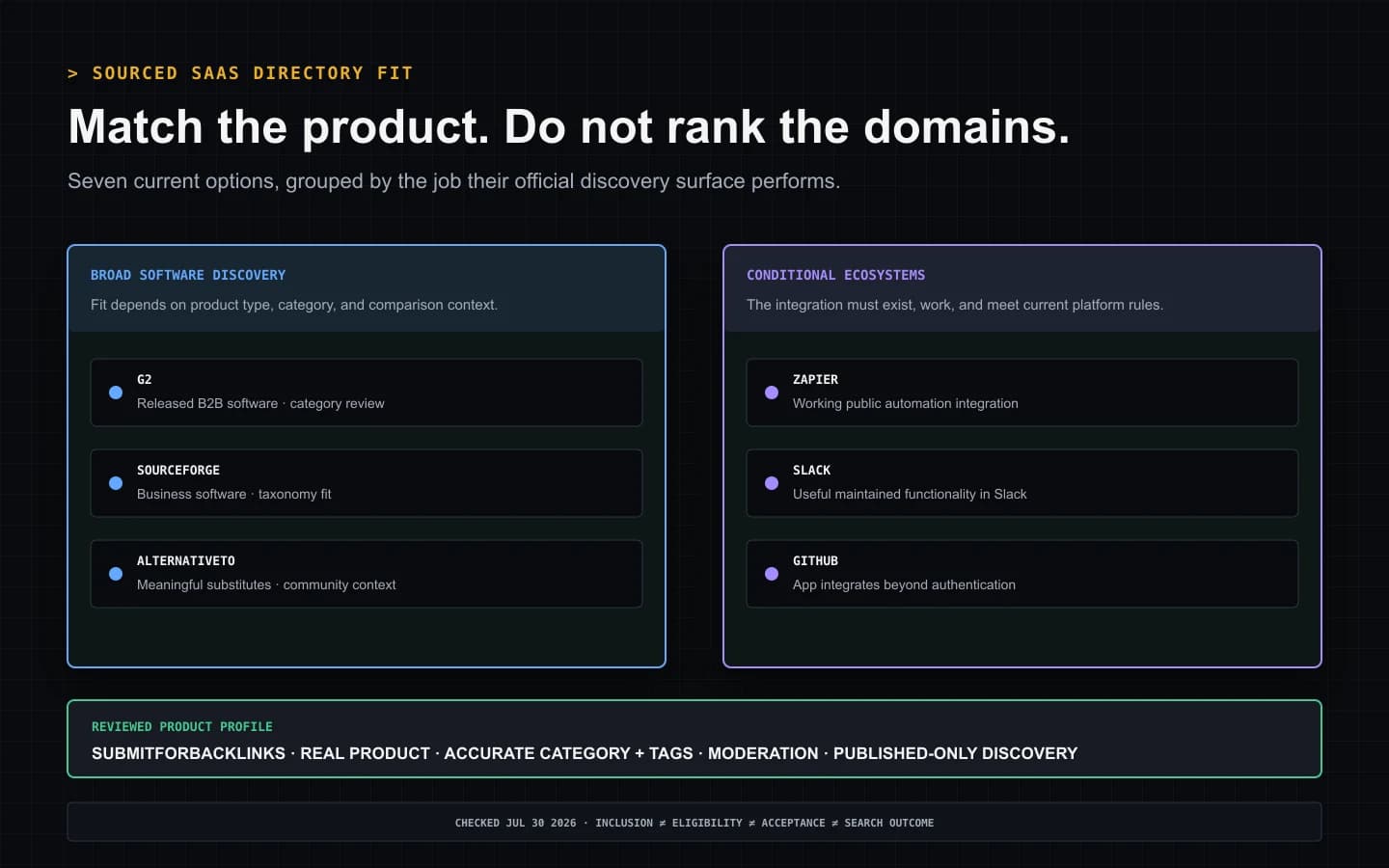
This guide names seven current options checked against first-party sources on July 30, 2026. They are not ranked by traffic, domain metrics, price, or an assumed backlink benefit. Three are broad software-discovery services, three are conditional ecosystem marketplaces, and one is SubmitForBacklinks’ own reviewed product directory.
Inclusion here means that an official discovery surface and a current contribution or review path were found. It does not mean that every SaaS is eligible, that a submission will be accepted, or that a listing will produce crawling, indexing, rankings, traffic, customers, authority, or link equity.
How this shortlist was selected
Each named service had to pass a dated evidence check:
- An official page explains the audience, product inventory, or marketplace.
- An official page describes a submission, contribution, or review path.
- A founder can identify a real product fit without inventing a category or integration.
- The resulting profile can be reviewed and corrected over time.
The evaluation deliberately excludes estimated traffic, third-party authority scores, review averages, directory approval statistics, and publication timelines. Those figures either answer a different question or can change without describing whether a specific product belongs.
| Directory | Best fit when | Current first-party evidence | Check | | --- | --- | --- | --- | | G2 | A released B2B product fits an established software category | Official product-submission and categorization guidance | Jul 30, 2026 | | SourceForge Business Software | The product is business software that can be represented in its comparison taxonomy | Official business-software inventory and vendor product route | Jul 30, 2026 | | AlternativeTo | Buyers can understand the product through meaningful alternatives | Official alternatives mission and community contribution model | Jul 30, 2026 | | Zapier App Directory | The SaaS has a working public Zapier integration | Official build, test, review, and directory-publication process | Jul 30, 2026 | | Slack Marketplace | The SaaS includes a useful, maintained Slack app | Official suitability, distribution, review, and maintenance rules | Jul 30, 2026 | | GitHub Marketplace | A real GitHub or OAuth app adds value beyond authentication | Official listing, support, privacy, integration, and publication requirements | Jul 30, 2026 | | SubmitForBacklinks | A real product can support an accurate reviewed profile | Current guidelines, structured fields, moderation, and published discovery | Jul 30, 2026 |
Use this table as a routing map, not a submission queue. A product may fit one row, several rows, or none.
Broad software discovery
G2
G2 is a candidate for a released B2B software product with a genuine category fit. Its current documentation directs an unlisted product to a product submission form, says its research team verifies eligibility and categorization, and lets an approved profile be claimed and managed.
The same guidance says G2 does not accept B2C products or products still in alpha or beta. That is a useful stop condition. Do not relabel a consumer product, hide its development stage, or force it into a nearby category merely to obtain a profile.
Prepare the official product name, public destination, stable description, category evidence, and current branding. Then compare the product with G2’s current category inclusion criteria. A reviewed categorization process is an eligibility path, not an outcome guarantee.
SourceForge Business Software
SourceForge maintains a business-software directory and an official vendor route for adding a product. Its current inventory covers business software across categories and supports comparison by factors such as deployment and integration.
That makes it worth evaluating when the SaaS solves a recognizable business job and its capabilities can be mapped to the live taxonomy without exaggeration. Inspect the exact category and several current product pages before preparing copy. Keep deployment, platform, integration, and product facts consistent with the live service.
SourceForge also offers promotional vendor programs, but this shortlist does not use plan position, traffic claims, pricing, or paid visibility as inclusion criteria. Record any commercial relationship separately from the factual product profile.
AlternativeTo
AlternativeTo’s official mission is to help people find alternatives to software they already know and may want to replace. Its lists are based on user recommendations, and the site invites members to participate in improving those recommendations.
The fit question is therefore relational: what established tool could a user reasonably compare with this product, and on which platforms or categories? Prepare accurate platform availability, product type, and differentiating facts. Do not manufacture a famous competitor relationship when the products solve different jobs.
Because community workflows and controls can change, confirm the current contribution path while signed in before starting work. The presence of an alternatives page does not endorse either product or promise that a proposed entry will remain unchanged.
Ecosystem directories are conditional
An ecosystem marketplace is not a generic company directory. It belongs on the shortlist only when the SaaS has built and maintains the integration that the marketplace exists to distribute.
Zapier App Directory
Zapier’s official publishing guide requires a working integration to be built, tested, and submitted for app review. Approved public integrations can appear in its App Directory. Separate publishing requirements cover the app’s identity, functionality, branding, and ownership.
Use this route only when customers can complete useful automations through a real Zapier integration. Prepare tested triggers or actions, working authentication, support documentation, accurate app identity, and an owner for ongoing maintenance. A marketing page that merely mentions Zapier is not an integration.
Slack Marketplace
Slack’s Marketplace documentation describes suitability screening, public distribution, submission review, and continuing expectations for performance, support, security, contact details, and listing accuracy. It also identifies apps that are unsuitable, including apps that add no functionality in Slack or use Slack only for sign-in.
Evaluate this option only for a production-ready Slack app that improves a real workflow inside Slack and can meet the current prerequisites. Recheck the official suitability list immediately before submission because platform permissions and marketplace rules can change.
GitHub Marketplace
GitHub says Marketplace tools must provide value to the GitHub community and integrate with GitHub beyond authentication. Current requirements also call for a relevant description, working contact and support paths, a privacy policy, public availability, and functioning listing links. A draft listing is submitted for publication review.
This route fits a real GitHub App or OAuth app whose workflow lives in the GitHub ecosystem. It does not fit a generic SaaS that happens to offer “Sign in with GitHub.” Prepare the integration, publisher ownership, support and privacy evidence, listing media, and current operational behavior before drafting.
SubmitForBacklinks as a first-party example
SubmitForBacklinks provides a reviewed product-discovery profile rather than an ecosystem integration listing. Its guidelines require a real safe product or public preview, people-first copy, accurate optional media, authorization, reviewed generated content, and moderation. Featured never bypasses review.
Current published profiles use structured product facts, a primary category, tags, canonical profile metadata, and a server-visible destination anchor. Only published records appear in public discovery. These controls make a listing inspectable; they do not certify the product, the referring page, or a search outcome.
Approved Free listings currently default to nofollow unless a reciprocal badge is verified during its active fixed follow window. Current paid Featured entitlement uses standard link treatment after approval and successful payment. These are owner-selected product rules, not Google endorsements. Google’s paid-link and reciprocal-link guidance remains relevant.
Inspect current profiles and use the directory quality test before deciding whether the audience and relationship fit.
Build one reusable evidence pack
Do not copy one promotional paragraph into seven forms. Build a dated product record, then adapt it to each directory’s current field purposes:
- preferred product name, canonical website, and accountable owner;
- one factual sentence explaining the customer, job, and current product;
- a longer description with supported capabilities and exclusions;
- the primary category and a constrained set of durable tags;
- current platform, deployment, integration, and availability facts;
- logo and screenshots that show the current product without private data;
- monitored support, contact, privacy, and correction routes;
- proof that any claimed Zapier, Slack, or GitHub integration actually works.
The SaaS directory submission checklist turns that record into a field-by-field preflight. Update the source record first when product facts change; otherwise profiles will drift into contradictory claims.
Verify the listing that was actually published
A completed form or review email is not evidence of a live profile. Open the
public result and record the source URL, surrounding product description,
category, destination, redirects, anchor, every rel token, relationship, and
last review date. Confirm that the page remains accessible and that a visitor
can identify the product without misleading copy.
Google says a generally crawlable link uses an <a> element with an href,
and recommends concise, descriptive anchor text. That inspection shows what
the page delivers; it does not show how Google will treat the source or
destination.
Search Console’s Links report can supply additional observations, but Google
says it is sampled, may include historical links, groups data by canonical URL
and root domain, and does not indicate whether a link is nofollow. Keep a
separate current ledger.
Choose a small maintainable portfolio
Reject directories that depend on unrelated categories, hidden commercial relationships, forced keyword anchors, copied low-value profiles, mass automation, excessive exchanges, or promises of ranking credit. Google lists low-quality directory links, paid ranking links, excessive exchanges, and automated link creation among link-spam examples.
For each suitable option, assign an owner and a refresh trigger:
| Trigger | Recheck |
| --- | --- |
| Product positioning or name changes | Description, category, alternatives, and destination |
| Integration or platform changes | Marketplace functionality, permissions, support, and media |
| Ownership or policy changes | Contact, privacy, disclosure, and relationship |
| Listing page changes | Public URL, copy, anchor, destination, redirects, and rel |
| Directory rules change | Eligibility, submission path, review evidence, and maintenance duty |
The best portfolio is the smallest set of pages that serves the right audience, represents the product accurately, and remains maintainable. If SubmitForBacklinks fits that standard, submit an accurate SaaS product. Treat it as one reviewed discovery opportunity, never a guaranteed result.
Use a narrower shortlist when the product or constraint demands it: compare current no-placement-fee paths, match a working AI product to AI-specific review routes, or select a startup company-profile system by its information job. Each page applies a different eligibility and maintenance test.
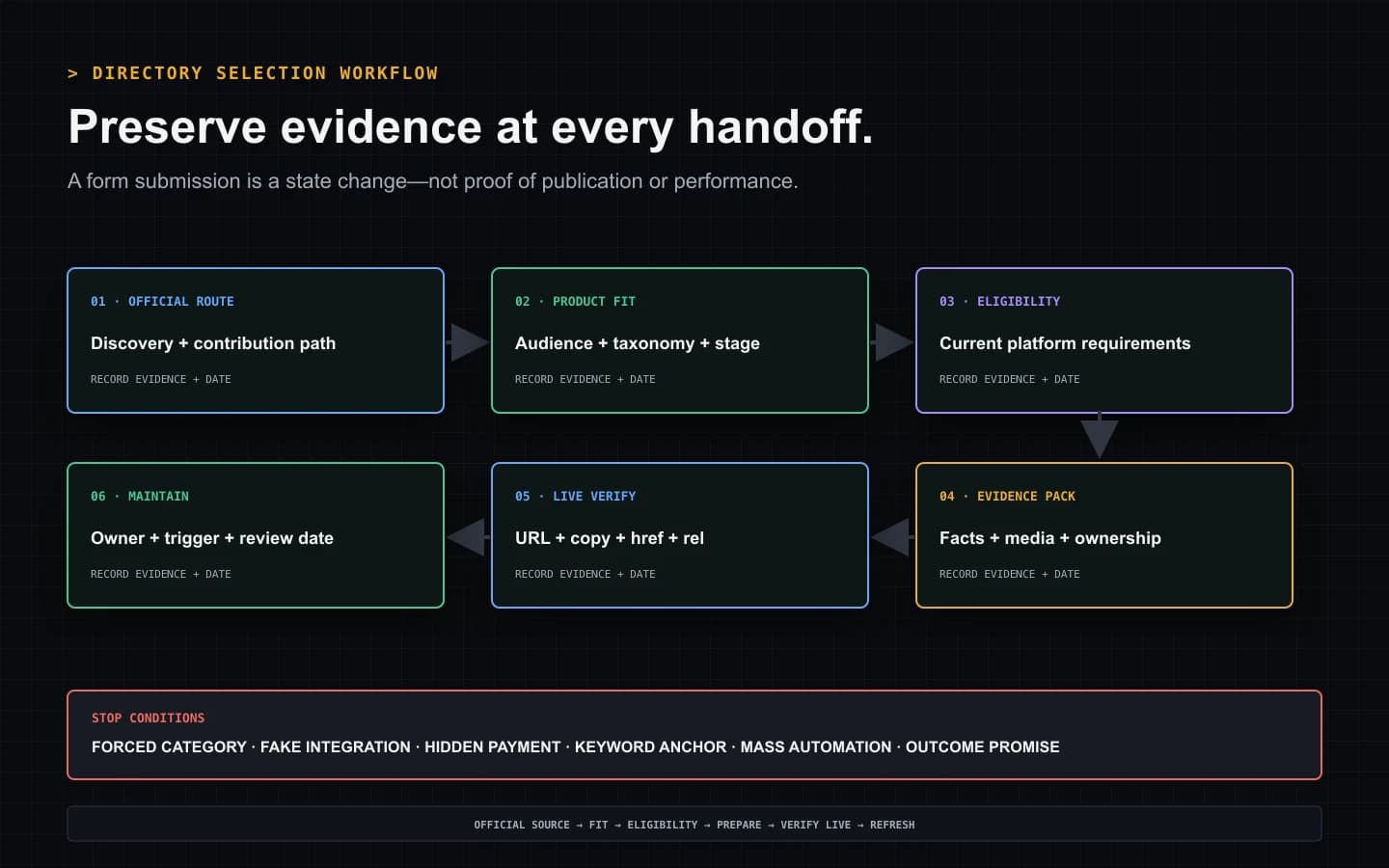
How to Select Current SaaS Directories
A 22-second source-led process for verifying a directory, matching product fit, preparing evidence, inspecting the live profile, and refreshing the decision.
Video transcript
Find the current first-party discovery surface and official contribution or review path, then date the check. Match the real audience, taxonomy, product stage, and ecosystem functionality without forcing eligibility. Adapt one factual product record to current category, support, privacy, media, and integration requirements. Verify the live URL, copy, category, destination, redirects, anchor, rel tokens, relationship, and review date. Recheck official rules and the profile after a product, integration, ownership, policy, or platform change. Inclusion does not guarantee eligibility, acceptance, publication, or a search outcome.
Sources and verification
Product behavior was checked against the current implementation and automated tests. External policy sources are linked directly.
- G2 product listing documentation — checked July 30, 2026
- SourceForge business software directory — checked July 30, 2026
- AlternativeTo mission and recommendation model — checked July 30, 2026
- Zapier public integration publishing guide — checked July 30, 2026
- Slack Marketplace distribution guide — checked July 30, 2026
- GitHub Marketplace listing requirements — checked July 30, 2026
- SubmitForBacklinks submission guidelines — checked July 30, 2026
Put the workflow into practice
Use the guided terminal flow or review the supporting documentation before submitting a product.
Related resources
Are Directory Backlinks Good for SEO? Use This Quality Test
Learn when directory backlinks are useful, how to inspect relevance, editorial controls, crawlability, paid-link treatment, and spam risk.
Open resourceThe SaaS Directory Submission Checklist
Prepare a SaaS directory submission with accurate copy, categories, tags, media, URLs, ownership, launch timing, and a policy-aware final preflight.
Open resourceDofollow vs Nofollow Backlinks: What Actually Changes
Compare dofollow and nofollow backlink HTML, sponsored and UGC values, Google’s hint model, and a repeatable way to inspect real links.
Open resource