Current no-placement-fee directory paths
Free SaaS Directories: Current Paths and Their Tradeoffs
Verify the current free path, eligibility gate, review state, paid boundary, delivered profile, and maintenance owner before calling a directory free. Price never promises acceptance, publication, or a search outcome.
- Reviewed by
- SubmitForBacklinks Editorial Team
- Published
- Updated
- Checked
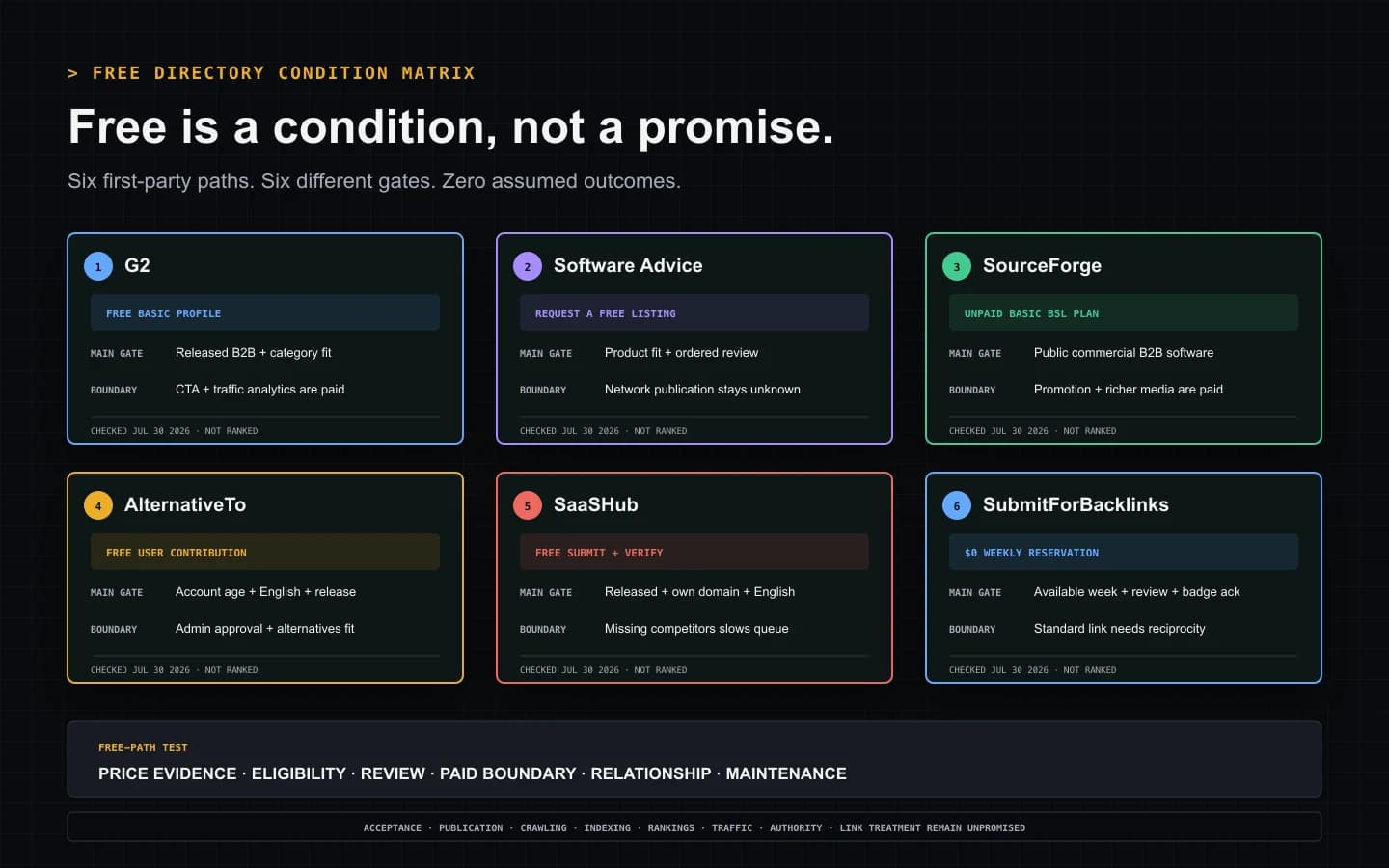
Current free paths, checked July 30, 2026
A free SaaS directory path is a current profile, contribution, or submission route that does not require a placement fee. It can still require a released product, account history, category fit, ownership proof, editorial review, waiting time, reciprocal action, or ongoing maintenance.
The following options had direct first-party evidence of a no-placement-fee path when checked on July 30, 2026. They are grouped by operating model, not ranked:
| Service | Verified free path | Main gate | Material tradeoff | | --- | --- | --- | --- | | G2 | Free basic product profile | Released B2B product and category review | Calls to action and profile traffic analytics require a paid plan | | Software Advice | Request a free listing | Product fit and ordered editorial review | Publication can take more than six weeks; network distribution is not assumed | | SourceForge | Unpaid Basic BSL Plan | Public commercial B2B software offered by its vendor | Promoted category positions and richer marketing features are paid | | AlternativeTo | Free user contribution | Account age, English support, release state, and approval | The product needs a meaningful alternatives context | | SaaSHub | Free product submission and verification | Released English product on its own domain | Missing competitors slows the queue; Featured is paid | | SubmitForBacklinks | $0 Free weekly reservation | Structured facts, available week, badge acknowledgement, and review | Standard-link treatment has a reciprocal condition and fixed window |
This table does not promise acceptance, publication, crawling, indexing, rankings, traffic, customers, authority, link treatment, or link equity. Google itself says inclusion in its index is not guaranteed and that there is no secret that automatically ranks a site first.
“Free” describes price, not the complete cost
Record four separate facts before calling a directory free:
- Placement price: Is a basic profile or submission available without required payment?
- Eligibility cost: What product stage, audience, language, domain, category, ownership, or account conditions must be met?
- Operating cost: Who prepares, submits, answers review, verifies delivery, and keeps the profile accurate?
- Commercial boundary: Which calls to action, analytics, queue priority, sponsored placement, media, or visibility features require payment?
A free tier can place competitor ads on a profile, omit a website CTA, restrict analytics, wait in a longer queue, or offer fewer controls. Those limits do not make the tier deceptive when they are visible. They do mean “free listing” and “equivalent to the paid plan” are different claims.
Reciprocal requirements deserve their own line. They do not charge money, but they exchange placement behavior. Google lists excessive exchanges and required unqualified links among link-spam risks. A zero-dollar path is not automatically low-risk or Google-approved.
How options entered this list
Each name needed a live first-party page that did all of the following:
- described a free, unpaid, or no-cost profile, contribution, or submission route;
- identified an official service, seller, vendor, or contribution workflow;
- exposed enough current conditions to state who should and should not use it;
- separated the basic path from paid promotion where that boundary exists.
The review saved the publisher, source URL, access date, free-path wording, eligibility, review state, paid boundary, and maintenance trigger. A service was not included merely because an old blog called it free.
This is a free-path filter, not the broader sourced SaaS directory shortlist. It excludes ecosystem marketplaces that require a working integration and leaves launch-day platforms to their dedicated comparison.
G2: free basic profile for eligible released B2B products
G2's current plans page includes a Free tier with three profile admins, a basic profile, standard seller page, and basic review collection and syndication. Current plan details also show limits: custom calls to action and profile traffic, time-on-page, and click analytics are not included in Free.
The free tier does not remove the product gate. G2's current listing documentation says it does not accept B2C products or products in alpha or beta. A product-submission form starts the process, the research team verifies eligibility and categorization, and an approved profile must then be claimed. The claim has its own approval review.
Use this path for released business software that fits an existing G2 category and has an authorized owner prepared to maintain product, feature, pricing, and media facts. Do not submit consumer software or label a pre-release product as released to pass the form.
“Free profile” establishes the plan price. It does not establish how many buyers will see the page, whether reviews will arrive, or whether the product will appear in a report.
Software Advice: a requested free listing with a long review path
Software Advice currently says a software provider can request a free listing when its product fits the site but it is not ready to join the paid Highly Qualified Leads program. Its team reviews submissions in received order to validate category fit and says vetting, profile writing, and publication can take more than six weeks.
Current first-party pages identify Software Advice, Capterra, and GetApp as properties in the G2 Digital Markets network. Common ownership is not proof that one free request creates or updates a profile on all three sites. Save the exact form used and verify each public destination separately.
The practical tradeoff is control and time. A free request can enter editorial review, but the provider does not control acceptance or publication timing. Paid lead-generation and sponsored options are different commercial services.
Use the current directory submission checklist before sending pricing and category information. The Software Advice FAQ says pricing information is required for listing even though exact prices are not publicly displayed.
SourceForge: an unpaid basic business-software listing
SourceForge's vendor terms define the Basic Business Software Listing plan as unpaid. The same terms set three central criteria: the software must be publicly and commercially available to businesses, offered by the vendor rather than an unauthorized reseller, and fit one or more categories.
SourceForge may create profile information from public sources, while an authorized vendor can request validation and update the product through the Vendor Portal. Its terms ask vendors to keep content accurate, factual, unique, and useful rather than copying another page.
The vendor pricing material distinguishes basic listings from paid upgrades. Upgrades can add category promotion, placement on competitor and alternatives pages, richer media, visitor data, and other marketing features. A basic listing should not be described as receiving those paid benefits.
Use the unpaid path for public B2B software with a real category and authorized maintainer. Record whether the listing already exists before creating another request, and inspect how the actual profile presents categories, claims, and outbound navigation.
AlternativeTo: a free contribution with community and release gates
AlternativeTo describes itself as a free, crowd-sourced service. Its current FAQ says a registered user can choose “Suggest new application,” complete the platform, license, description, and tag fields, and send the application for verification and approval.
This is a community contribution model, not a vendor placement purchase. New accounts must wait one week before submitting a new app page. Applications must support English. Closed-beta or merely announced products are not accepted, while an open beta that is easy to access may qualify. AlternativeTo also says user profiles cannot be used to advertise software; products belong in the application workflow.
Fit depends on alternatives. Identify software a real user might compare and explain the functional relationship accurately. Do not add an unrelated popular product merely to borrow its audience.
The FAQ gives a usual approval range from a couple of days to a week, but that is not a deadline or guarantee. Save the pending state and inspect the approved application page rather than reporting the suggestion as a live listing.
SaaSHub: free submission with release, domain, and verification rules
SaaSHub's current submission page accepts SaaS, IaaS, PaaS, most software and apps, and certain leading niche services. It rejects unreleased products, waiting-list landing pages, free subdomains, products that are not in English, and software-development agencies. Every submitted product goes through approval.
The form asks for relevant categories and competitors. SaaSHub explicitly says a submission without competitors is slowed and moved toward the bottom of the queue. That makes preparation part of the free-path cost.
Ownership verification is also free. A representative can use a company-domain email, an HTML snippet, or request a verification link. SaaSHub then sends a quarterly reminder to confirm that listing data remains current. Paid Featured placement is a separate option and is not required for the basic submission.
Use this route when the product is released on its own domain, supports English, and has defensible categories and alternatives. Do not invent competitors or publish before the product is ready merely to improve queue priority.
SubmitForBacklinks: $0 placement with a reciprocal condition
SubmitForBacklinks currently offers a $0 Free path. A submission requires a real safe product or public preview, people-first copy, authorization, accurate optional media, an available weekly launch reservation, badge acknowledgement, and review. Featured is a separate one-time $8.99 path and never bypasses review.
An approved Free listing currently uses nofollow unless a reciprocal badge is verified during its fixed follow window. Reinstalling or rechecking a badge does not extend the original period. The product's current pricing page states that rankings and traffic are not guaranteed.
This owner-selected relationship carries material policy risk. Google's spam guidance addresses excessive exchanges and required unqualified links. A badge verification result or standard link does not mean Google approves or credits the relationship.
Review the listing guidelines, inspect current profiles, and use the Free path only when the audience, queue, and reciprocal condition fit. The listing can still offer a public product record and referral route when standard-link treatment is absent or expires.
Prepare once, adapt each submission
Build a dated source record before opening any form:
- canonical product URL, preferred public destination, and authorized owner;
- released status, audience, B2B or consumer model, supported languages, and domain ownership;
- factual short and long descriptions;
- current pricing model, categories, alternatives, and competitors;
- maintained logo, screenshots, documentation, support, and privacy routes.
Keep facts consistent while adapting the context. G2 needs category and released B2B fit. AlternativeTo needs meaningful alternatives. SaaSHub asks for competitors. SourceForge needs commercial business-software fit. One generic paragraph copied into every form can obscure those differences.
Use the full preflight checklist for field-level work. Stop when authorization, evidence, eligibility, or relationship terms remain unclear.
Count delivery only after inspecting the public page
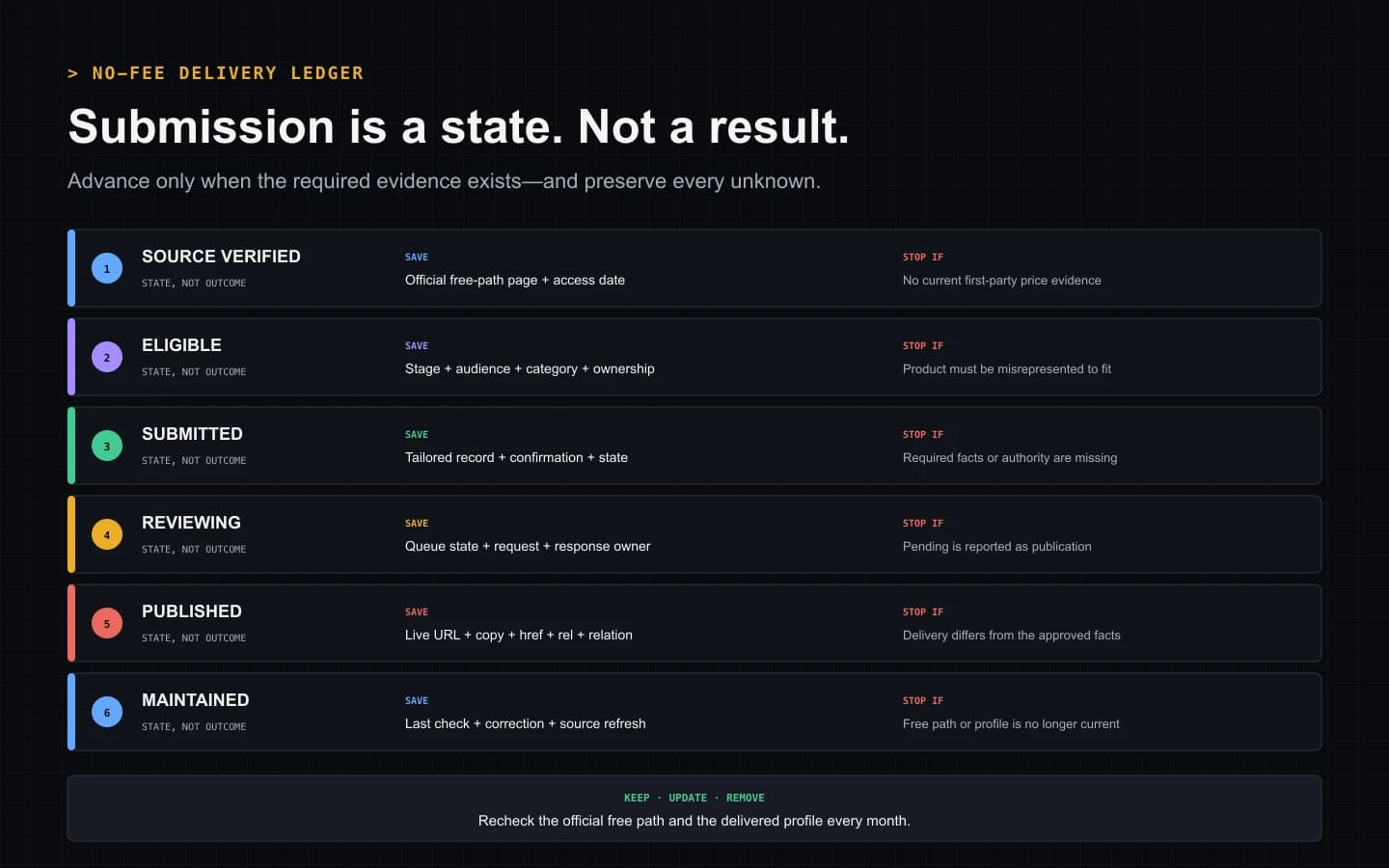
Keep a ledger with separate states: source verified, eligible, submitted,
reviewing, published, corrected, and removed. For a published profile, record
the public URL, displayed facts, category, anchor, href, redirects, final
destination, every rel token, relationship, and last-checked date.
The guide to dofollow and nofollow links explains the markup, while the directory quality test evaluates the actual page. Do not infer link treatment from an old screenshot, plan name, or third-party list.
Refresh this shortlist monthly. Keep a service when its official free path and your profile remain current. Update changed gates or paid boundaries. Remove the recommendation when required payment appears, the contribution route closes, eligibility changes, or current first-party evidence disappears.
Free directory work is useful when it produces an accurate, maintainable path for a fitting audience. The price is only the first condition; eligibility, review, delivery, relationship, and maintenance determine what the product actually receives.
How to Verify a Free SaaS Directory Path
A 23-second process for checking directory cost, eligibility, submission, delivered profile evidence, and current first-party terms.
Video transcript
Save the current first-party page that states the free, unpaid, or no-cost profile path, its access date, and the paid boundary. Check release stage, audience, taxonomy, language, domain, ownership, category, queue, and relationship conditions. Adapt one accurate product record to the official contribution route and preserve the confirmation and review state. Inspect the public source URL, copy, category, destination, redirects, anchor, rel tokens, relationship, and date; pending is not published. Keep the option only while the source and profile remain current, update changed requirements, and remove the recommendation when no free path can be verified.
Sources and verification
Product behavior was checked against the current implementation and automated tests. External policy sources are linked directly.
- G2 plans and free profile features — checked July 30, 2026
- Software Advice vendor listing FAQ — checked July 30, 2026
- SourceForge vendor pricing — checked July 30, 2026
- AlternativeTo submission FAQ — checked July 30, 2026
- SaaSHub product submission service — checked July 30, 2026
- Google Search spam policies: link spam — checked July 30, 2026
- SubmitForBacklinks submission guidelines — checked July 30, 2026
Put the workflow into practice
Use the guided terminal flow or review the supporting documentation before submitting a product.
Related resources
Best SaaS Directories: A Current, Sourced Shortlist
Compare current SaaS directories by audience, eligibility, review path, profile evidence, and maintenance—without invented traffic or authority scores.
Open resourceThe SaaS Directory Submission Checklist
Prepare a SaaS directory submission with accurate copy, categories, tags, media, URLs, ownership, launch timing, and a policy-aware final preflight.
Open resourceFree Backlinks for SaaS: Legitimate Methods That Cost Time
Build free SaaS backlinks through useful profiles, repositories, documentation, original resources, and outreach without ranking or indexing promises.
Open resourceAre Directory Backlinks Good for SEO? Use This Quality Test
Learn when directory backlinks are useful, how to inspect relevance, editorial controls, crawlability, paid-link treatment, and spam risk.
Open resource