No-fee SaaS references
Free Backlinks for SaaS: Legitimate Methods That Cost Time
A free backlink has no placement fee, but it still requires accurate evidence, useful context, host eligibility, verification, and maintenance. Match one real product artifact to one audience instead of manufacturing links.
- Reviewed by
- SubmitForBacklinks Editorial Team
- Published
- Updated
- Checked
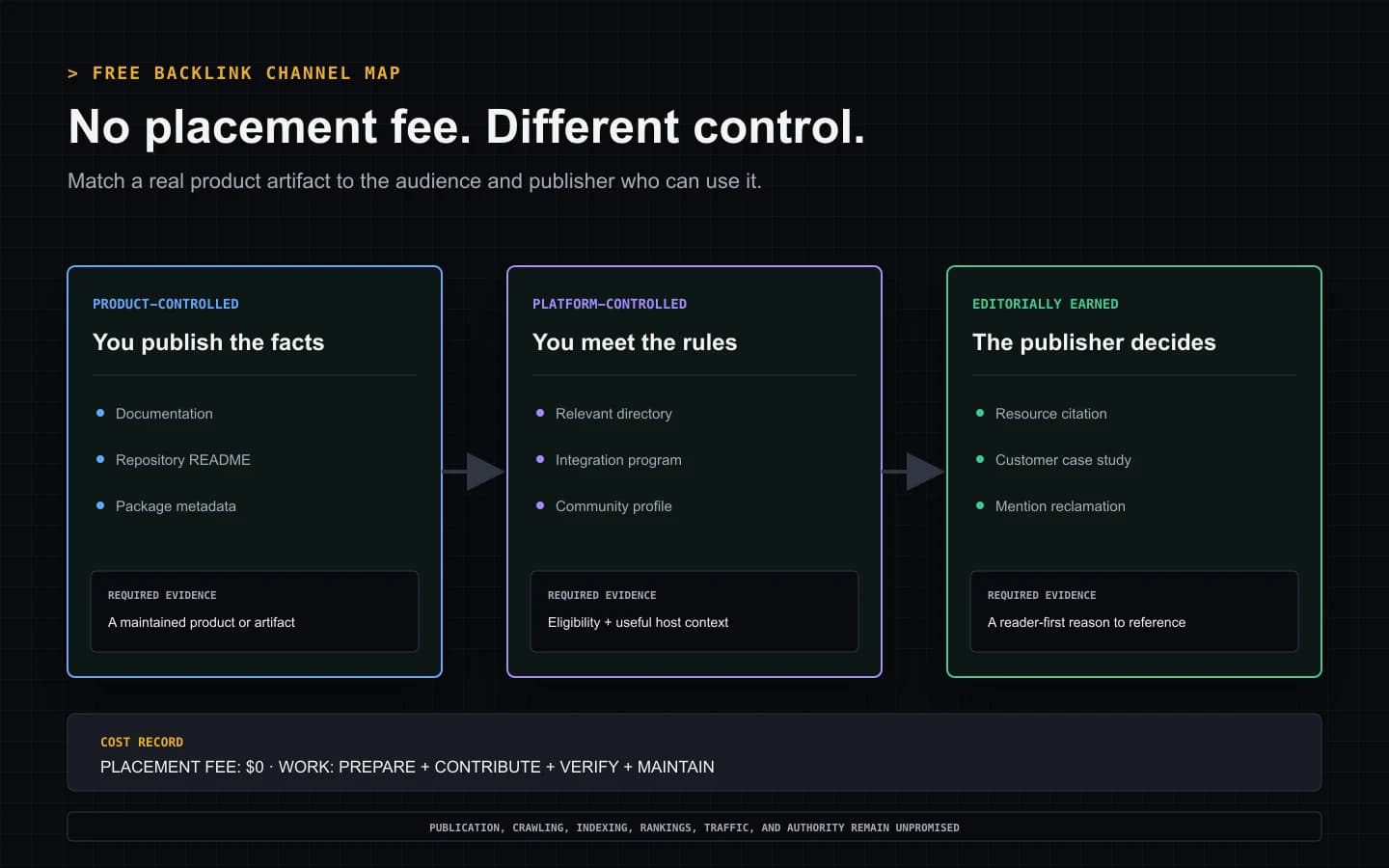
Free backlinks cost work, not placement fees
SaaS companies can pursue legitimate backlinks without paying a placement fee. The practical methods include accurate public product profiles, real software repositories and package pages, integration documentation, useful original resources, existing mention reclamation, and relevant community participation.
“Free” does not mean instant or effortless. Someone must prepare accurate information, meet a host's eligibility rules, contribute something useful, answer review questions, verify the live page, and maintain it. A submitted profile is not an accepted listing, and an accepted listing is not a guaranteed search result.
Google says it primarily discovers pages through links from pages it already crawled. It also says links arise naturally over time and site owners can promote useful content. That is a discovery mechanism, not a promise that any particular link will be crawled, indexed, counted, or rewarded.
The safest working rule is simple: pursue a no-fee reference only when the host's users would benefit from it even if no ranking change occurred.
Prepare one source-of-truth kit first
Do not start by opening fifty submission forms. Create one reviewed product kit that makes every later contribution faster and more accurate:
- canonical product URL and preferred public destination;
- one-sentence proposition and a fuller factual description;
- intended audience, primary use case, and product category;
- current pricing model, platform, and product type;
- maintained logo, screenshots, documentation, and support route;
- founder or company identity plus authorization to represent the product.
Add one resource that demonstrates real value: public documentation, a working template, an API reference, an open repository, a benchmark with methodology, or a detailed implementation guide. The resource should exist for users, not just to create something another page can link to.
Google's people-first guidance emphasizes original, substantial, current, trustworthy content created for an intended audience. That standard is useful before outreach: if the destination is thin, copied, stale, or unclear, more links will not repair the underlying experience.
Keep the kit in version control or another reviewed record. Every profile and pitch should derive from the same facts, but should still be adapted to the host's audience instead of pasted unchanged.
Method one: document real software surfaces
Technical SaaS products often already have legitimate public surfaces. A GitHub organization profile can display a public README, and repository READMEs are shown to visitors. GitHub's own guidance describes a README as a place to explain what a project does, why it is useful, how to start, where to get help, and who maintains it.
Use that surface when a public repository, SDK, integration example, or open-source component actually exists. Link to the canonical docs or product page where it helps a developer complete the task. Do not create empty repositories whose only content is an optimized anchor.
If the SaaS publishes a real npm package, official npm metadata supports a description, homepage, and repository location. Set those fields to accurate, maintained destinations. A package page is documentation for an installable artifact, not a generic profile anyone should manufacture for SEO.
These surfaces are product-controlled, so they do not prove independent endorsement. Their value is accurate developer navigation and a connected source of truth. Record them separately from editorial mentions.
Method two: submit accurate no-fee directory profiles
A relevant SaaS or software directory may offer a free submission path. Before submitting, inspect the audience, review controls, live profile pages, robots rules, canonical, outbound anchor, redirects, and link qualification. The dedicated directory backlink quality test provides the full inspection process.
Use the directory only when its category and profile help an intended customer. Prepare accurate descriptions and current media, follow its eligibility rules, and accept that the publisher controls approval and link markup. Do not treat a high third-party authority score or the word “dofollow” as sufficient evidence.
Google lists low-quality directory links and automated link creation among link-spam examples. It does not say every directory profile is spam. Quality, purpose, acquisition method, and relationship matter. A useful moderated listing is different from mass-created thin pages sold primarily for ranking credit.
Do not invent a count of available free directories. Terms, eligibility, queue capacity, and pricing change. A future sourced directory list can be checked on its own date; this guide stays focused on the method.
Method three: earn integration and ecosystem references
An integration creates a natural documentation relationship. If your SaaS connects to another product, publish a complete setup guide on your own site: requirements, permissions, data flow, screenshots, failure modes, removal, and support ownership.
Then check the partner's official integration, developer, or marketplace program. Apply only when the product meets the documented requirements. Give the reviewer a stable integration URL and evidence that the workflow works. The partner decides whether to publish, which destination to use, and how to qualify the link.
Do not build a superficial “integration” page for every popular brand. A name and logo without a working connection is weak evidence and can mislead users. One verified integration with useful support documentation is a more defensible reference target than dozens of pages made mainly to attract links.
The no-fee part is the absence of a placement purchase. Engineering, support, security review, and maintenance still have real costs.
Method four: publish an original resource worth citing
An earned editorial link needs a reason. Build a resource that helps a specific audience complete work:
- a calculator with disclosed assumptions;
- an anonymized benchmark with sample and methodology;
- a reusable checklist, template, or migration worksheet;
- an open dataset with provenance and update date;
- a technical comparison based on reproducible tests;
- a reference implementation with documented limitations.
Publish the method, not just the conclusion. State who created the asset, when it was checked, which inputs were used, and what the evidence cannot establish. That makes it possible for an editor, customer, partner, or community member to cite the resource accurately.
Outreach should identify the exact page and reader problem the resource helps. Do not offer payment, reciprocal ranking credit, or a prewritten keyword-rich anchor. The publisher should decide whether a reference improves its page.
Google's starter guide says effective promotion can speed discovery among interested people and lists community engagement and word of mouth among the methods. It also warns that promotion can be overdone and perceived as search manipulation. A small relevant outreach list is easier to defend than a mass campaign.
Method five: reclaim facts already published
Sometimes a customer, partner, newsletter, event page, podcast, or article already mentions the company without linking to the best destination. That is not a new placement opportunity created from nothing; it is an existing editorial fact that may benefit from a useful reference.
Confirm the mention is accurate and current. Ask the publisher whether linking the product name or relevant resource would help readers. Supply the canonical URL, explain any redirect, and leave the anchor choice to the editor. Accept a no, a qualified link, or no response.
The same process can repair broken references after a documentation move or domain migration. Redirect old destinations when you control them. When you do not, contact only pages that actually cite the moved resource. Do not turn routine link repair into an unrelated pitch.
Method six: contribute to communities without link dropping
Use communities to answer real questions, show working examples, and learn what users need. Link only when the destination materially supports the answer and the community permits it. Disclose your affiliation.
Google recommends ugc for user-generated links, and its spam examples include
forum comments with optimized links. A qualified community link can still send
relevant visitors; it simply should not be presented as guaranteed ranking
credit.
Avoid signature links repeated across unrelated discussions, copied answers, automated comments, and threads created mainly to place a URL. The durable outcome is useful participation and direct audience understanding. A link is secondary.
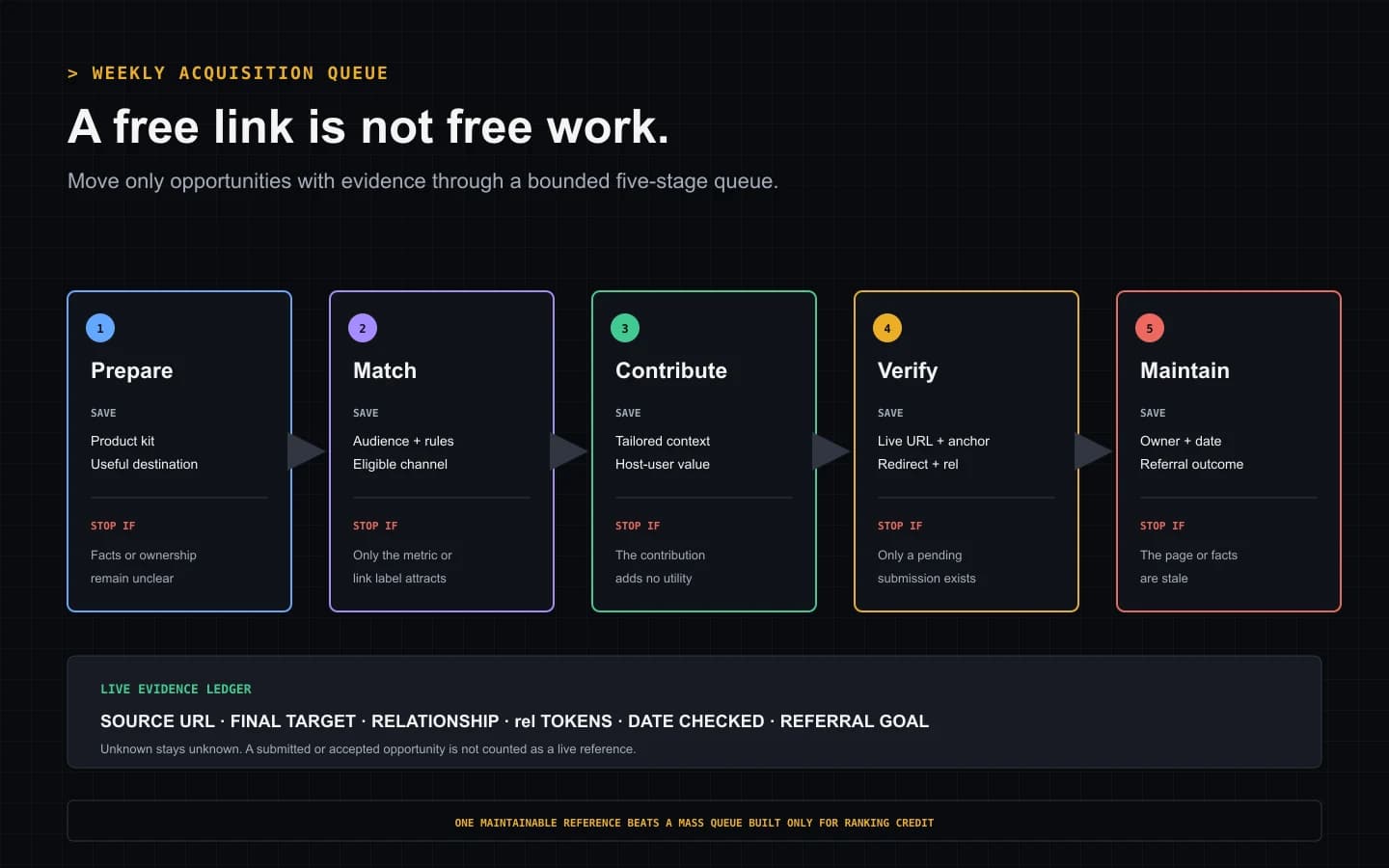
Run a bounded weekly acquisition queue
Use a small queue rather than a huge spreadsheet of unverified prospects:
| Stage | Required evidence | Stop condition |
| --- | --- | --- |
| Prepare | Reviewed product kit and useful destination | Facts or ownership are unclear |
| Match | Host audience, rules, and eligible channel | Only the metric or link type is attractive |
| Contribute | Tailored profile, resource, or request | The contribution adds no reader value |
| Verify | Live source, target, redirect, anchor, and rel | Submission is only pending or rejected |
| Maintain | Owner, check date, referral and conversion record | Facts are stale or the page is gone |
Cap active work at what one owner can maintain. For each published reference,
save the source URL, final destination, relationship, exact rel tokens, and
date checked. Use the link-attribute
guide when a classification is unclear.
Measure what you can observe: publication state, referral sessions, qualified visits, signups, and assisted conversions. Search Console's Links report can help locate sources, but Google says it is sampled, may include historical links, and does not identify nofollow. Absence from that report does not prove a live link was never discovered; presence does not prove a ranking effect.
The current SubmitForBacklinks Free path
SubmitForBacklinks currently offers a $0 Free plan with an available weekly launch reservation, structured product details, and editorial or safety review. Featured does not bypass review, but it is a separate paid option and is not part of this no-fee method.
An approved Free product page defaults to nofollow. The current workflow requires acknowledging and installing a reciprocal badge to activate standard link treatment inside one immutable 60-day window. Daily rechecks can revoke that treatment when the badge is removed; reinstalling it does not extend the original expiration. The badge verification guide documents the operational contract.
This owner-selected policy carries material search-policy risk. Google's spam guidance addresses excessive exchanges and required unqualified links. The $0 price, successful verification, or delivered standard link does not prove Google approval or a ranking benefit.
Review the submission guidelines, prepare accurate facts, and use the Free path only if the directory audience and reciprocal requirement fit your product. The listing can still have referral and discovery value after the follow window ends.
Keep “free” evidence-based
Legitimate free backlinks come from accurate product surfaces, useful contributions, real compatibility, relevant profiles, and editorial decisions. They exchange effort for a chance to help another audience; they do not create free guaranteed authority.
Build one source-of-truth kit, match one real channel, contribute something useful, verify the delivered result, and maintain the facts. Stop when the method depends on mass creation, hidden relationships, optimized link drops, or an outcome nobody can promise.
If the product just launched, use the new SaaS priority sequence first; when several channels are ready, place them inside a measurable SaaS backlink strategy.
Free SaaS Backlink Workflow
A 23-second workflow for preparing evidence, matching no-fee channels, contributing useful context, verifying live links, and maintaining results.
Video transcript
Prepare one source-of-truth kit with the canonical URL, audience, proposition, maintained media, and a real resource. Match that evidence to an eligible repository, package, directory, integration, original resource, or existing mention. Contribute accurate context for the host’s users and stop when the only reason is ranking credit. Verify the delivered page, destination, anchor, redirects, and rel tokens; an accepted submission is not yet live evidence. Measure referral visits and conversions, maintain the facts, and leave crawling, indexing, rankings, traffic, and authority unknown until separate evidence exists.
Sources and verification
Product behavior was checked against the current implementation and automated tests. External policy sources are linked directly.
- Google Search SEO Starter Guide — checked July 30, 2026
- Google Search spam policies: link spam — checked July 30, 2026
- Google guidance for qualifying outbound links — checked July 30, 2026
- GitHub guidance for repository READMEs — checked July 30, 2026
- npm package.json documentation — checked July 30, 2026
- Google Search Console Links report — checked July 30, 2026
Put the workflow into practice
Use the guided terminal flow or review the supporting documentation before submitting a product.
Related resources
Are Directory Backlinks Good for SEO? Use This Quality Test
Learn when directory backlinks are useful, how to inspect relevance, editorial controls, crawlability, paid-link treatment, and spam risk.
Open resourceDofollow vs Nofollow Backlinks: What Actually Changes
Compare dofollow and nofollow backlink HTML, sponsored and UGC values, Google’s hint model, and a repeatable way to inspect real links.
Open resourceHow Automated Backlink Submission Should Work
Learn which backlink submission tasks to automate, which controls need human review, and how idempotent retries prevent duplicate actions.
Open resourceHow to Verify a Dofollow Backlink for a Free Listing
Install the reciprocal badge, verify the live page, diagnose failures, and understand the fixed 60-day dofollow window and daily rechecks.
Open resource