New SaaS reference sequence
Backlinks for a New SaaS: What to Pursue First
Begin with sources that already have a factual reason to identify the product: real software surfaces, working integrations, existing counterparties, and a few relevant reviewed profiles. Broader outreach waits for useful evidence.
- Reviewed by
- SubmitForBacklinks Editorial Team
- Published
- Updated
- Checked
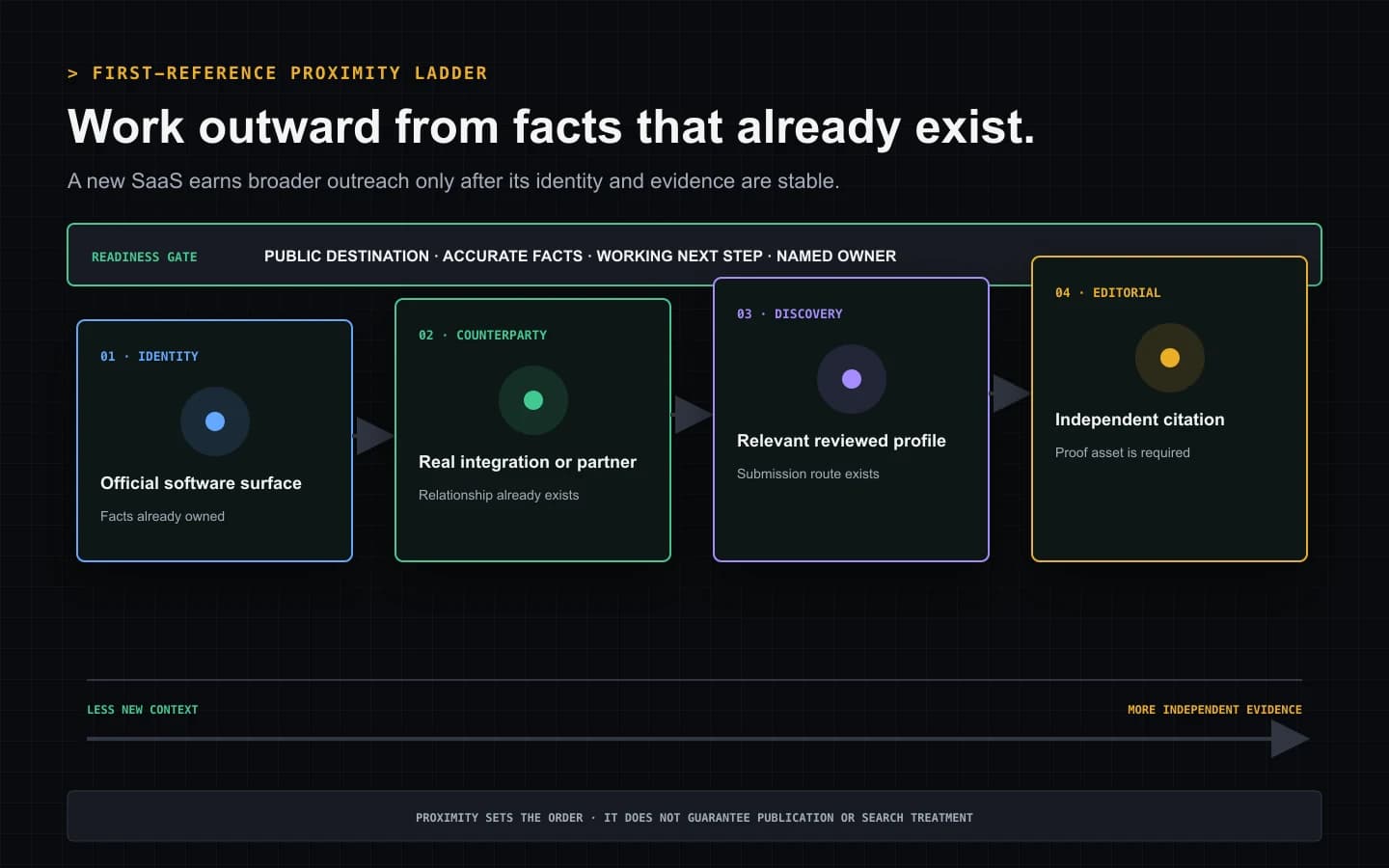
Start with proximity, not prestige
The first backlinks for a new SaaS should come from sources with an immediate, factual reason to reference the product. Begin with legitimate public software surfaces you control, documentation for integrations that actually work, consented references from existing counterparties, and a small number of relevant profiles with real review.
Broader editorial outreach comes later, when the product has evidence another publisher can use: a tested guide, original method, useful tool, documented integration, or transparent dataset. A new company does not need to imitate a mature brand's backlink portfolio on launch day.
This sequence does not guarantee approval, crawling, indexing, rankings, traffic, customers, authority, or link equity. Google says links are one way it discovers pages, but it also says indexing is not guaranteed. Treat each early reference as a maintained path for a real reader, not an injection of search authority.
Pass a launch-reference gate first
Do not distribute a destination that is still changing underneath visitors. Before requesting any reference, confirm five facts:
- The product or public preview works at one stable HTTPS destination.
- The product name, audience, proposition, pricing state, and availability are accurate wherever they appear.
- A visitor can complete the next useful step: read documentation, try a preview, create an account, join a waitlist, or contact the team.
- One named owner can correct claims, broken links, and outdated profiles.
- The public destination is eligible for discovery: it returns HTTP 200, contains indexable content, and does not block the crawlers you intend to allow.
Google describes those technical conditions as minimum eligibility, not a promise that the page will be indexed. A backlink campaign cannot repair an error response, private onboarding wall, placeholder proposition, or abandoned signup flow.
Freeze a small source-of-truth record with the canonical product URL, preferred name, one-sentence description, longer factual description, audience, current logo, screenshots, support route, and owner. Use it to prevent contradictions; do not paste identical marketing copy into every source.
Choose the destination for the fact
A new SaaS homepage is often the correct reference for product identity. It states what the product is and gives the visitor a starting point. It is not automatically the right destination for every claim.
An installation step should point to maintained installation documentation. An integration claim should lead to the exact integration guide. A benchmark should link to its method and limitations. A public package should lead to the package or repository surface that helps a developer use it.
Write a simple pair before outreach:
Fact on the source: what the publisher can accurately say.
Destination: the page that substantiates that fact and completes the next reader task.
If the destination cannot support the fact, correct the page or do not request the reference. Early consistency matters because a young product has little other public evidence to resolve a contradiction.
Use a first-reference proximity ladder
Prioritize opportunities by how much new editorial context must be invented. The nearest source already has a legitimate relationship with the product; the furthest needs an independent reason to care.
| Level | Source relationship | Why it may be ready | | --- | --- | --- | | Identity | Official public software surface | The team owns the facts and the software exists there | | Counterparty | Integration, vendor, customer, or partner | A working or consented relationship already exists | | Discovery | Relevant reviewed profile | The service has an audience and an explicit submission route | | Editorial | Independent article, resource, or newsletter | A proof asset improves a specific reader task |
This is an order of investigation, not a promise that every level produces a link. A counterparty can decline. A directory can reject the submission. An editor can decide that the evidence does not fit. Preserve those outcomes instead of substituting unrelated placements to meet a quota.
The ladder also avoids a prestige shortcut. A famous domain with no reason to mention the product is not a realistic first target. A modest but genuine integration page may have a clearer audience and maintenance owner.
Level one: align legitimate software surfaces
Use public developer surfaces only when they represent real software. If the SaaS maintains a public repository, GitHub says its README can explain what the project does, why it is useful, how to start, where to get help, and who maintains it. GitHub surfaces a recognized README to repository visitors.
If the product publishes a real public npm package, npm supports a description, homepage, repository, and issue location in package metadata. Keep those fields accurate and point them to the page that helps the package user.
Do not create empty repositories or placeholder packages to manufacture links. Do not expose private source code, credentials, internal issue details, or an unsupported SDK for the sake of a public profile. If the product has no legitimate public developer surface, skip this level.
Check names and destinations across the surfaces that do exist. A repository, package, documentation site, and homepage should not describe four different products or send visitors through expired redirects.
Level two: document existing relationships
Inventory relationships already created by building and operating the product: integrations, platform programs, implementation partners, vendors, accelerators, design partners, and customers who have explicitly agreed to be identified.
The request should improve an existing page. An integration provider may add a supported-app entry or setup step. A partner may maintain a solution page. A customer may choose to reference a public case study whose claims and permissions it has approved. The counterparty owns the editorial decision, anchor, and publication timing.
Do not call a superficial logo connection an integration. Do not name a customer without permission. Do not ask a vendor to rewrite an unrelated page because its domain has a high score. The strength of this level is an existing fact, so preserve the evidence that makes the relationship real and assign an owner to update it when the product changes.
Payment can be part of a legitimate commercial relationship, but payment for
ranking credit is a different proposition. Google recommends sponsored for
advertisements and paid placements; nofollow remains acceptable. Honest
qualification does not erase referral value, and a standard link does not make
an irrelevant placement useful.
Level three: use reviewed discovery selectively
A relevant product, startup, software, or category directory can provide an early public profile when it has a real audience, useful listing pages, clear requirements, and a correction path. The purpose is accurate discovery, not a large count.
Inspect the category and several live profiles before submitting. Confirm that the product belongs, the fields can represent it accurately, and payment does not bypass review. Save the submitted facts and revisit the published page.
Google's spam examples include low-quality directory links, automated link creation, keyword-rich distributed links, and links purchased for ranking purposes. A directory label is neither approval nor condemnation; the audience, page, review, and relationship decide whether the profile has a reader-first purpose.
Use the directory quality test for a full inspection and the link-attribute guide to classify the delivered anchor. A nofollow profile can still be a useful product reference. A standard link cannot guarantee any search outcome.
Level four: earn a reason for broader citation
Cold outreach becomes more realistic when the product contributes evidence that the publisher cannot obtain from its own generic description. Build one proof asset from real product work:
- a tested integration walkthrough with failure states;
- a calculator with visible assumptions;
- a small benchmark with sample, method, date, and limitations;
- an anonymized operational analysis with the necessary permission;
- a migration worksheet or reference implementation;
- a public methodology explaining how the product reaches a result.
Google's people-first questions ask whether content provides original information or analysis, shows clear sourcing and first-hand expertise, serves an intended audience, and helps someone achieve a goal. Use those questions as an editorial screen, not as a ranking formula.
Pitch one exact page and explain the reader problem the asset resolves. Let the publisher choose the anchor and decide whether to cite it. If the email still works after replacing the product with any competitor, the context is not specific enough.
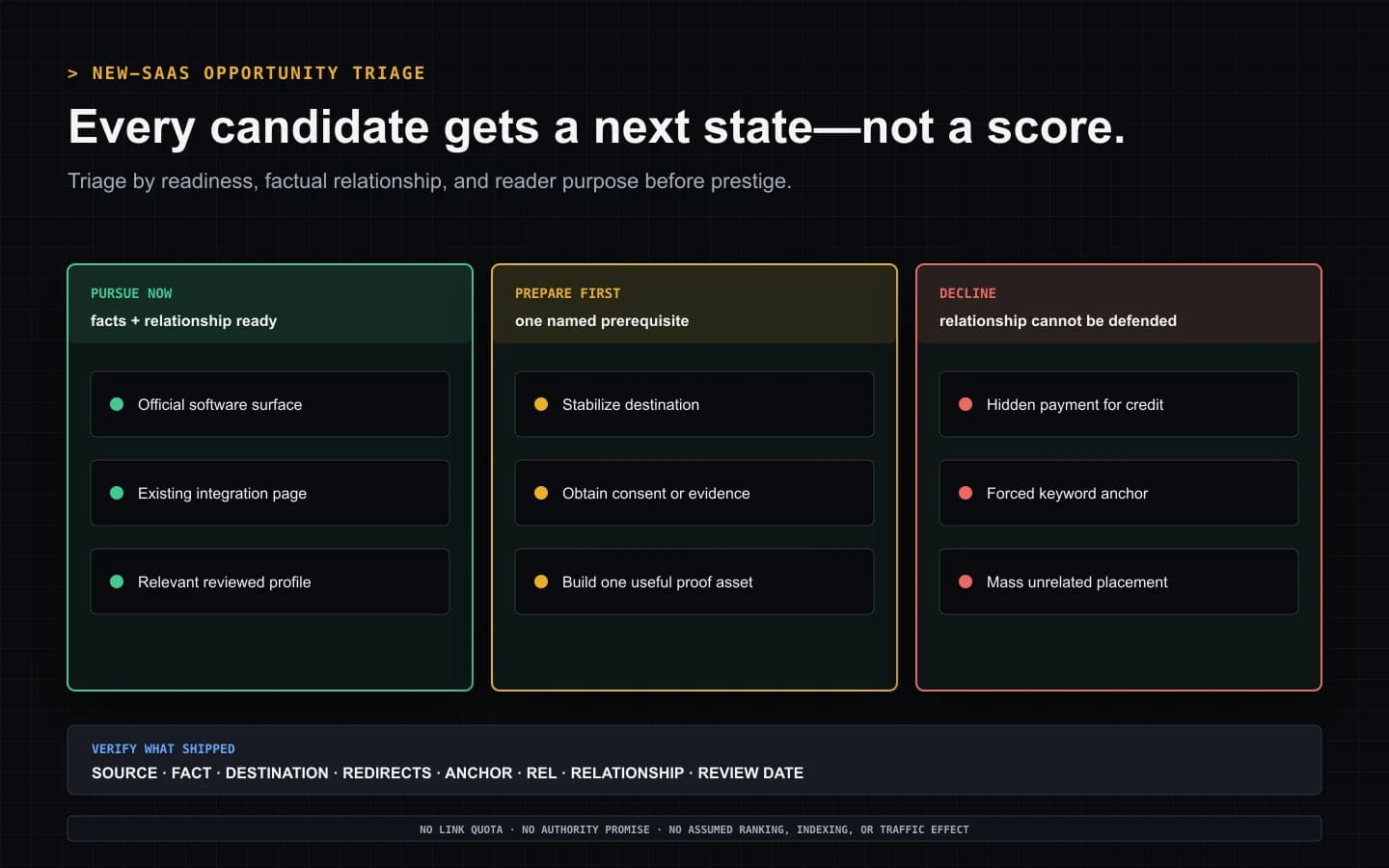
Triage opportunities without a link quota
Place each candidate in one of three columns:
Pursue now when the product is ready, the relationship already exists, the source has a clear reader purpose, and the facts can be maintained.
Prepare first when the audience fits but the destination, permission, integration evidence, source-page context, or correction owner is missing. Name the exact prerequisite rather than leaving the opportunity “in progress.”
Decline when the offer depends on hidden payment, forced keyword anchors, mass automation, unrelated pages, excessive exchange, fake accounts, invented customer evidence, or a guarantee nobody can support.
Google's link-spam guidance makes paid ranking links, excessive exchanges, automated creation, and required unqualified links material risks. Newness is not a reason to lower the standard. A product with few references can wait for a defensible opportunity.
Verify the reference that actually shipped
A submission, accepted pitch, or invoice is not a live backlink. Open the final source page and record:
| Field | Evidence |
| --- | --- |
| Source | Public URL, page owner, and surrounding fact |
| Delivery | Anchor, href, redirects, final destination, and every rel token |
| Relationship | Editorial, partner, paid, reciprocal, or user-submitted |
| Maintenance | Product owner, publisher correction route, and last check |
| Observation | Referral visits or instrumented actions, if available |
Google's generally crawlable pattern is an <a> element with an href, and it
recommends descriptive, concise anchor text. These checks prove what a visitor
and inspector received, not what a search engine will count.
Search Console's Links report can help find source pages, but Google says it is
sampled, may show historical links, groups data by canonical URL and root
domain, and does not report nofollow. Keep your own current ledger and measure
referral behavior separately.
Expand when the evidence—not the count—is ready
The first portfolio is ready to widen when its facts agree, destinations remain stable, relationships are disclosed, correction owners respond, and at least one proof asset gives an unfamiliar publisher a useful citation reason. There is no universal number of links that marks this transition.
At that point, use an opportunity-quality framework for source-page evaluation and a broader strategy for campaign ownership and measurement. Before then, more prospect rows mostly create more places for a young product to publish stale or unsupported claims.
How SubmitForBacklinks fits the first sequence
SubmitForBacklinks offers one reviewed discovery surface. Its guidelines require a real safe product or public preview, people-first copy, accurate optional media, authorization, reviewed generated content, and moderation. Featured never bypasses review.
Current published profiles expose structured facts, a primary category, tags, and a server-visible destination link. Public discovery contains published listings, and each product profile declares a self-canonical. These controls support an inspectable profile; they do not certify product quality or authority.
Approved Free listings currently default to nofollow unless a reciprocal badge is verified inside its active fixed follow window. Paid Featured entitlement currently uses standard link treatment after approval and successful payment. Those are owner-selected rules, not Google endorsements. Google's paid and reciprocal link policies remain relevant, and no treatment promises ranking credit.
Inspect live profiles, review the reciprocal badge workflow, and decide whether the audience and relationship fit. If the product passes the launch-reference gate, run the directory submission preflight, then submit accurate product facts as one early discovery step—not as a guaranteed result.
First Backlinks for a New SaaS
A 21-second sequence for readying a new SaaS, anchoring its identity, prioritizing nearby references, verifying delivery, and expanding only when evidence supports it.
Video transcript
Ready the product with one stable public destination, accurate facts, a working next step, a named owner, and an index-eligible page. Anchor its identity across official repositories, packages, documentation, and product facts only where those surfaces legitimately exist. Work outward by proximity: existing counterparties and relevant reviewed discovery require less invented context than broad cold outreach. Verify every live reference by source page, fact, destination, redirects, anchor, rel tokens, relationship, and review date. Expand only when the evidence is maintainable and a useful proof asset gives publishers a reader-first citation reason.
Sources and verification
Product behavior was checked against the current implementation and automated tests. External policy sources are linked directly.
- Google Search SEO Starter Guide — checked July 30, 2026
- Google Search technical requirements — checked July 30, 2026
- Google guidance for crawlable links and anchor text — checked July 30, 2026
- Google guidance for creating helpful content — checked July 30, 2026
- GitHub guidance for repository READMEs — checked July 30, 2026
- Google Search Console Links report — checked July 30, 2026
Put the workflow into practice
Use the guided terminal flow or review the supporting documentation before submitting a product.
Related resources
Free Backlinks for SaaS: Legitimate Methods That Cost Time
Build free SaaS backlinks through useful profiles, repositories, documentation, original resources, and outreach without ranking or indexing promises.
Open resourceHigh-Authority Backlinks for SaaS: A Practical Test
Evaluate SaaS backlinks by relevance, editorial evidence, page context, crawlable markup, and policy fit—without mistaking DR for Google.
Open resourceHow to Build a SaaS Backlink Strategy You Can Measure
Build a SaaS backlink strategy around audience fit, linkable evidence, source relevance, policy risk, attribution, and measurable business outcomes.
Open resourceDofollow vs Nofollow Backlinks: What Actually Changes
Compare dofollow and nofollow backlink HTML, sponsored and UGC values, Google’s hint model, and a repeatable way to inspect real links.
Open resource