SaaS authority evidence
High-Authority Backlinks for SaaS: A Practical Test
Authority is an evidence stack for one exact citation, not a domain-score verdict. Inspect the audience, rationale, publisher, source page, relationship, and delivered link before accepting an opportunity.
- Reviewed by
- SubmitForBacklinks Editorial Team
- Published
- Updated
- Checked
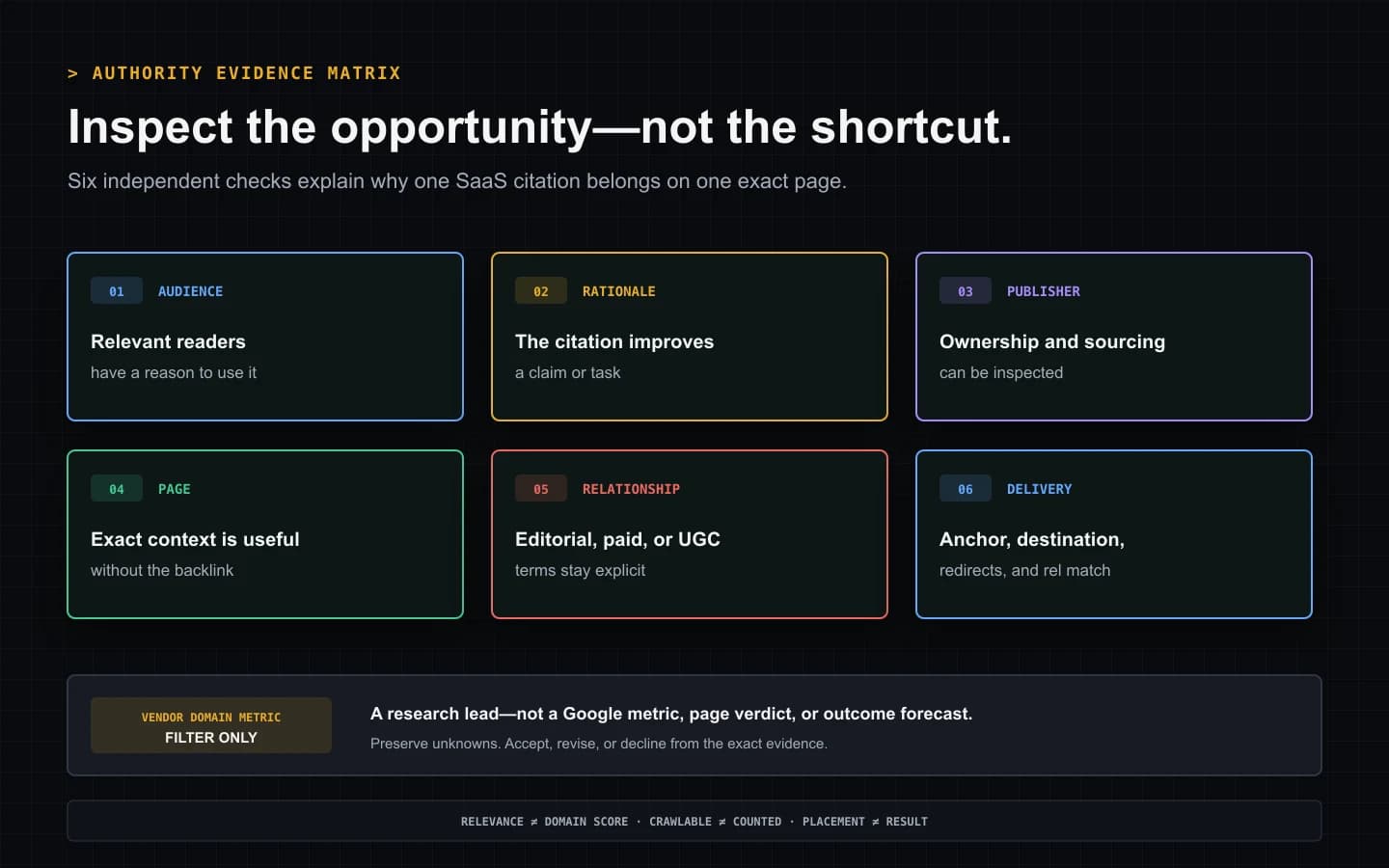
Authority is evidence, not a domain score
A high-authority backlink for a SaaS product is a citation with a defensible reason to exist. The source reaches a relevant audience, the exact page provides useful context, the publisher is transparent, and the anchor leads to an asset that supports the surrounding claim. The link is crawlable, its qualification matches the relationship, and its direct value can be evaluated without promising a search outcome.
That definition is more useful than “a backlink from a high-score domain.” Third-party metrics can help prioritize a research queue, but they do not decide whether one page is relevant, whether a placement is editorial, or how Google will treat it. No backlink can guarantee crawling, indexing, rankings, traffic, customers, or authority.
Ask a harder question: if no ranking improvement could be promised, would this citation still help the source page's reader understand, verify, compare, or complete something? If yes, there is a reader-first reason to inspect it. If the only benefit is a score or an unqualified link, the evidence is incomplete.
Separate Google link analysis from vendor metrics
Google documents that it uses links to discover pages and as one signal for determining relevance. Its ranking-systems guide also says its core systems include link-analysis systems, including PageRank, that consider how pages link to one another. That does not create a public “domain authority” number that a publisher can sell.
Domain Rating, or DR, is Ahrefs' metric. Ahrefs defines it as the relative strength of a website's backlink profile in its own database on a 0–100 scale. It is domain-level; Ahrefs' URL Rating is page-level. Ahrefs also says there is no evidence that search engines use DR or Moz's Domain Authority as ranking factors and warns against judging a website on site-wide authority alone.
Use a vendor score as a filter, not a verdict:
- record the provider, score, and date rather than calling it “Google authority”;
- use it to identify candidates that may deserve inspection;
- compare it with topical relevance, page quality, real audience, traffic evidence, and editorial practice;
- never translate a score into a predicted ranking or link value.
The exact source page matters more to the opportunity decision than the publisher's homepage badge. A broad domain can contain an excellent specialist resource and an irrelevant sponsored roundup at the same time.
Start with an asset that deserves a citation
Before evaluating publishers, define the destination. “Our homepage needs a backlink” is not a citation rationale. A reader needs a reason to follow the link.
For SaaS, a useful destination might be original research with a documented method, an integration guide that completes a setup step, a public calculator, a maintained reference, an incident analysis, or a product page that substantiates a specific capability. These are examples, not guaranteed link magnets. The asset still has to be accurate, accessible, and appropriate for the proposed source page.
Write one citation job:
This page should cite our asset because it helps this audience complete or verify this specific task.
Then identify the claim the source would make, the evidence your asset supplies, and the section where the link belongs. If you cannot fill those three fields, revise the asset or decline the target. Authority cannot repair a missing editorial reason.
Map four kinds of relevance
“Relevant website” is too vague. Check four connections separately.
Audience relevance: Are the source page's readers plausible users, evaluators, implementers, partners, or researchers for the SaaS product?
Topic relevance: Does the page discuss a subject the destination genuinely covers, rather than sharing only a broad category such as “technology”?
Task relevance: Does following the link help the reader take the next step, compare evidence, verify a statement, or use a referenced tool?
Claim relevance: Does the destination support the exact surrounding sentence? A link to a generic homepage does not substantiate a technical, pricing, security, or performance claim unless that evidence is actually there.
Record each connection in one sentence. This prevents topical language from becoming decoration around an unrelated placement. It also produces a more natural anchor because the anchor describes the real destination rather than a keyword selected only for search.
Apply a six-check opportunity rubric
Evaluate one proposed source page, not an abstract domain:
| Check | Evidence to preserve | Pass condition |
| --- | --- | --- |
| Audience | Page purpose and intended readers | A relevant reader has a reason to use the citation |
| Rationale | Claim, section, and destination asset | The link improves the explanation or completes a task |
| Publisher | Ownership, authorship, sourcing, corrections | The source is transparent enough to evaluate |
| Page | Original context, maintenance, and accessibility | The exact page is useful without the backlink |
| Relationship | Editorial, paid, reciprocal, or user-submitted terms | The real relationship is disclosed and qualified |
| Delivery | Public URL, anchor, destination, redirects, and rel | The delivered link is reproducible and accurately recorded |
Do not hide unknowns inside a total score. A missing relationship disclosure is not equivalent to a slightly weaker audience match. Preserve “unknown” and request clarification. Accept when the evidence fits, revise when a specific change can resolve the mismatch, and decline when the placement depends on a misleading relationship or an irrelevant page.
Google's people-first self-assessment supports this evidence-first approach. It asks about original and substantial information, clear sourcing, demonstrated experience or expertise, an intended audience, first-hand knowledge, and a site's primary purpose. These prompts help inspect credibility; they are not a formula for predicting one link's treatment.
Inspect the publisher and the exact page
Start with ownership. Look for an identifiable organization or author, editorial or submission guidelines, source attribution, a correction path, and a clear commercial model. Then open several current pages and older examples. Transparent identity does not guarantee quality, but it gives another reviewer evidence to verify.
On the proposed page, check whether the copy is original, whether claims have sources, whether the section containing the link serves a real reader task, and whether dated material is maintained. A respected publisher's abandoned, generic, or auto-generated page is not rescued by the rest of the domain.
Also inspect the acquisition method. Did an editor choose the resource? Is it a
partner integration page? Can anyone submit a profile? Is payment buying
advertising or being presented as ranking credit? Is a reciprocal link required?
The answer changes the necessary disclosure and rel treatment.
Google lists paid ranking links, excessive exchanges, automated link creation, required unqualified links, keyword-rich distributed anchors, and low-value content made to manipulate linking signals among its link-spam examples. Editorial relevance cannot be inferred from a successful payment or automatic approval.
Compare exact opportunities, not labels
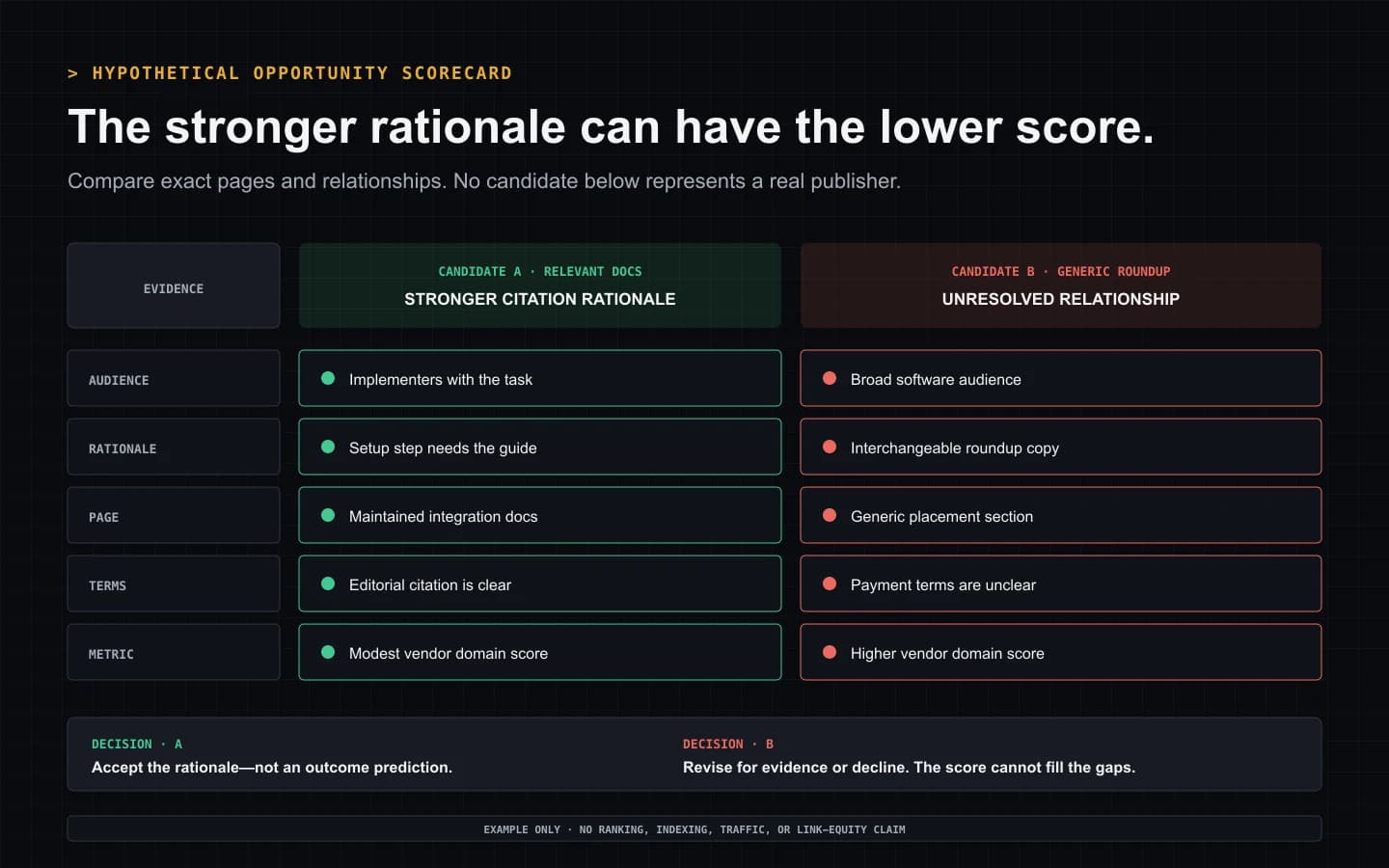
Consider two explicitly hypothetical candidates.
Candidate A is a maintained integration document for a platform used by the SaaS product's customers. It has a clear owner, explains a real setup task, and would cite the product's technical guide in the step where readers need it. The publisher has a modest vendor score.
Candidate B is a generic “top software” roundup on a domain with a much higher vendor score. The proposed paragraph is interchangeable, the audience is broad, payment terms are unclear, and the seller emphasizes a standard link rather than what the citation adds.
Candidate A presents the stronger rationale because its audience, task, claim, and destination align. That is an evidence comparison, not a prediction that the link will rank, index, pass value, or convert. Candidate B could be revised only if its source-page purpose, editorial process, and commercial relationship become clear. Its score alone cannot resolve those unknowns.
This comparison also prevents an overly simple “lower scores are better” conclusion. A high-scoring publisher can host an excellent relevant citation, and a lower-scoring site can be thin or deceptive. Inspect the actual opportunity every time.
Verify the anchor, destination, and relationship
Google's generally crawlable pattern is an <a> element with an href that
resolves to a real address. Its link guidance recommends anchor text that is
descriptive, concise, and relevant to the source and destination. Use language
that helps a reader understand where the link goes; do not demand repetitive
keyword anchors.
After publication, record:
- the public source URL and date checked;
- the rendered anchor text and destination;
- every redirect before the final URL;
- every
reltoken; and - the nearby sentence that supplies context.
Google recommends sponsored for advertisements and paid placements, while
nofollow remains acceptable for paid links. It provides ugc for
user-generated links. A regular link needs no special rel value when those
relationships do not apply. Accurate qualification describes the relationship;
it does not guarantee that Google will approve, count, index, or reward the
link.
If the terms require payment, exchange, automation, or an exact keyword anchor for unqualified ranking credit, revise or decline the opportunity. A legitimate advertisement or partnership can still serve readers, but its value proposition should survive truthful disclosure.
Measure outcomes that are actually observable
Preserve the opportunity record before outreach, then verify it again after publication. Track referral visits, qualified sessions, trials, assisted conversions, or partnership outcomes when your consent and analytics design allow. These are business observations, not evidence of search-engine treatment.
Search Console's Links report can help discover linking pages, but Google says
the report is sampled, may include links it found in the past, groups data by
canonical URL and root domain, and does not report whether a link is
nofollow. Absence from the report does not prove absence from Google's index,
and presence does not assign authority or ranking credit.
Avoid before-and-after claims based on one link. Rankings and traffic can change for many reasons. The defensible record is narrower: what was proposed, why it served the reader, what relationship applied, what was delivered, and what direct behavior was observed.
How SubmitForBacklinks fits—and where it stops
SubmitForBacklinks provides one directory context, not a universal authority certificate. Its public guidelines require a real safe product, people-first copy, accurate optional media, authorization, reviewed generated content, and moderation. Featured never bypasses review.
Published profiles expose structured product facts, a primary category, tags, and a server-visible destination anchor. Public discovery is limited to published listings, and product profiles declare a self-canonical. The outbound component records human navigation for attribution without replacing the crawlable destination.
Current Free listings default to nofollow unless a reciprocal badge is verified inside its active fixed follow window. Current paid Featured entitlement uses standard link treatment after approval and successful payment. These are owner-selected product rules, not evidence that SubmitForBacklinks is “high authority” or that Google will grant ranking credit. Google's paid and reciprocal link policies remain relevant.
You can inspect live product profiles, compare link attributes, and review the reciprocal badge workflow before deciding whether the audience, page, and relationship fit. If they do, the relevant next step is to submit an accurate SaaS product, not to purchase a promised search outcome.
Keep an evidence ledger
For every candidate, save the audience map, citation job, publisher evidence, source-page snapshot, relationship terms, technical inspection, decision, and review date. Add the metric provider and date only when a vendor score helped prioritize the candidate.
Authority is the conclusion of that review, not its starting number. Accept a placement because its evidence is coherent. Revise it when a better destination, context sentence, anchor, or qualification would make the relationship honest. Decline it when the case depends on irrelevance, hidden payment, required unqualified credit, or an outcome promise.
That process will not reveal a secret Google score. It will produce something more useful: a backlink decision another person can reproduce without confusing a vendor metric, a crawlable link, a relevant citation, and a business result. Use that decision record to prioritize candidates inside a measurable SaaS backlink strategy.
SaaS Backlink Authority Review
A 22-second review of relevance, source-page evidence, link delivery, relationship, and an evidence-bounded decision.
Video transcript
Define authority from the exact audience, source page, relationship, and destination rather than a domain-score verdict. Map the citation’s audience, topic, task, and claim to a real reason the SaaS asset belongs. Inspect authorship or ownership, useful maintained context, crawlable markup, destination, redirects, and rel tokens. Compare explicitly hypothetical candidates: relevant integration documentation can present a stronger rationale than a generic high-score placement. Save the evidence, then accept, revise, or decline while measuring referral behavior separately from search treatment.
Sources and verification
Product behavior was checked against the current implementation and automated tests. External policy sources are linked directly.
- Google guidance for crawlable links and anchor text — checked July 30, 2026
- Google guide to ranking systems — checked July 30, 2026
- Google guidance for creating helpful content — checked July 30, 2026
- Google Search spam policies: link spam — checked July 30, 2026
- Ahrefs definition of Domain Rating — checked July 30, 2026
- Google Search Console Links report — checked July 30, 2026
Put the workflow into practice
Use the guided terminal flow or review the supporting documentation before submitting a product.
Related resources
Free Backlinks for SaaS: Legitimate Methods That Cost Time
Build free SaaS backlinks through useful profiles, repositories, documentation, original resources, and outreach without ranking or indexing promises.
Open resourceDofollow vs Nofollow Backlinks: What Actually Changes
Compare dofollow and nofollow backlink HTML, sponsored and UGC values, Google’s hint model, and a repeatable way to inspect real links.
Open resourceHow to Verify a Dofollow Backlink for a Free Listing
Install the reciprocal badge, verify the live page, diagnose failures, and understand the fixed 60-day dofollow window and daily rechecks.
Open resourceAre Directory Backlinks Good for SEO? Use This Quality Test
Learn when directory backlinks are useful, how to inspect relevance, editorial controls, crawlability, paid-link treatment, and spam risk.
Open resource