SaaS backlink operating system
How to Build a SaaS Backlink Strategy You Can Measure
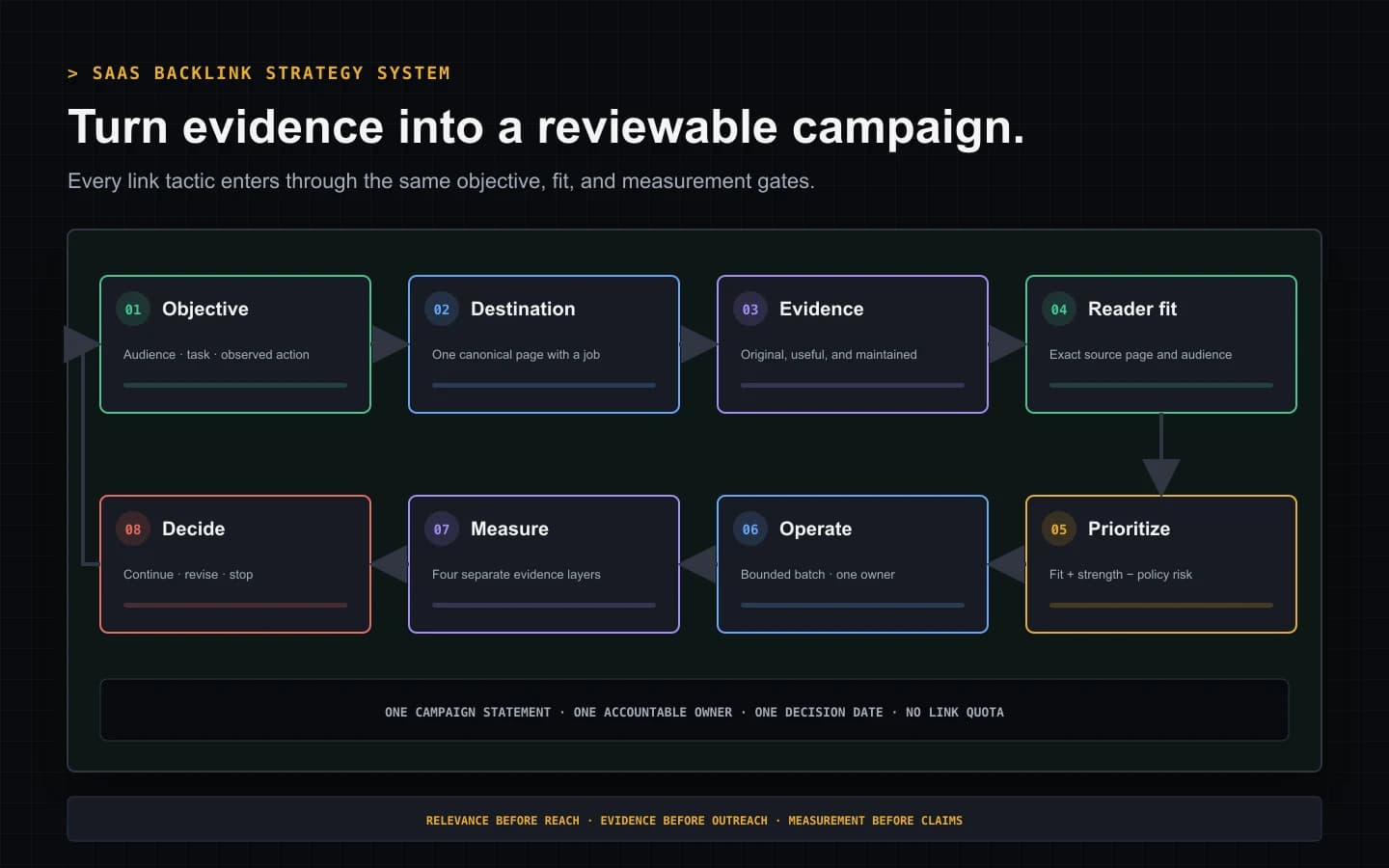
A useful strategy connects one intended audience and business objective to a ready destination, defensible evidence, relevant source pages, a bounded campaign, and a decision date. It does not begin with a monthly link quota.
- Reviewed by
- SubmitForBacklinks Editorial Team
- Published
- Updated
- Checked
Direct answer: build a decision system, not a link quota
A SaaS backlink strategy connects one business objective and intended audience to a destination page, a useful evidence asset, relevant publishers, a relationship policy, and a measurement plan. It is not a monthly promise to produce a fixed number of links.
Start with the decision the campaign should inform. Do you need qualified visitors to evaluate an integration, independent references to original research, discovery for a product category, or partner traffic to a specific workflow? Choose one primary outcome and one page that completes the visitor's next task.
For a launch-stage product without a stable reference base, begin with the new SaaS first-link sequence before operating the broader system below.
Then define what you can observe. You can record which publishers were qualified, which pages linked, which referrals arrived, and which instrumented product actions followed. Search Console can report impressions, clicks, and CTR for your pages and queries. None of those observations alone proves that a backlink caused a ranking change, indexing event, signup, or sale.
Choose the destination before the publisher
Teams often start with a site list and only later decide where the links should point. Reverse that sequence. A destination earns attention when it has a clear job for a specific reader.
For a product-led campaign, the destination might be an integration guide, technical comparison, methodology, security page, original benchmark, or template that helps someone make a real decision. A homepage can be correct when the product itself is the subject, but it should not be the automatic target for every opportunity.
Write a one-line campaign statement:
Help this audience use this evidence to complete this task on this page, then measure this observable action.
If the statement needs “increase authority” as its only outcome, it is not specific enough. Authority can refer to a third-party metric, editorial reputation, topical expertise, or a hoped-for search effect. Name the audience behavior you actually want to understand.
Pass four readiness gates
A strategy should not distribute a page that is not ready. Use four gates before prospecting.
Claim readiness: Every material claim on the destination is accurate, sourced where necessary, and consistent with the current product. Pricing, availability, screenshots, and integration behavior should match what a visitor will find.
Evidence readiness: The page contributes something worth referencing: first-party data with a methodology, a tested workflow, a useful tool, original analysis, product documentation, or a clearly maintained resource. Google asks whether people-first content serves an intended audience, demonstrates first-hand expertise, and helps someone achieve a goal.
Conversion readiness: The next action works. Forms, demo requests, account creation, documentation navigation, and product CTAs should lead somewhere useful on desktop and mobile. A link campaign cannot repair a broken visitor journey.
Measurement readiness: Save a dated baseline and confirm which events are
actually collected. Unknown or disconnected events are not instrumented, not
zero. Decide who owns the measurement review before outreach begins.
These are campaign gates, not a company-age sequence. A new or established SaaS can pass them for one page and fail them for another.
Build a small portfolio of linkable evidence
Do not publish content only because it resembles pages that have attracted links elsewhere. Build evidence from work the product already needs.
A compact portfolio can include:
- implementation documentation that resolves a recurring integration problem;
- a benchmark with a visible sample, method, date, and limitations;
- a template, checklist, or calculator that produces a useful output;
- a product methodology that explains how a decision or score is made;
- an educational comparison that discloses its criteria and conflicts.
Each asset needs an owner, intended audience, update trigger, and canonical URL. Remove unsupported numbers and anonymous success claims. If customer evidence is involved, obtain permission and describe what happened without turning one result into a universal promise.
Google's people-first questions provide a useful editorial screen: does the content add original information or analysis, show first-hand expertise, and leave the intended reader able to accomplish something? Passing that screen does not guarantee that anyone will cite the asset. It establishes a defensible reason to offer it.
Map publisher fit to a reader task
Relevance is a page-level question before it is a domain-level metric. Inspect the exact source page or section where a reference could help.
Ask:
- Does its audience overlap the people the destination serves?
- Is there a specific sentence, claim, or workflow that your evidence improves?
- Would the reference still help if search engines ignored ranking credit?
- Can the publisher describe the destination with a natural, accurate anchor?
- Can both teams maintain the relationship when the product changes?
A strong domain-wide score cannot answer those questions. A smaller specialist site may have the more precise reader and page fit. The separate planned authority guide owns evaluation of domain metrics and publisher quality; this strategy uses those observations as inputs, not as the objective.
Google says links help it discover pages and are used as a relevancy signal.
It also recommends descriptive anchor text in crawlable <a href> links. That
guidance does not mean every relevant pitch will earn a link or every crawlable
link will affect search results.
Prioritize with a transparent opportunity score
Use a score that a teammate can challenge. For each exact page, assign:
- reader fit: 0–3;
- source-page fit: 0–3;
- evidence strength: 0–2;
- maintainability: 0–2; and
- policy risk: subtract 0–3.
The maximum is ten. This is an internal planning heuristic, not a Google score, Domain Rating substitute, or success probability.
Write one sentence beside every value. “Reader fit 3” is weak evidence; “Security leads evaluating OAuth implementations already use this comparison page” is reviewable. A high total still requires a human decision. A policy conflict or misleading placement can disqualify an opportunity regardless of the arithmetic.
Prioritization protects limited research and outreach time. It also records why a team declined a famous but irrelevant publisher instead of rewriting history after results arrive.
Run a bounded campaign
Give one owner a defined asset, audience, prospect set, and decision date. A bounded campaign produces a reviewable result even when no placement occurs.
For each opportunity, record the source page, contact or submission route, reason for relevance, proposed destination, relationship type, date, current state, and next action. Tailor the request to the page. Explain the missing or outdated reference your evidence can improve; do not demand an exact keyword anchor or unqualified link.
Use channels as a portfolio:
- editorial resources and research citations;
- integration and ecosystem pages;
- partner education and joint documentation;
- relevant directories with real review and useful listing pages;
- product communications that expose the evidence to an existing audience.
This is not a directory list or a catalog of free tactics. Allocate effort based on the campaign statement and score. Automate record movement, reminders, and duplicate checks where useful, but keep relevance, claims, consent, and final outreach under review. The safe automation guide explains that operating boundary.
Put policy before scale
Google defines link spam by the purpose of manipulating search rankings. Its examples include paid ranking links, excessive exchanges, automated link creation, low-quality directory links, distributed footer or template links, and low-value content made mainly to manipulate linking signals.
Compensation, sponsorship, user placement, or another relationship can require
a qualified outbound link. Google recommends sponsored for advertisements and
paid placements, with nofollow still accepted. The guide to dofollow and
nofollow backlinks covers the delivered
HTML.
Do not treat a qualification as a campaign failure. A relevant sponsored or nofollow mention can still send visitors and communicate a real relationship. Conversely, a standard link does not make a weak or manipulative placement useful.
SubmitForBacklinks currently retains owner-selected standard-link treatments for paid Featured and verified reciprocal Free listings. That behavior carries an accepted policy risk and is not represented as Google-approved. Review the submission guidelines and your own risk tolerance before making the directory one channel in a broader plan.
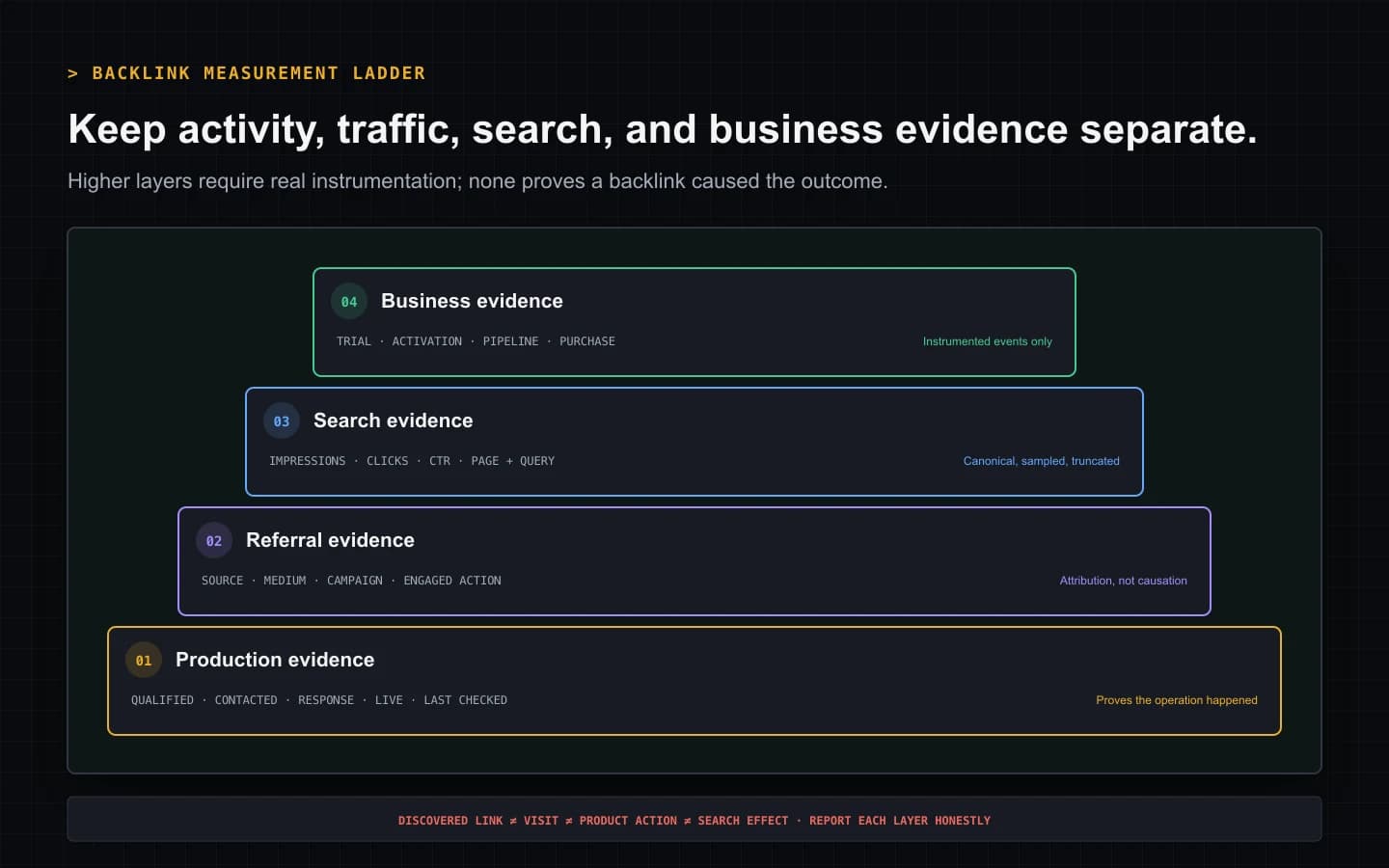
Measure four separate layers
Keep measures in layers so a team does not turn an early signal into a causal claim.
Production evidence covers qualified opportunities, reviewed contacts, responses, accepted placements, live source pages, accurate anchors, and last inspection dates. This shows whether the operation happened.
Referral evidence covers tagged or referrer-attributed sessions, engaged
visits, and instrumented actions on the destination. Google Analytics documents
utm_source, utm_medium, and utm_campaign for identifying campaign
referrals. Use consistent names when a publisher accepts a tagged destination.
For ordinary untagged editorial links, preserve the referrer hostname and
landing page instead of inventing campaign attribution.
Search evidence covers impressions, clicks, CTR, and query/page coverage in Search Console. Compare the same canonical destination and document the date window. Search Console omits anonymized queries and may truncate rows, so a table is not the complete demand picture. Its Links report is also sampled, may retain removed links, and does not identify nofollow.
Business evidence covers only events your product records, such as a trial, qualified demo, activation, pipeline stage, or purchase. Define the event and owner before the campaign. Do not backfill an assumed conversion because a referral and signup occurred near each other.
Review the layers together, but report each separately. An accepted placement with no measured visits can prompt a page or audience review. A referral with a useful product action can justify maintaining the relationship without a search claim.
Understand the SubmitForBacklinks measurement boundary
The current owner dashboard reports listing views, unique views, outbound website clicks, unique clicks, and outbound CTR. Bots are filtered, and visitor identity is salted and hashed. Those metrics describe activity on published SubmitForBacklinks listing surfaces.
The server-rendered listing link keeps the clean product destination. When a person clicks, the product adds source, medium, campaign, and content parameters for navigation and records the canonical destination. This provides a reproducible referral path without turning the crawlable backlink into a tracking URL.
It does not prove the effect of every external backlink in a SaaS campaign. It
also does not complete the separate SEO-guide funnel. Landing, CTA,
authorization, scan, submission, badge, and checkout events are defined in a
privacy-safe contract, but their producers and storage are not connected.
Those guide conversion measures remain not instrumented.
Use SubmitForBacklinks directory discovery as one observed channel, then reconcile its dashboard measures with your own product analytics and campaign ledger.
Continue, revise, or stop
Set a decision date before outreach. At review, make one of three calls.
Continue when the destination remains accurate, qualified publishers confirm the reader need, relationships are maintainable, and observed referral or business evidence justifies the work.
Revise when a specific gap appears: publishers need a clearer method, visitors arrive but miss the next step, the target page is too broad, campaign names fragment attribution, or a relationship needs different qualification. Change one material variable and document it.
Stop when the work depends on poor fit, forced anchors, unqualified compensation, scaled exchange, stale evidence, or uninstrumented outcomes being presented as success. Preserve the record so the same weak opportunity is not reopened without new evidence.
A strategy becomes useful when it makes those decisions easier. Keep one objective, one accountable owner, one evidence portfolio, and one honest measurement model. Then place each tactic—directory, integration, partner, or editorial—inside that system instead of treating the backlink count as the plan. When the destination is ready, submit your SaaS as one reviewable channel rather than a promised result.
For the complete owned, community, partner, discovery, lifecycle, and paid mix, use the SaaS product promotion plan.
SaaS Backlink Strategy Operating Loop
A 23-second operating sequence for selecting an objective, passing readiness gates, prioritizing relevant opportunities, and reviewing measurable evidence.
Video transcript
Choose one audience, business objective, and destination page. Pass four readiness gates: the page’s claims are accurate, its evidence is original and useful, its next action works, and a baseline exists. Score opportunities by reader fit, page fit, evidence strength, maintainability, and policy risk. Give one owner a bounded campaign and a decision date. Measure production, referral, Search Console, and instrumented business signals separately. A discovered link or traffic change does not prove causation. Continue when evidence and audience fit hold, revise a specific gap, and stop work that depends on weak fit or manipulative placement.
Sources and verification
Product behavior was checked against the current implementation and automated tests. External policy sources are linked directly.
- Google guidance for crawlable links and anchor text — checked July 30, 2026
- Google guidance for creating helpful content — checked July 30, 2026
- Google Search spam policies: link spam — checked July 30, 2026
- Google guidance for qualifying outbound links — checked July 30, 2026
- Google Search Console performance documentation — checked July 30, 2026
- Google Analytics campaign URL guidance — checked July 30, 2026
Put the workflow into practice
Use the guided terminal flow or review the supporting documentation before submitting a product.
Related resources
Free Backlinks for SaaS: Legitimate Methods That Cost Time
Build free SaaS backlinks through useful profiles, repositories, documentation, original resources, and outreach without ranking or indexing promises.
Open resourceHigh-Authority Backlinks for SaaS: A Practical Test
Evaluate SaaS backlinks by relevance, editorial evidence, page context, crawlable markup, and policy fit—without mistaking DR for Google.
Open resourceHow Automated Backlink Submission Should Work
Learn which backlink submission tasks to automate, which controls need human review, and how idempotent retries prevent duplicate actions.
Open resourceDofollow vs Nofollow Backlinks: What Actually Changes
Compare dofollow and nofollow backlink HTML, sponsored and UGC values, Google’s hint model, and a repeatable way to inspect real links.
Open resource