SaaS promotion portfolio
How to Promote a SaaS Product Without Betting on One Channel
Choose one audience in one moment, give that audience a relevant reason to act, and assign a small mix of channels distinct jobs. Measure whether each lane moves people toward a working product step.
- Reviewed by
- SubmitForBacklinks Editorial Team
- Published
- Updated
- Checked
Promote a movement, not a pile of channels
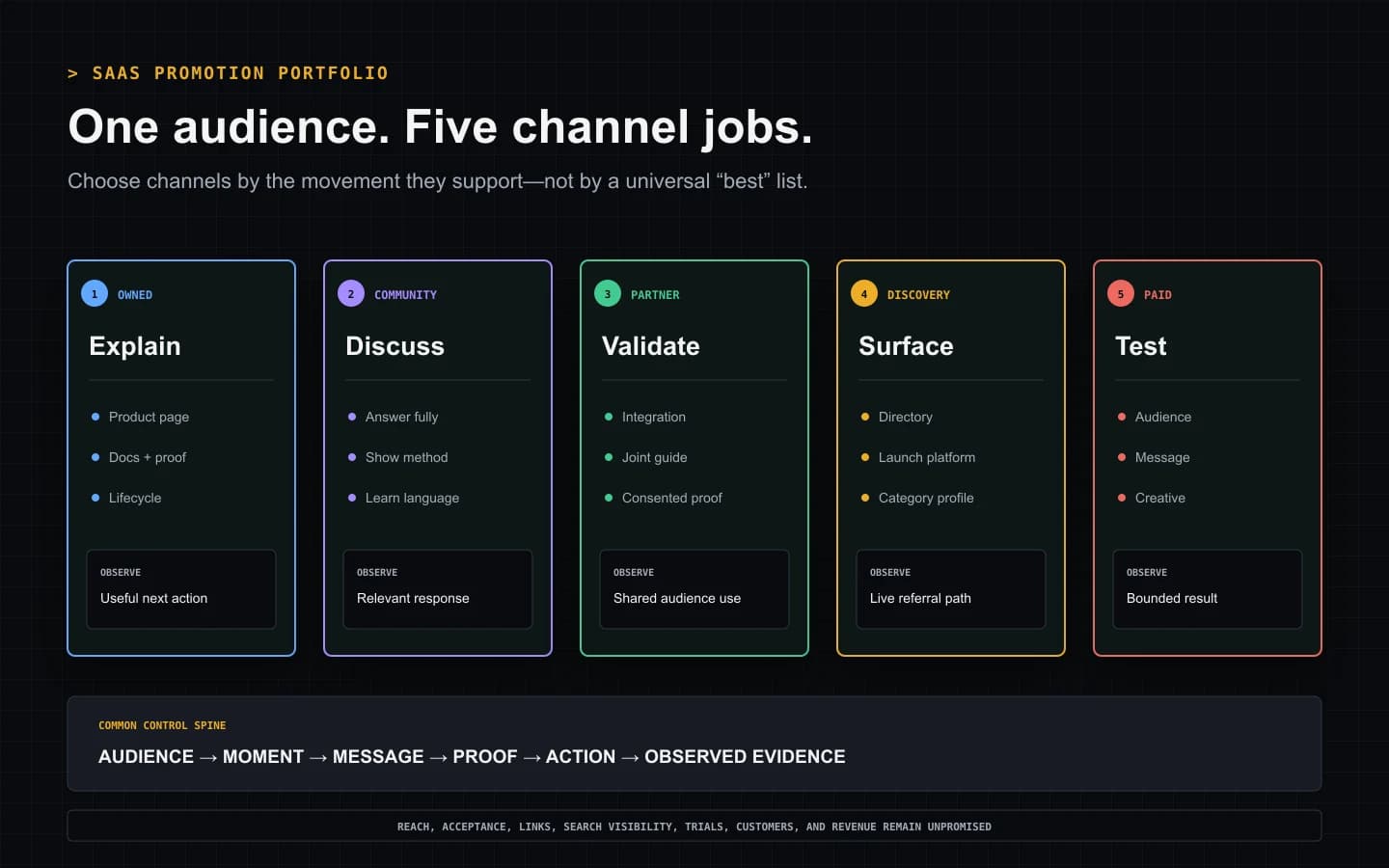
To promote a SaaS product, choose one audience in one moment, give that audience a relevant reason to act, and use a small mix of channels to move people toward a working product step. The channel mix can include your own site, communities, partners, directories, launch platforms, lifecycle messages, and paid distribution. Each needs a defined job.
A directory profile can make the product discoverable in a relevant category. A community answer can resolve a specific problem. A partner guide can validate a working integration. An advertisement can test a message with a bounded budget.
Google lists social promotion, community engagement, advertising, and word of mouth among ways to promote a site. It also warns that people can tire of overpromotion and that some practices may look like search manipulation. That is a useful product-marketing boundary: distribution should help an intended audience make progress, not manufacture attention or ranking credit.
No plan can guarantee reach, acceptance, backlinks, crawling, indexing, rankings, traffic, trials, customers, pipeline, or revenue. The practical goal is to run observable promotion work and make the next decision with better evidence.
Pass a product-journey gate before adding reach
Promotion magnifies what happens after a person arrives. Do not increase reach until one complete visitor journey works:
- Promise: A specific audience can understand the problem and outcome without decoding internal product language.
- Proof: The page demonstrates the capability with current screenshots, documentation, a working example, a transparent method, or permitted customer evidence.
- Destination: The campaign points to the page that supports its exact message, not automatically to the homepage.
- Next action: A visitor can try, evaluate, compare, contact, subscribe, or read the implementation detail without hitting a broken path.
- Ownership: Someone can answer questions and correct stale claims.
- Measurement: The team knows which visits and product actions are collected and which remain uninstrumented.
Google's people-first questions ask whether content serves an intended audience, shows first-hand expertise, has a clear purpose, adds original information, and helps someone achieve a goal. Use those questions to inspect the destination. They are not a formula for ranking or conversion.
For a new product, the launch-reference readiness guide provides a narrower check for stable facts and first public references. This page begins after the broader visitor journey can withstand attention.
Choose an audience moment before a channel
“SaaS buyers” is too broad for a campaign. Name the person, the situation, and the decision they are making.
- A problem-aware operations lead needs language for an expensive manual task.
- A solution-aware developer needs to confirm permissions and implementation limits.
- A comparing buyer needs explicit criteria, pricing context, and evidence.
- A new user needs a working first outcome.
- An existing user needs a reason to adopt another workflow or invite a team.
Write one promotion sentence:
Help this audience, in this situation, use this proof to complete this next action.
The sentence determines the channel. A technical implementation belongs in documentation, a developer community, or an integration guide. A category comparison may fit search content, a specialist directory, or an evaluation newsletter. A release for current users belongs in lifecycle communication before it becomes a broad announcement.
Do not publish the same generic description everywhere. Preserve the same product facts, then adapt the explanation to the audience's current question.
Make owned surfaces the conversion foundation
Owned surfaces are the pages and messages the product team controls: product pages, documentation, templates, reports, email, in-product education, and release notes. They turn temporary attention into something a visitor can use or revisit.
Build one canonical campaign destination with a single primary action. Support it with proof that suits the claim: a walkthrough for a workflow, methodology for a benchmark, limitations for a comparison, permission for a testimonial, or setup detail for an integration. Remove unsupported superlatives and out-of-date interface claims.
Then create a compact promotion pack:
- one factual sentence about the product and audience;
- one problem-and-outcome explanation;
- one proof asset with a stable URL;
- one maintained image or short demonstration;
- one primary action and one fallback educational action;
- one disclosure record for compensation, affiliation, or customer permission.
This is not a copy-and-paste kit. It is the controlled source from which channel versions are reviewed. The details stay consistent while the context changes.
Earn community reach by being useful in place
Communities are not distribution endpoints waiting for links. They have their own membership, norms, archives, moderators, and tolerance for promotion.
Start with recurring questions the team can answer from product experience. Explain the method fully enough to be useful without a click. Link only when a resource materially supports the answer and the rules allow it. State your affiliation. If the product is not necessary to answer the question, do not force it into the response.
Community evidence includes accepted contributions, relevant replies, questions that improve the product message, and referred visits where attribution is available. Volume alone is weak evidence. Repeated link drops, automated comments, copied answers, hidden identities, and keyword-rich signatures create attention without trust and can also create search-policy risk.
Use the language people use in real questions to improve owned explanations. Do not convert private or sensitive community details into marketing material.
Turn real relationships into partner distribution
Partnership promotion works when the relationship already helps a shared audience. A working integration can support setup documentation, a webinar, a marketplace entry, a migration guide, or joint education. A consented customer story can show a specific workflow and its limits. An implementation partner can explain where responsibilities meet.
Define who owns claims, approvals, support, updates, and removal. Give every joint asset a stable destination and review date. A logo wall without permission or an “integration” without a working connection is not useful proof.
Commercial relationships need visible treatment. FTC guidance says endorsements must be truthful and not misleading, and material connections that could affect how people evaluate them should be disclosed. Google separately identifies product-for-linked-coverage and paid ranking links as link-spam risks. Do not hide payment, free access, affiliate terms, employment, or another material relationship.
If a paid or sponsored page links to the product, Google recommends
rel="sponsored"; nofollow remains acceptable. Honest qualification does not
erase referral value, and a standard link does not prove independent
endorsement.
Give directories and launch platforms one clear role
Directories and launch platforms can provide category discovery, a structured public profile, a launch moment, or a referral path. Those are supporting promotion jobs—not a complete go-to-market plan.
Before submitting, inspect the audience, category, eligibility, moderation, profile fields, correction route, payment, outbound destination, and link relationship. The directory-quality guide provides the detailed review. Prepare accurate copy and current media, but adapt the profile to the platform's users rather than duplicating the product page.
Separate launch activity from evergreen maintenance. A launch platform may concentrate attention around a date and require active participation. A directory may remain useful as a maintained category record. Record the actual publication state and revisit facts when pricing, positioning, screenshots, or availability change.
Google's spam examples include low-quality directory links, automated link creation, excessive exchanges, and links purchased for ranking purposes. That does not make every directory profile improper. It means audience value, editorial control, acquisition method, payment, and relationship qualification matter. Do not select a directory only because it advertises authority or “dofollow.”
Help interested people return
Many people will not act during the first visit. Lifecycle promotion helps an interested audience return when new evidence or product progress matters.
Use permission-based email, in-product education, release notes, documentation updates, and account messages for specific changes. Segment by what the person asked to receive or what the product legitimately knows, not by an invented intent score. Give each message one useful next step and a clear path to change preferences.
Google's starter guide specifically notes recurring newsletters with audience permission as one way to announce new site content. A lifecycle message should still earn the return visit: a new integration guide, resolved limitation, useful template, or material release is stronger than repeating “check us out.”
Measure the action the message was designed to support. Opens or clicks do not automatically establish activation, retention, or revenue.
Use paid promotion as a bounded test
Paid distribution can test an audience, message, creative, or destination without waiting for organic reach. Set a fixed scope, named owner, stop date, and maximum spend before the campaign begins.
Change one major variable at a time. If the ad earns attention but the landing page produces no instrumented next action, inspect message-to-page continuity before buying more visits. If the audience does not engage with a proven destination, revise the targeting or stop the test.
Do not present one campaign as a universal acquisition benchmark. Platform auctions, targeting, creative, season, market, price, attribution, and product readiness differ. Preserve spend, delivered impressions, visits, and instrumented actions as separate observations.
Paid coverage, native advertising, sponsorships, affiliates, and creator endorsements also require appropriate relationship disclosure. Payment can buy distribution; it cannot buy an honest independent opinion or a guaranteed search result.
Run one promotion control board
Keep the portfolio in one reviewable record:
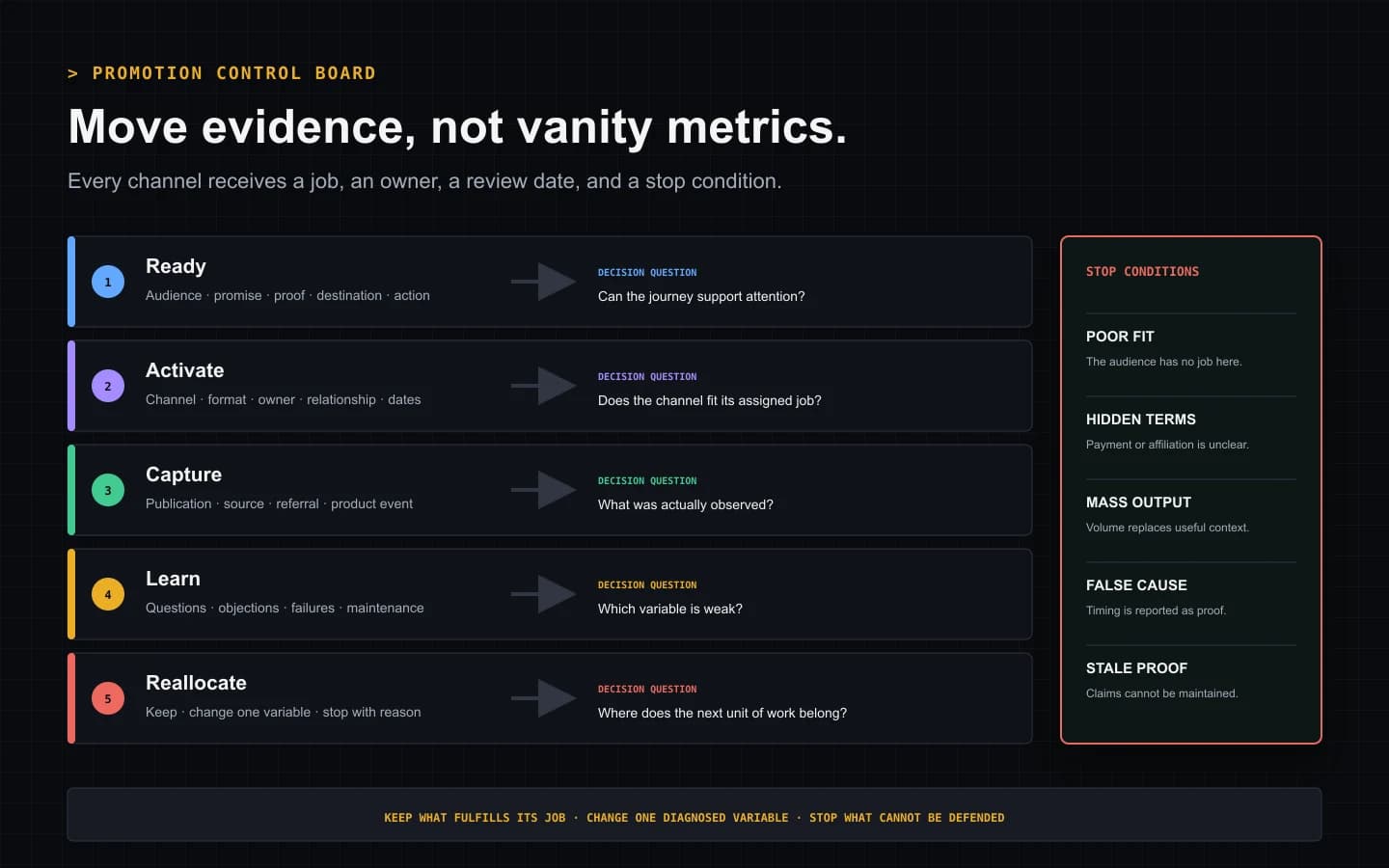
| Control | Record | Decision question | | --- | --- | --- | | Ready | Audience, promise, proof, destination, action | Can the journey support attention? | | Activate | Channel, format, owner, relationship, dates | Does this channel fit its assigned job? | | Capture | Publication, campaign source, referral, product event | What was actually observed? | | Learn | Questions, objections, failures, maintenance work | Which variable is weak? | | Reallocate | Keep, change, or stop with a reason | Where does the next unit of work belong? |
Google Analytics documents utm_source, utm_medium, and utm_campaign for
identifying campaign referrals. Use a consistent, case-sensitive naming
convention on links you control so one campaign is not fragmented across report
rows. Do not overwrite or demand tracking parameters on independent editorial
links; preserve referrer and landing-page evidence when available.
Search Console can group search performance by canonical page, query, device, country, and search appearance, subject to its reporting limits. Review search evidence separately from campaign referrals and product actions. A change that follows promotion is not, by timing alone, proof that one placement caused it.
Where SubmitForBacklinks fits
SubmitForBacklinks is one directory lane. Its guidelines require a real product, accurate copy and media, authorization, reviewed generated content, and moderation. Run the submission checklist before using it. Featured never bypasses review.
The owner dashboard currently reports listing views, unique views, outbound clicks, unique clicks, and CTR for listing surfaces. Human outbound navigation adds source, medium, campaign, and content attribution while the stored destination remains canonical. Those observations describe activity from this directory; they do not prove every external campaign or any search effect.
The current pricing terms offer a $0 Free path with weekly reservation and reciprocal badge requirements for time-limited standard-link treatment, plus a one-time $8.99 Featured path that skips the badge and weekly queue after approval. These are owner-selected product rules.
Paid standard-link treatment and required reciprocal links carry material Google-policy risk. A verified badge, paid placement, or delivered unqualified link is not Google approval and cannot guarantee rankings or traffic. Inspect the delivered relationship, decide whether the audience and terms fit, and submit one accurate product only as part of a wider promotion plan.
Reallocate by evidence
Keep a channel when it performs its assigned job and the work remains accurate, disclosed, and maintainable. Change one diagnosed variable when the audience, message, proof, destination, format, or follow-up is weak. Stop when the channel depends on poor fit, hidden relationships, mass posting, unsupported claims, or outcomes the evidence cannot show.
Promotion is not maximum presence. It is a controlled process for helping the right audience discover, understand, evaluate, try, and return to a product. Build the journey first, give each channel one job, preserve what happened, and move effort according to observed usefulness rather than promises.
SaaS Product Promotion System
A 24-second system for readying a SaaS journey, choosing channel roles, activating proof, capturing evidence, and reallocating promotion work.
Video transcript
Ready the journey by confirming the promise, proof, destination, next action, owner, and measurement boundary. Choose one audience moment and give selected channels distinct jobs: explain, discuss, validate, discover, or test. Activate one adapted proof pack across owned, community, partner, directory or launch, lifecycle, and paid surfaces without duplicating copy. Capture delivered publication, campaign attribution, referral behavior, and instrumented product actions while leaving unknowns unknown. Rebalance by evidence: keep a channel that fulfills its job, change one diagnosed variable, or stop weak fit, hidden relationships, and unsupported claims.
Sources and verification
Product behavior was checked against the current implementation and automated tests. External policy sources are linked directly.
- Google guidance for promoting a website — checked July 30, 2026
- Google guidance for creating helpful content — checked July 30, 2026
- Google Analytics campaign URL guidance — checked July 30, 2026
- FTC endorsement and influencer guidance — checked July 30, 2026
- Google Search spam policies: link spam — checked July 30, 2026
- Google Search Console performance documentation — checked July 30, 2026
Put the workflow into practice
Use the guided terminal flow or review the supporting documentation before submitting a product.
Related resources
Backlinks for a New SaaS: What to Pursue First
Prioritize realistic backlinks for a new SaaS using launch readiness, relationship proximity, reviewed profiles, verification, and policy-aware limits.
Open resourceHow to Build a SaaS Backlink Strategy You Can Measure
Build a SaaS backlink strategy around audience fit, linkable evidence, source relevance, policy risk, attribution, and measurable business outcomes.
Open resourceAre Directory Backlinks Good for SEO? Use This Quality Test
Learn when directory backlinks are useful, how to inspect relevance, editorial controls, crawlability, paid-link treatment, and spam risk.
Open resourceDofollow vs Nofollow Backlinks: What Actually Changes
Compare dofollow and nofollow backlink HTML, sponsored and UGC values, Google’s hint model, and a repeatable way to inspect real links.
Open resource