Submission automation controls
How Automated Backlink Submission Should Work
A responsible system automates public-data collection and repeatable transport without automating away truth, owner consent, relevance, or editorial review.
- Reviewed by
- SubmitForBacklinks Editorial Team
- Published
- Updated
- Checked
The short answer: automate repetition, not judgment
Automated backlink submission is safest when software handles repeatable mechanics while people retain responsibility for truth, relevance, consent, and publication. A useful system can scan a public product website, normalize listing fields, preserve an authenticated owner session, retry an interrupted request safely, and report status. It should not invent product claims, submit to unrelated sites, impersonate an owner, bypass editorial review, or promise rankings.
That distinction separates a controlled submission workflow from a bulk link campaign. The goal is not to manufacture the largest possible number of links. The goal is to prepare one accurate submission for a relevant destination, record the owner’s reviewed choices, and make every mutation recoverable and auditable.
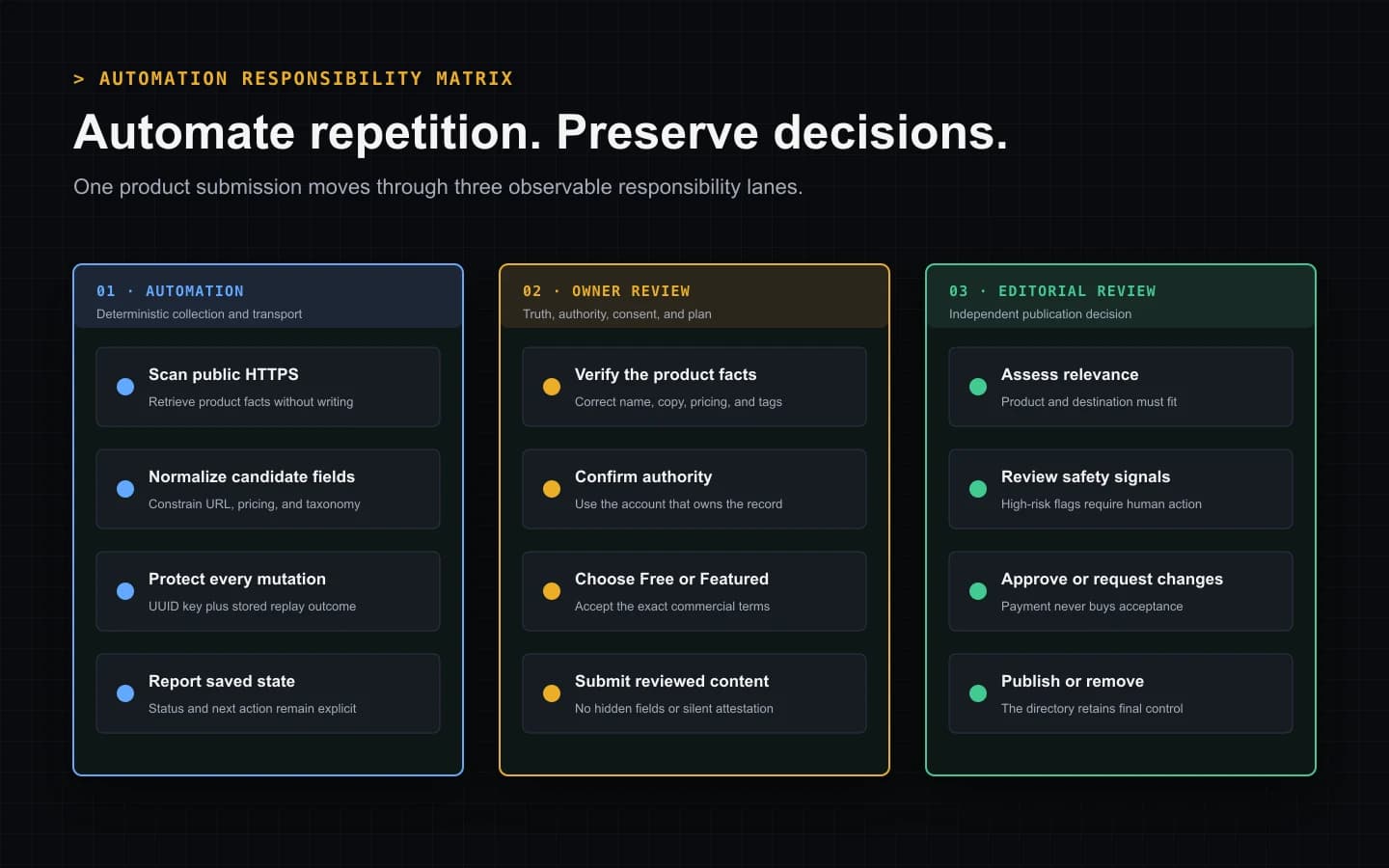
SubmitForBacklinks uses three responsibility lanes:
- Automation collects public facts and performs deterministic transport.
- The product owner reviews the facts and chooses whether to submit.
- The directory editor decides whether the listing is suitable to publish.
The diagram above maps those lanes. If a product collapses all three into an unattended “build links” button, the missing controls matter more than the time it claims to save.
Start by identifying the real unit of work
The phrase “automated backlink submission” can describe two very different activities. One is a controlled workflow for a known product and destination. The other is indiscriminate distribution across a large list of websites.
In the controlled model, the unit of work is an owner-reviewed listing. It has a canonical product URL, a truthful draft, an authenticated account, an explicit plan choice, a unique request identity, and an editorial outcome. A failure can be traced to one stage and retried without guessing whether the previous request succeeded.
In the bulk model, the unit of work is often a target count. The service may optimize for the number of forms completed rather than the relevance or accuracy of each destination. That creates predictable problems: duplicated descriptions, wrong categories, stale pricing, unauthorized claims, and links from pages that provide little value to the product’s actual audience.
A target count is not evidence of a useful backlink. Before evaluating any automation service, ask what durable record exists for each submission and who reviews the data before it leaves the system.
What responsible automation should handle
Good automation removes mechanical work that is easy to repeat and easy to verify. For a SaaS directory submission, five tasks fit that description.
Public website scanning
The system can retrieve a public HTTPS page and identify candidate product facts such as name, tagline, pricing model, platform, category, and descriptive tags. This saves retyping, but the output remains a proposal. A polished landing page can still contain outdated pricing or broad marketing copy that does not fit a directory field.
The scan should be non-writing. It should not reserve capacity, create an owner record, or publish anything merely because a URL was entered. Keeping discovery separate from mutation lets a user inspect a weak result and stop.
Structured normalization
Directories need consistent values. Automation can map a phrase such as “free plan plus paid upgrades” to a supported pricing option, normalize a bare domain to HTTPS, and constrain a category to the current taxonomy. These transformations should be visible in the reviewed draft rather than hidden inside the submission request.
Authenticated transport
The request that creates or updates a listing must be tied to an authorized account. A browser authorization flow can establish that ownership without requiring the person to paste a long-lived secret into a command. The credential proves which account owns the record; it does not prove that every fact inferred from a public website is correct.
Safe retry behavior
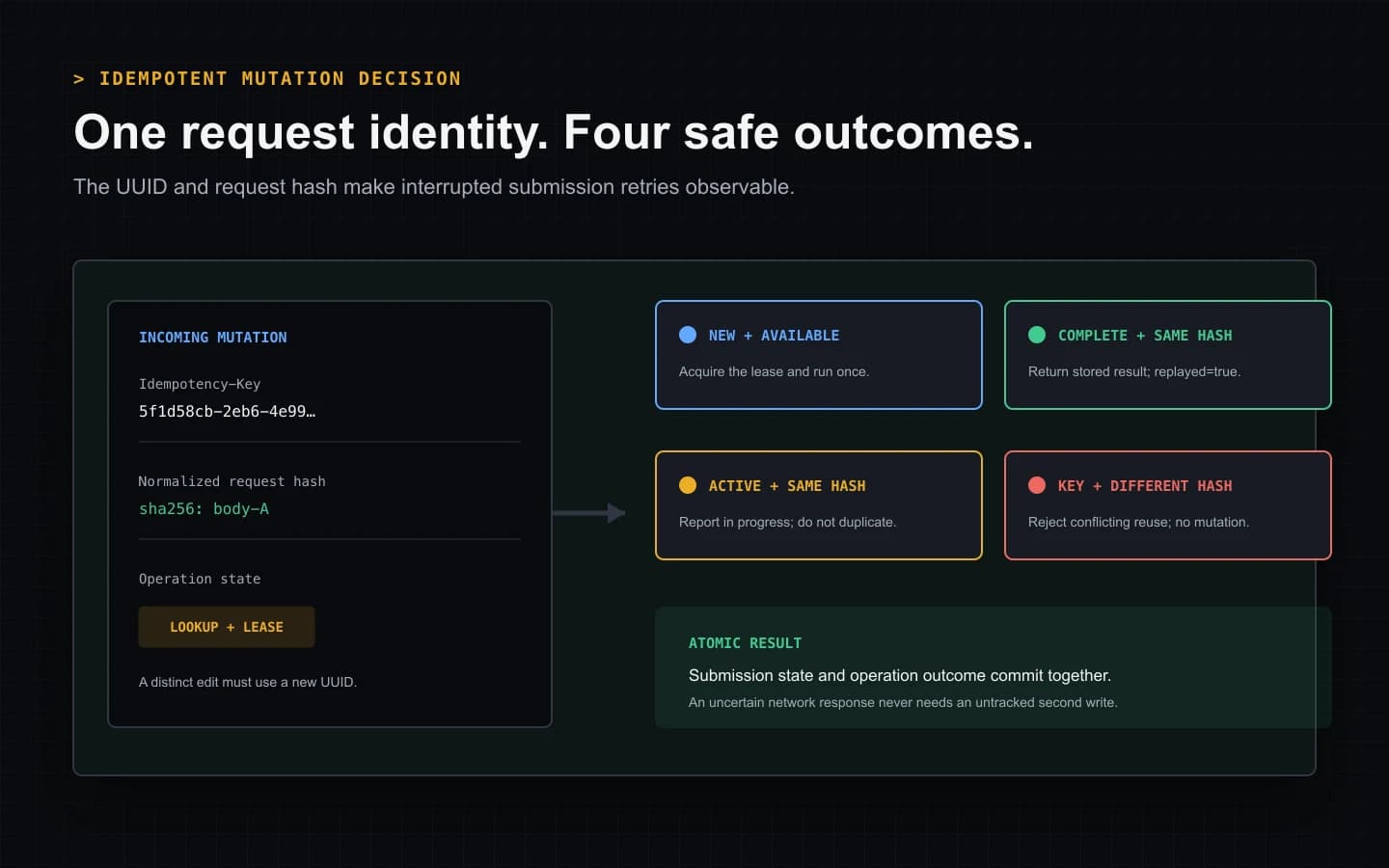
Networks fail at awkward moments. A client may send a request, lose the response, and be unable to tell whether the server committed the action. The right response is not to send an untracked duplicate. A mutation should carry a unique idempotency key that identifies that exact attempt.
SubmitForBacklinks requires a UUID idempotency key for agent mutations. An identical retry can return the stored completed result. Reusing the same key with a different body is rejected, and an operation that is still running is reported as in progress. Those rules turn an uncertain retry into a deterministic state transition.
Status and next-action reporting
Automation should say what happened and what remains. A saved Free submission needs a launch week and reciprocal-badge step. A saved Featured-intent submission needs checkout. Both still need editorial review. “Submitted” is not a synonym for “published,” and “published” is not a guarantee that a search engine will index or value the page.
What the owner must still decide
The owner is responsible for decisions that require authority or context. Before submission, that person should verify the canonical product URL, name, tagline, descriptions, category, pricing, platform, and tags. They should also confirm that they can represent the product and that the selected listing option matches the intended commitment.
This review is not ceremonial. A scanner cannot reliably decide whether a temporary promotion is the normal price, whether a feature is generally available, or whether a broad category reflects the product’s primary use. It also cannot consent to submission guidelines on behalf of a company.
For the Free path, the owner selects an available launch week and accepts the reciprocal-badge requirement used by the current product policy. For Featured, the owner chooses the one-time checkout path without a weekly queue or badge. Payment changes the commercial entitlement after approval; it does not buy an editorial decision.
What editorial review must retain
Editorial review protects the destination and its visitors. An editor can evaluate whether the product is legitimate, the page is useful, the category is appropriate, the copy is comprehensible, and a safety flag needs human judgment. Automation may provide evidence, but it should not silently override a moderation decision.
The same rule applies to a high-risk automated screen. A risk signal should route the record to an explicit human action rather than make publication impossible or approve it automatically. The final state should record whether the editor approved, requested changes, rejected, or removed the listing.
Keeping this lane separate also makes commercial terms clearer. Featured placement can affect queueing, display, and link treatment under the published product policy, while editorial acceptance remains independent.
A tested idempotent replay
Consider a client creating one reviewed draft. It generates a UUID, sends the request, and then loses the connection before receiving a response.
Attempt 1
key: 5f1d58cb-2eb6-4e99-8a66-e9e8059d64d1
body hash: A
result: committed, response interrupted

Attempt 2
key: 5f1d58cb-2eb6-4e99-8a66-e9e8059d64d1
body hash: A
result: stored response, replayed=true

Unsafe reuse
key: 5f1d58cb-2eb6-4e99-8a66-e9e8059d64d1
body hash: B
result: conflict; no second mutation
The key is not a permanent draft identifier and should not be reused for the next edit. Each distinct mutation receives a new key. The same key is reused only when retrying the identical operation.
The supporting diagram on this page shows the decision table behind that behavior: the request body, operation state, and lease ownership determine whether the server starts work, returns a replay, reports an operation in progress, or rejects conflicting reuse. The integration suite also checks that the submission record and operation outcome commit atomically, preventing a stale worker from leaving an orphaned listing after another request takes over.
Unlimited does not mean unconstrained
The current agent capability contract reports no application quota for general agent requests, anonymous or authenticated website scans, or submission creation. That removes a daily submission-count barrier for owners managing many legitimate products.
It does not remove every real constraint. The scanner still depends on the target website responding. Free listings use shared weekly launch capacity. Badge verification has bounded hourly controls to prevent repeated checks from overloading either side. Request-size, authentication, validation, duplicate identity, moderation, and billing rules still apply.
This distinction is important when assessing a tool. “Unlimited submissions” should describe the absence of an application quota, not imply guaranteed fetching, acceptance, publication, backlink permanence, or results.
Warning signs in an automated service
Treat the following behaviors as reasons to stop and inspect the workflow:
- it submits before showing the extracted fields;
- it cannot identify the account or person responsible for the product;
- it reuses one generic description across unrelated directories;
- it chooses targets only by a third-party authority metric;
- it hides whether a request was created, retried, or duplicated;
- it treats payment as guaranteed editorial acceptance;
- it promises a Domain Rating increase, indexing date, traffic, or ranking;
- it cannot remove or correct a listing after publication; or
- it creates links primarily to manipulate search ranking.
Google’s spam policies list automated programs or services that create links for ranking manipulation among link-spam examples. They also identify paid links that pass ranking credit, excessive link exchanges, and low-quality directory links as potential problems. Automation is not automatically spam, but the purpose, destination, claims, and link arrangement matter.
SubmitForBacklinks currently uses standard links for approved Featured listings and time-limited verified reciprocal-badge entitlements. The product owner has accepted the related Google policy risk. This guide documents that choice; it does not present the arrangement as Google-approved or promise a search outcome.
A control checklist for evaluating a workflow
Before trusting an automated submission product, answer these questions:
- Input: Does it scan only public, eligible URLs and show the source?
- Truth: Can the owner review every material field before submission?
- Authority: Is the mutation tied to an authenticated owner account?
- Consent: Are plan terms and required attestations explicit?
- Relevance: Is the destination appropriate for the product and audience?
- Retry safety: Can an interrupted mutation be replayed without duplication?
- State: Does the system distinguish scanned, saved, submitted, approved, published, rejected, and removed?
- Correction: Can the owner or administrator edit or permanently delete the record under the supported rules?
- Moderation: Does a human retain the publication decision?
- Claims: Does the service avoid guarantees about rankings, indexing, traffic, authority scores, or acceptance?
A system does not need a complicated interface to satisfy these controls. It needs an observable contract. A concise terminal prompt can be trustworthy when the state changes behind it are authenticated, validated, idempotent, and reviewable.
Apply the model to one submission
Use the guided terminal flow when you want to test the boundary with one SaaS product. The command scans the website, shows the proposed fields, asks for the listing choice, saves the reviewed record, and opens the appropriate next action. Developers can inspect the same lifecycle in the agent API reference.
Use the manual versus automated decision model to decide which steps remain owner-controlled before scaling the workflow.
Start with one product rather than a bulk target. Check whether the scan is accurate, the retry contract is clear, the owner dashboard reflects the saved state, and the editorial outcome remains independent. That small test reveals more about the quality of the automation than a promised directory count.
The expected outcome is a traceable submission with a known owner, reviewed content, safe replay behavior, and a clear next step. It is not guaranteed publication or SEO growth. Responsible automation earns its value by reducing repetition without removing the decisions that keep a directory useful.
For no-placement-fee acquisition beyond directory delivery, use the free backlinks for SaaS guide.
Safe Automated Backlink Submission
A 20-second first-party explanation of automated scanning, owner review, UUID retry safety, editorial review, and the explicit Free or Featured next action.
Video transcript
Start with one public product URL. Automation retrieves the page, normalizes candidate listing fields, and presents a draft without writing a record. The authorized owner reviews the facts, chooses Free or Featured, and submits the exact approved body. Every mutation receives a UUID idempotency key: an identical completed retry returns its stored outcome, while different content cannot reuse that key. Editorial review independently decides whether the listing is suitable to publish. The saved record then reports the next action, such as a Free launch week and reciprocal badge or a Featured checkout. This workflow reduces repetition without promising publication, indexing, rankings, traffic, or authority growth.
Sources and verification
Product behavior was checked against the current implementation and automated tests. External policy sources are linked directly.
- SubmitForBacklinks agent capability contract — checked July 30, 2026
- SubmitForBacklinks agent API reference — checked July 30, 2026
- SubmitForBacklinks terminal documentation — checked July 30, 2026
- SubmitForBacklinks submission guidelines — checked July 30, 2026
- Google Search spam policies — checked July 30, 2026
- Google guidance for helpful, reliable, people-first content — checked July 30, 2026
Put the workflow into practice
Use the guided terminal flow or review the supporting documentation before submitting a product.
Related resources
How to Submit a SaaS Listing With an AI Agent
Run one command, scan your SaaS website, review the listing, and submit it from your terminal with a clear Free or Featured next step.
Open resourceHow AI Agent Directory Submission Works
See how an AI agent discovers capabilities, uses scoped authorization, saves an owner draft, submits reviewed fields, and handles each result.
Open resource