Submission operating models
Manual vs Automated Directory Submission: Choose the Right Workflow
The useful choice is not person versus software. Separate repeatable mechanics from decisions that require product authority, destination context, exception handling, and independent editorial control.
- Reviewed by
- SubmitForBacklinks Editorial Team
- Published
- Updated
- Checked
The short answer: choose by decision load, not by label
Manual directory submission is useful when every destination has unusual rules, the product needs careful positioning, or the person submitting must resolve exceptions in real time. Controlled automation is useful when the inputs, validation, transport, retry behavior, and status checks are repeatable.
Most serious workflows need both. Software can prepare public product facts, normalize fields, preserve an authenticated session, retry an interrupted request safely, and record status. A product owner should still confirm the facts, choose the destination and plan, accept the relevant terms, and authorize the mutation. A directory editor should still control publication.
That is the practical difference between a hybrid operating model and an unattended bulk submission service. The hybrid model automates observable mechanics. It does not automate consent, invent claims, or treat publication as a purchased result.
This guide compares the operating models. For the controls inside an automated system, read the separate guide to automated backlink submission.
Define the three models before comparing them
“Manual versus automated” sounds binary, but it usually describes three different systems.
Fully manual
A person researches each destination, creates or claims the account, rewrites the product description, chooses categories, uploads assets, submits the form, handles verification, and records the outcome.
Manual work provides direct visibility into unusual forms and editorial rules. It does not guarantee accuracy. A rushed person can paste stale copy, select the wrong category, create a duplicate profile, lose a confirmation email, or fail to record what happened.
Unattended bulk automation
A tool distributes one profile to many destinations with little or no review. Its success measure is commonly an attempted or completed submission count. The owner may not see the final fields, account terms, destination relevance, or delivered listing.
That model is not simply “the faster option.” It changes who makes decisions and who bears cleanup risk. A count of form completions is not evidence that the destinations were appropriate, the copy was truthful, the links remained live, or any page was indexed or valued.
Controlled hybrid
A controlled system separates repeatable mechanics from judgment. Software prepares a draft and performs deterministic transport. The owner reviews the facts and authorizes the request. Exceptions return to a named person. The directory retains its editorial decision.
Hybrid does not mean inserting a ceremonial approval button into an otherwise opaque process. The review must expose the material fields, destination, commercial choice, attestations, and next action before anything is submitted.
Compare five factors that actually change the decision
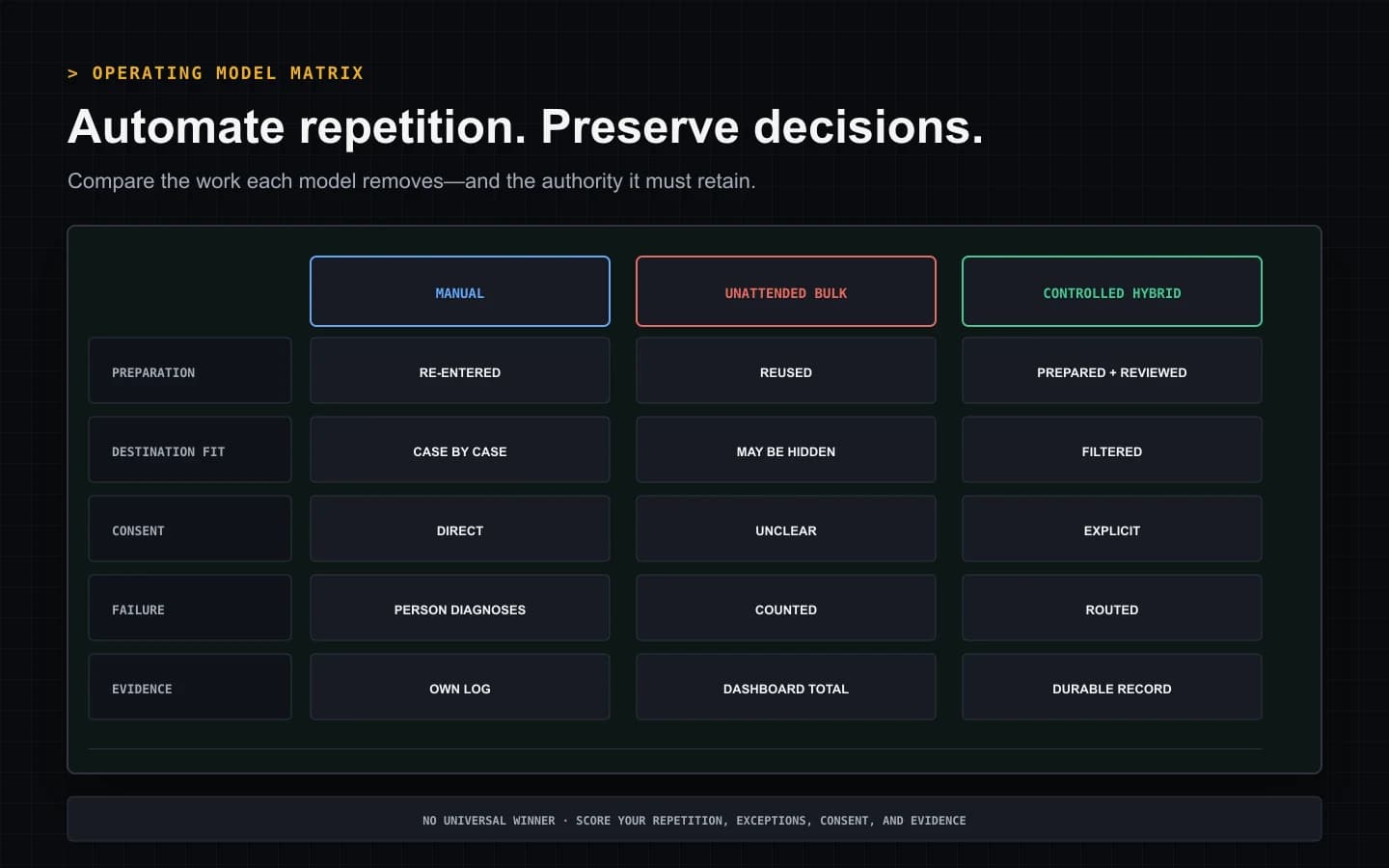
The hero matrix on this page compares each operating model across five factors: repetition, control, exception handling, consent, and evidence.
| Factor | Manual | Unattended bulk | Controlled hybrid | | --- | --- | --- | --- | | Repeated preparation | Re-entered by a person | Reused automatically | Prepared automatically, then reviewed | | Destination fit | Evaluated case by case | May be hidden or list-driven | Filtered first; exceptions return to an owner | | Material consent | Person acts directly | Can be unclear | Explicit owner action is recorded | | Failed submission | Person diagnoses it | May disappear into a count | State and retry identity remain inspectable | | Publication | Directory decides | Often reported ambiguously | Directory decision stays separate |
No column wins every row. Manual execution spends human attention on both decisions and repetition. Unattended bulk execution removes attention from both. Controlled hybrid tries to remove repetition while preserving decision ownership.
Inventory the work before estimating speed
Published comparisons often attach a universal number of hours to manual work or promise a fixed percentage of time saved. Those figures do not transfer cleanly between campaigns. A destination with a simple public form is not the same task as one requiring account recovery, new screenshots, category research, or a custom commercial agreement.
Use a work-unit inventory instead:
- List each destination you are genuinely considering.
- Record the fields, assets, account, verification, and policy checks it needs.
- Mark each task as repeated, destination-specific, or decision-bearing.
- Mark the exceptions that require a person with authority.
- Record what durable evidence should exist after completion.
Repeated tasks are candidates for automation. Destination-specific work needs adaptation. Decision-bearing work needs a person who can understand and accept the consequence.
This inventory supports a real pilot without inventing a forecast. Measure the actual preparation, review, exception, and follow-up work for your product. Do not substitute a vendor’s directory count for your own operating cost.
Accuracy comes from reviewable inputs
Manual entry and automated extraction can both be wrong. The useful distinction is whether the proposed data can be traced and corrected.
A scanner can collect candidate facts from a public product website: name, tagline, descriptions, pricing model, platform, category, and tags. That reduces retyping, but the result is still a draft. A temporary promotion can be mistaken for the normal price. A broad homepage statement can be unsuitable for a constrained directory field. A suggested category can be technically valid but unhelpful to visitors.
The owner should see every material value before submission and be able to replace it. The system should reject unsupported category values, malformed URLs, missing descriptions, and contradictory choices before transport. Automation earns trust by making correction cheaper, not by presenting inference as fact.
Google’s link best practices also emphasize crawlable anchors and descriptive, contextual anchor text. Neither a human nor a bot should use awkward keyword stuffing simply because a form accepts it.
Consent and authority cannot be inferred from a public website
A public product page does not prove that the person or agent reading it can represent the company. It also cannot accept submission terms.
The operating model needs an authority boundary. For SubmitForBacklinks agent workflows, the mutation is tied to an authenticated account. Before submission, the request records attestations that the owner is authorized, reviewed generated content, accepts the terms, and is not submitting prohibited material.
Those are decisions, not fields to auto-fill. A reusable profile may contain a company name and logo, but it cannot carry blanket consent into every future destination. Terms, link requirements, payment, publication rules, and data use can differ.
The same principle applies to commercial relationships. The U.S. Federal Trade Commission’s endorsement guidance says endorsements must be truthful and not misleading, and material connections that affect how an endorsement is evaluated should be disclosed. Automation should preserve required disclosures rather than optimize them away.
Safe transport needs a durable identity
Even a reviewed submission can fail after the request leaves the browser or terminal. The server may commit the mutation while the client loses the response. Sending the form again without a durable identity can create a duplicate or an uncertain second intent.
SubmitForBacklinks agent mutations use UUID idempotency keys. An identical retry can reuse the stored outcome. Reusing a key with changed intent is rejected. A new edit receives a new identity.
Manual workflows need the same discipline even if they implement it with a spreadsheet or task system:
- destination and account;
- exact profile version submitted;
- timestamp and responsible person;
- confirmation or request identifier;
- current state and next action; and
- correction or removal route.
Without that record, “manual” can mean an inbox search and “automated” can mean an unverifiable dashboard total. Evidence quality matters more than the label.
Keep editorial review independent
Submission, payment, and publication are separate states. A directory may approve, reject, request changes, delay, or remove a listing. A trustworthy workflow does not translate “request sent” into “backlink earned.”
The current product records editorial review separately from the owner’s submission. Featured intent can change commercial treatment after approval, but payment does not purchase editorial acceptance. Free intent uses shared launch capacity and the current reciprocal-badge requirement.
Google’s spam policies list automated programs or services used to create links for ranking manipulation, low-quality directory links, excessive exchanges, and certain paid arrangements among link-spam examples. The policy concern is not whether a keyboard or script entered the fields. Purpose, destination quality, link arrangement, and editorial independence matter.
Use a five-stage hybrid handoff
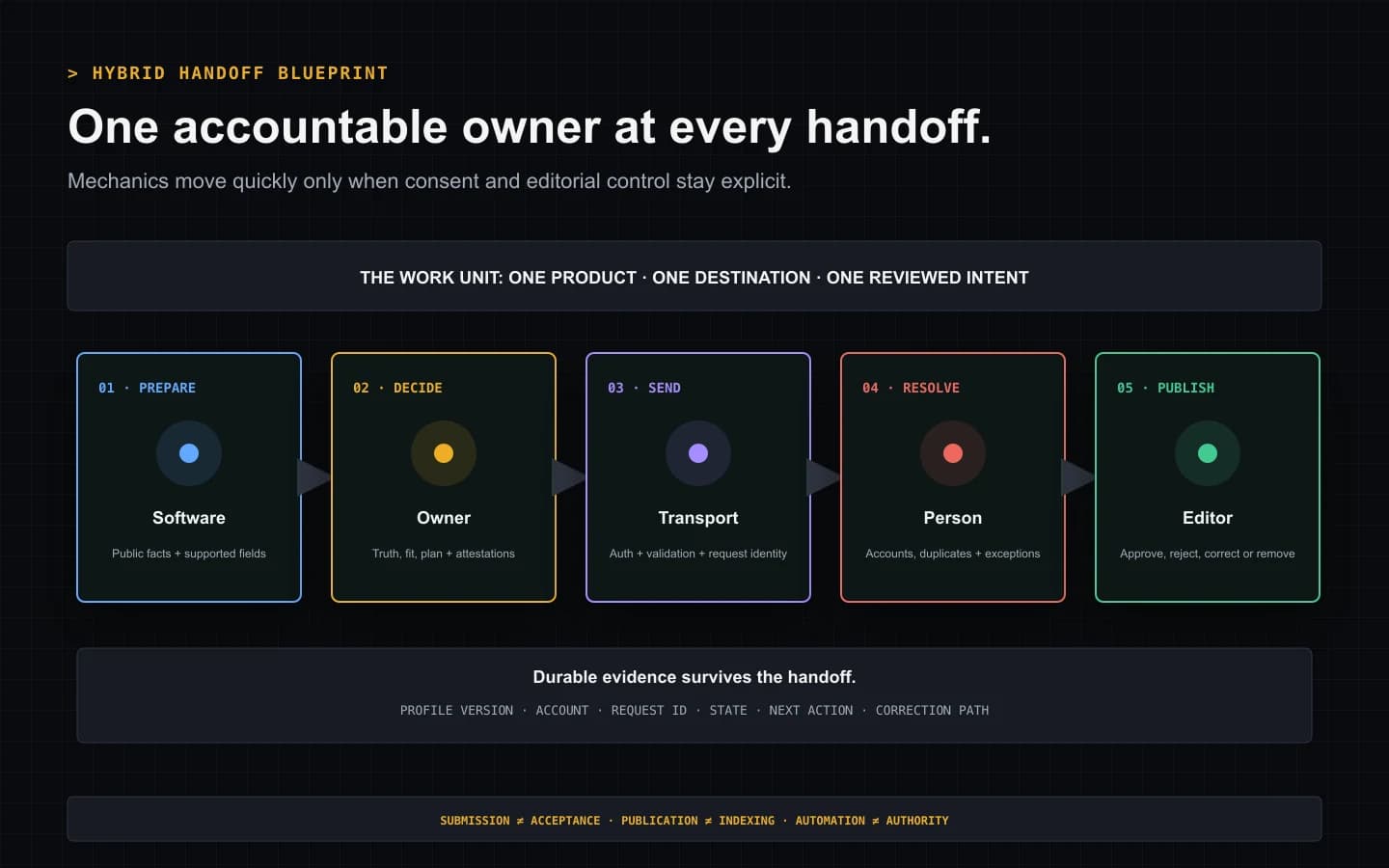
The supporting blueprint assigns one accountable owner to each stage.
1. Automation prepares
Collect public facts, normalize supported values, identify missing fields, and produce a source-linked draft. Do not publish or reserve a scarce resource during discovery.
2. The product owner decides
Verify the canonical URL, positioning, category, pricing, screenshots, destination fit, plan choice, and required attestations. Stop if the person cannot represent the product.
3. Deterministic transport sends
Authenticate the request, preserve its identity, validate the payload, and return a structured result. Retry only the identical intent with the same key.
4. A person resolves exceptions
Handle account verification, CAPTCHA, duplicate profiles, policy questions, custom fields, rejected assets, and changed terms. Do not hide exceptions inside a failure percentage.
5. The directory decides
Retain moderation, correction, removal, link qualification, and publication control. Report the actual state without promising acceptance, permanence, indexing, traffic, rankings, or authority.
When each model is a reasonable choice
Choose mostly manual execution when the campaign is small, each destination is materially different, the category is regulated or sensitive, the listing requires negotiation, or the team has not yet established accurate reusable product data.
Choose controlled automation when the same verified fields recur, supported destinations have known contracts, mutations are authenticated and traceable, and exceptions reliably return to an authorized person.
Choose hybrid when repeated preparation and status tracking are substantial but destination fit, consent, copy, commercial choices, or editorial exceptions still require judgment. That is a common operating shape, but it is not a universal recommendation. Your work-unit inventory should decide.
Avoid unattended bulk submission when the service cannot show the destination list, reviewed fields, responsible account, submission evidence, failure states, or correction path. Stop if it promises ranking, indexing, traffic, Domain Rating, acceptance, or a permanent link.
If a third party will operate the workflow, evaluate its managed-service scope, evidence, account controls, and offboarding separately from the manual-versus-automation decision. Software mechanics do not define who may represent the product or who owns the delivered records.
Pilot one reversible submission
Start with one relevant destination. Freeze the reviewed profile version, record the operating model, and observe every handoff from preparation through the directory’s response. Count corrections and exceptions. Confirm who can edit or remove the result.
You can use the guided terminal workflow to inspect a first-party controlled submission, or review the submission guidelines before choosing a plan. The expected result is a traceable request and an honest next state—not a promised backlink or search outcome.
SubmitForBacklinks currently uses standard links for approved Featured
listings and time-limited verified reciprocal-badge entitlements. The product
owner has accepted the related Google policy risk. Google recommends
rel="sponsored" for paid placements in its
outbound-link guidance.
This guide discloses the difference; it does not claim Google approval.
Choose the operating model that makes truth, authority, exceptions, and editorial control easiest to inspect. Speed matters only after those boundaries survive the workflow.
Choosing a Directory Submission Operating Model
A 20-second decision sequence for separating repeatable submission mechanics from owner and editorial judgment.
Video transcript
Inventory one campaign by separating repeated preparation, destination-specific work, and decisions. Compare fully manual execution, unattended bulk submission, and controlled hybrid operation. Assign public-fact preparation to software, truthful fields and consent to the product owner, authenticated delivery to deterministic transport, unusual accounts or duplicates to a person, and publication to the directory editor. Pilot one reversible submission with a frozen profile version. Record the account, request identity, state, next action, and correction path. A request sent is not editorial acceptance, publication, indexing, ranking, traffic, or authority.
Sources and verification
Product behavior was checked against the current implementation and automated tests. External policy sources are linked directly.
- SubmitForBacklinks agent API reference — checked July 30, 2026
- SubmitForBacklinks submission guidelines — checked July 30, 2026
- Google Search spam policies: link spam — checked July 30, 2026
- Google guidance for crawlable links and anchor text — checked July 30, 2026
- Google guidance for qualifying outbound links — checked July 30, 2026
- FTC endorsement guidance — checked July 30, 2026
Put the workflow into practice
Use the guided terminal flow or review the supporting documentation before submitting a product.
Related resources
How Automated Backlink Submission Should Work
Learn which backlink submission tasks to automate, which controls need human review, and how idempotent retries prevent duplicate actions.
Open resourceHow to Submit a SaaS Listing With an AI Agent
Run one command, scan your SaaS website, review the listing, and submit it from your terminal with a clear Free or Featured next step.
Open resource