Current startup company-profile shortlist
Best Startup Directories for Verifiable Company Profiles
Match one startup to a current company-profile job, official create-or-claim route, accountable owner, and maintenance plan. No proxy ranking turns a profile into a promised outcome.
- Reviewed by
- SubmitForBacklinks Editorial Team
- Published
- Updated
- Checked
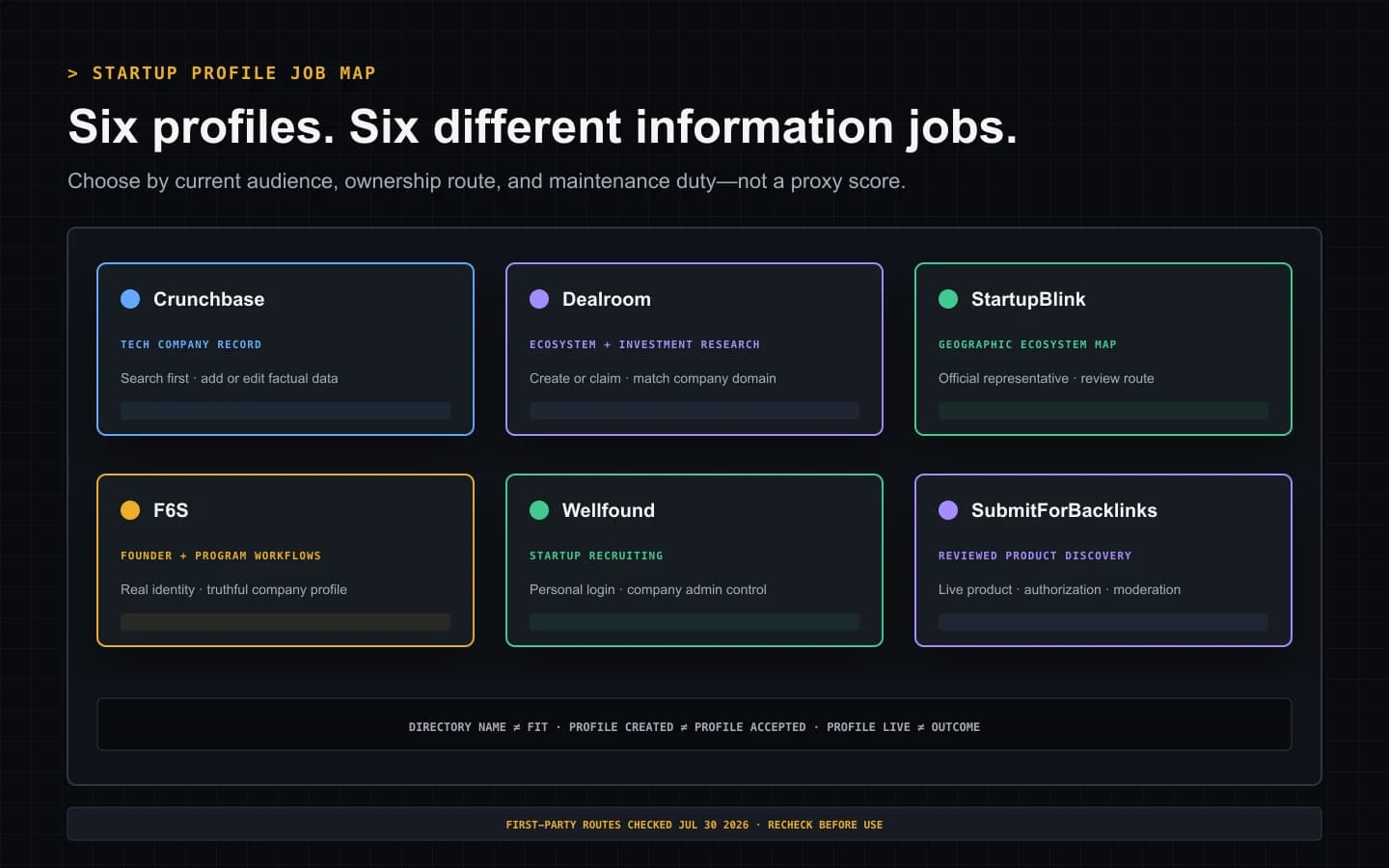
Direct answer: choose a company-profile surface by its information job
The best startup directories are not one ranked list. They are current company-profile systems that serve a specific audience and let an authorized operator create, claim, or maintain an accurate record. As of July 30, 2026, six options with checkable first-party routes are Crunchbase, Dealroom, StartupBlink, F6S, Wellfound, and SubmitForBacklinks.
Use Crunchbase or Dealroom when the primary job is company and ecosystem research. Use StartupBlink when location and startup-ecosystem mapping are material. Use F6S when the company needs a startup-community profile connected to programs and opportunities. Use Wellfound when the profile supports real startup hiring. Use SubmitForBacklinks when a live product or public preview fits a reviewed product-discovery directory.
This is a fit map, not a performance ranking. Inclusion does not guarantee eligibility, acceptance, publication, crawling, indexing, rankings, traffic, funding, applicants, customers, authority, or link equity. Platform rules and profile fields change, so recheck the cited official route before preparing a record.
How this startup directory shortlist was built
A service appears here only when a July 30, 2026 first-party source verifies three things: a current company-discovery surface, a route for a founder or authorized operator to create or manage a profile, and a clear audience or use-case boundary. Each option also needs a plausible maintenance path; a profile that cannot be corrected is a liability, not an asset.
The review deliberately excludes domain-rating tables, traffic estimates, assumed link attributes, reported approval speed, and vendor claims about search outcomes. It also separates persistent company profiles from launch events. Product Hunt, for example, documents a scheduled product-post workflow and featuring criteria. That makes it relevant to a launch-platform evaluation, not interchangeable with every directory below.
The six options are non-ranked:
| Directory | Profile's information job | Use it when | Stop when | | --- | --- | --- | --- | | Crunchbase | Technology-company record | The company belongs in the tech ecosystem and an owner can maintain factual company data | A duplicate exists or the organization is outside the platform's scope | | Dealroom | Startup, ecosystem, and investment research | A founder can claim or create the company and keep sector, location, team, and funding facts current | The owner cannot verify the profile or domain | | StartupBlink | Geographic startup-ecosystem map | Location, industry, and ecosystem identity are accurate and useful discovery context | The submitter is not an official representative | | F6S | Founder, company, and startup-opportunity network | The technology startup will use a truthful company profile for programs, community, or recruiting | The team cannot maintain an authorized, accurate record | | Wellfound | Startup recruiting and employer profile | The company is actively building an employer presence or hiring | There is no recruiting use or authorized profile administrator | | SubmitForBacklinks | Moderated product-discovery profile | A real product or public preview fits the current taxonomy and guidelines | The startup is only an idea, the copy is unsupported, or no owner can respond |
Crunchbase: maintain a technology-company record
Crunchbase's current profile guide says a registered, socially authenticated user can add a profile. It tells contributors to search first so they do not create a duplicate, then choose a profile type and enter the available details. A company record can include a logo, founded date, website and social links, descriptions, headquarters, industries, founders, funding rounds, employees, board members, and advisers. Some system-generated fields are not editable.
This route fits a startup that belongs in the technology ecosystem and can support those facts. Search the exact company name, former names, and domain before creating anything. If a record already exists, edit the existing entity through the documented controls instead of splitting the company's history.
Treat funding, people, location, and status as factual data. Do not add an unannounced round, inflate an employee count, or assign a category because it sounds valuable. Assign one company owner to recheck the record after a name, domain, headquarters, leadership, or financing change.
Dealroom: claim a startup and ecosystem research profile
Dealroom's current help center documents creating, claiming, and editing a company profile. A registered user should search first; if no entity exists, the interface offers an “Add your entity” route requiring the company name, website, and LinkedIn company profile. Claiming is designed around a company email whose domain matches the website, with support available when those domains differ.
After access is established, editable areas can include location, tags, company details, financials, funding rounds, and team information. Dealroom says its profiles are used by founders, investors, and analysts to follow company developments and investments. That makes it a fit when startup research and ecosystem classification are the real information jobs.
Prepare evidence for the legal or public name, current website, sector, location, team, and disclosed financing before editing. Do not turn a pitch into a factual field. If the site already has a profile, claim and correct that record rather than manufacturing another entity.
StartupBlink: use ecosystem location as the discovery context
StartupBlink's live “Add startup” route adds a startup to its Global Startup Ecosystem Map. The current form requests the startup name, website, city, industry, subindustry, and a 30–350 character description; a logo is optional. It also requires the submitter to confirm that they are an official representative and warns that a domain mismatch may require verification. The submission is sent for review.
Choose this route when city, region, industry, and startup-ecosystem membership help someone understand the company. Confirm that the operating location and sector reflect the startup now, not an incorporation address the team no longer uses or a future market it hopes to enter.
Write the short description to identify the customer, problem, and current approach. Avoid awards, market-size numbers, or performance claims that the destination cannot support. A map submission remains under review and does not promise placement or any downstream result.
F6S: connect a truthful startup profile to founder workflows
F6S describes its service as a platform for technology startup founders, with startup programs, accelerators, grants, funding opportunities, benefits, recruiting, and company profiles. Its current terms require real personal and organization names, accurate and truthful information, and authority to act for any represented organization. The terms also state that entrepreneurs and companies supply profile content and that F6S may moderate it.
That makes F6S useful when the team will actually participate in its founder and company workflows. Establish the individual founder account and company ownership carefully; do not use a shared fictional persona. Keep the public description, team, location, stage, and program answers consistent with the company's current evidence.
An F6S profile is not proof that a startup qualifies for a particular accelerator, grant, investor, or benefit. Read each opportunity's own criteria and application terms. If the team only wants a passive backlink and will not maintain the company record, this route is a poor fit.
Wellfound: build a company profile for real recruiting
Wellfound's support center positions company profiles inside a startup hiring system. Its current setup guide requires a personal user profile, tells the operator to search for the company first, and provides recruiting onboarding when no company exists. A community-generated profile can be claimed through a review process; an existing managed profile requires permission from its administrator or help from support.
Use Wellfound when candidates are a genuine audience. The company page should help a person assess the product, team, culture, operating status, and current roles. Wellfound recommends keeping company information current and transparent because candidates use the page to research a startup.
Do not create the profile merely to occupy another domain. Name an authorized recruiting owner, document who can approve changes, and remove or close stale roles. The profile's value depends on truthful employer context, not on an assumed search benefit.
SubmitForBacklinks: a disclosed, reviewed product-directory option
SubmitForBacklinks is this publisher's first-party example, so its commercial and link policies require explicit disclosure. The current submission guidelines require a real product or public preview, people-first copy, accurate optional media, authorization, review of generated content, and moderation. Featured does not bypass review.
The directory suits a startup with something a visitor can inspect now. Current profiles use structured product details, a primary category, tags, canonical metadata, and a server-visible destination link. Only published records appear in public discovery. Inspect current profiles to decide whether the audience and taxonomy fit before opening the form.
Current paid Featured listings and active verified reciprocal Free listings use owner-selected standard-link treatment; other Free listings use nofollow. Those are product rules, not Google approval or a promise of ranking credit. Google's spam policies identify paid ranking links, excessive exchanges, automated link creation, and low-quality directory links as examples of link spam. Record the actual relationship and evaluate the risk independently.
If the product fits, use the submission checklist and submit an accurate product. A paid or reciprocal choice does not convert moderation into endorsement.
Verify one profile before adding another
Create a startup profile ledger with one row per service:
- official source and date checked;
- profile job, audience, and eligibility evidence;
- existing entity search and duplicate decision;
- authorized owner and correction route;
- exact facts, media, and disclosures sent;
- status: researching, claimed, submitted, needs changes, live, rejected, or retired;
- live profile URL and last verified date;
- displayed destination, redirects, anchor,
relvalues, and relationship; - next refresh trigger.
Do not report “submitted” as “listed.” Open the public record and compare its
name, description, category, location, team, destination, and disclosure with
the source file. Google says a generally crawlable link is usually an <a>
element with an href; that technical check still cannot show whether a
search engine will index, count, or value the page.
Prioritize the smallest set that reflects real company activity. A research profile, ecosystem-map record, founder-network identity, recruiting page, and product listing perform different jobs. Maintain the ones the startup has earned, correct material changes, and retire inaccurate records. That is a defensible directory portfolio—even when it produces no measurable search, funding, hiring, or customer outcome.
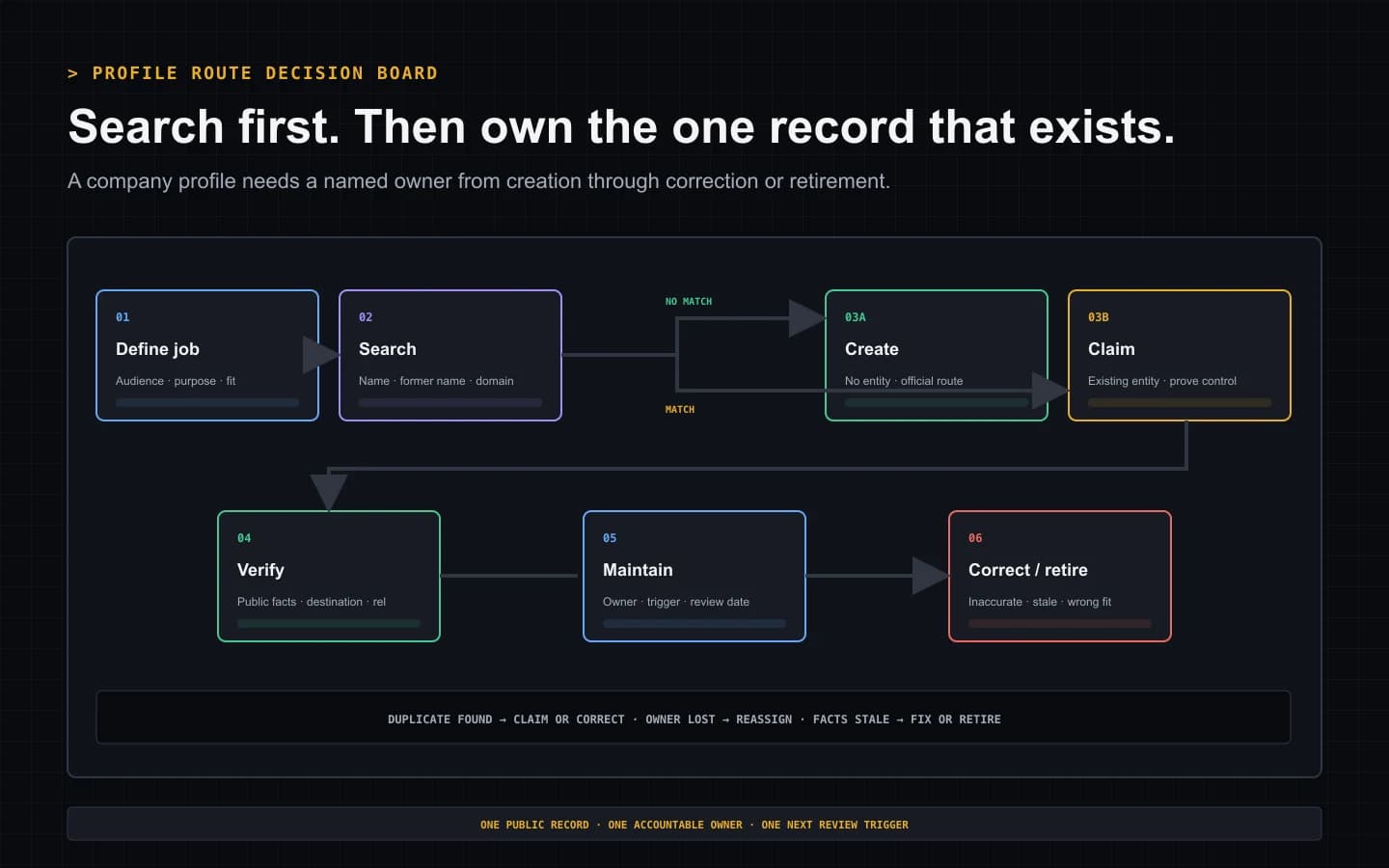
How to Route a Startup to the Right Directory
A 21-second source-led process for choosing a startup profile job, checking duplicates, proving ownership, verifying the public record, and maintaining it.
Video transcript
Choose the information job and audience the company profile must serve. Search the company name, former name, and domain before creating anything. If no entity exists, use the official creation route; if one exists, claim or correct it and prove control with the required evidence. Inspect the public facts, destination, and link relationship after review. Assign an owner, next review date, and change trigger. Maintain accurate profiles, correct material changes, and retire stale or ownerless records. A profile does not guarantee acceptance, indexing, rankings, funding, applicants, or customers.
Sources and verification
Product behavior was checked against the current implementation and automated tests. External policy sources are linked directly.
- Crunchbase profile creation guidance — checked July 30, 2026
- Dealroom company profile creation and claiming — checked July 30, 2026
- StartupBlink startup submission form — checked July 30, 2026
- F6S startup platform — checked July 30, 2026
- Wellfound company profile guidance — checked July 30, 2026
- Google SEO starter guide — checked July 30, 2026
- SubmitForBacklinks submission guidelines — checked July 30, 2026
Put the workflow into practice
Use the guided terminal flow or review the supporting documentation before submitting a product.
Related resources
Best SaaS Directories: A Current, Sourced Shortlist
Compare current SaaS directories by audience, eligibility, review path, profile evidence, and maintenance—without invented traffic or authority scores.
Open resourceFree SaaS Directories: Current Paths and Their Tradeoffs
Compare current free SaaS directory paths by eligibility, review, queue, profile limits, paid upgrades, and maintenance—checked July 30, 2026.
Open resourceThe SaaS Directory Submission Checklist
Prepare a SaaS directory submission with accurate copy, categories, tags, media, URLs, ownership, launch timing, and a policy-aware final preflight.
Open resourceBacklinks for a New SaaS: What to Pursue First
Prioritize realistic backlinks for a new SaaS using launch readiness, relationship proximity, reviewed profiles, verification, and policy-aware limits.
Open resource