Current SaaS launch models
SaaS Launch Platforms: Timing, Rules, and Lasting Value
Choose a launch surface by its current audience, operating model, timing, participation rules, and durable record. A scheduled or paid submission is not a promise of selection, reach, votes, or business results.
- Reviewed by
- SubmitForBacklinks Editorial Team
- Published
- Updated
- Checked
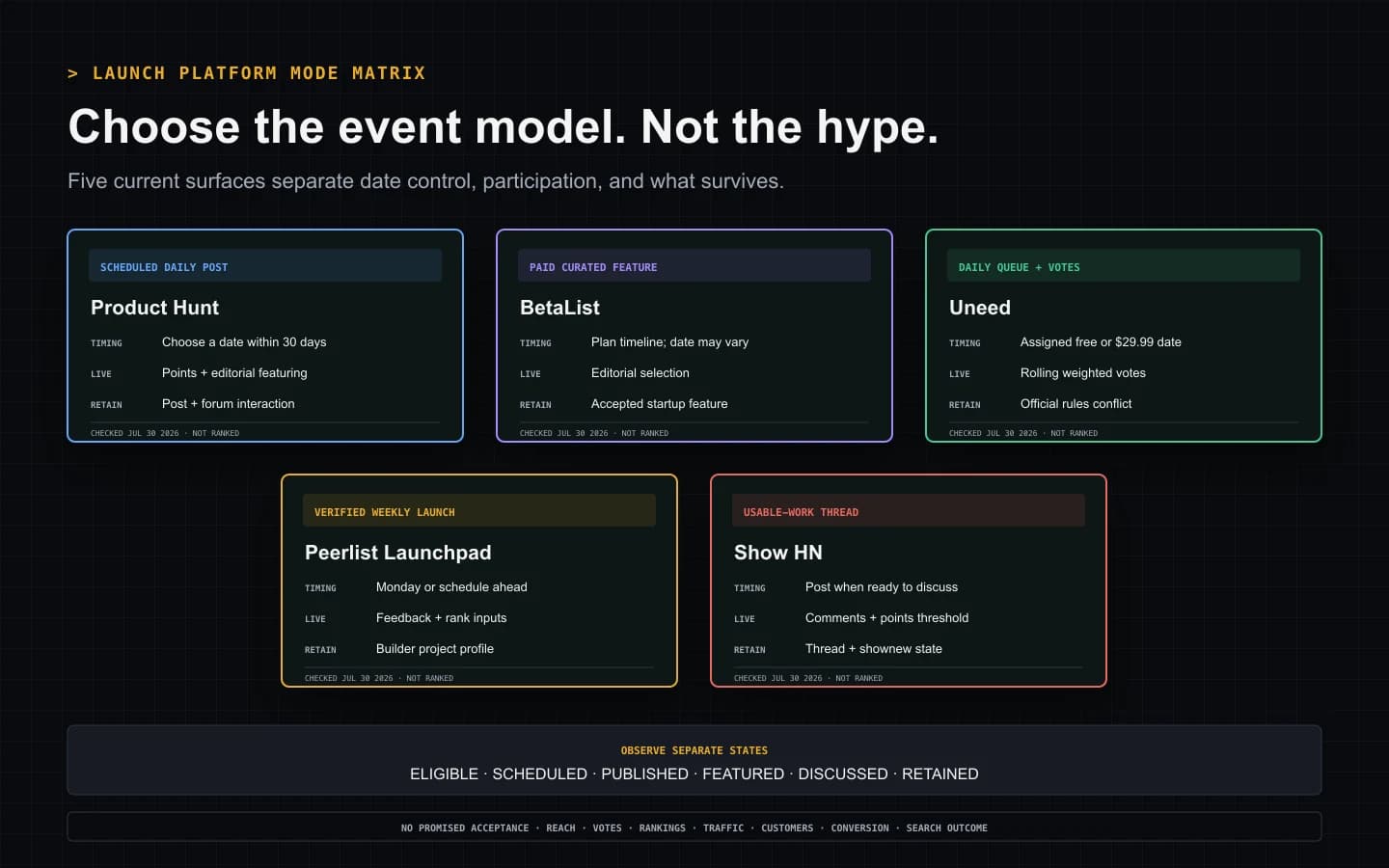
Current launch models, checked July 30, 2026
A SaaS launch platform gives a product a time-bound chance to be presented, discussed, reviewed, or ranked inside an existing community. It is not automatically a directory, press release, advertising campaign, or complete go-to-market plan.
The current options below are grouped by operating model, not ranked:
| Surface | Launch model | Timing control | Participation and retained state |
| --- | --- | --- | --- |
| Product Hunt | Scheduled daily product post with editorial homepage featuring | Maker chooses a date within 30 days | Points combine authentic engagement signals; the post remains live even when it is not featured |
| BetaList | Paid editorial review for pre-launch and recently launched internet startups | Plan controls expected timing; preferred dates depend on the selected plan and availability | No selection guarantee; an accepted startup receives a maintained feature controlled by BetaList |
| Uneed | Daily launch queue with rolling community votes | Free queue assigns a date; $29.99 skip-the-line currently permits date choice | Votes continue after launch, but official retention wording is inconsistent |
| Peerlist Launchpad | Weekly project launch from a verified individual profile | Monday launch window or advance scheduling | Builders answer feedback; upvotes are one input and the project remains on the profile |
| Show HN | Community discussion for personally built, usable work | No booked marketing slot; post only when ready and available to discuss | Every submission enters shownew; a points threshold controls broader Show-page visibility |
None of these paths promises acceptance, homepage featuring, votes, launch reach, rankings, traffic, customers, conversions, crawling, indexing, authority, or link treatment. Google also says that inclusion in its index is not guaranteed and that there is no secret that automatically ranks a page first.
Launch events and directory profiles do different work
A launch event concentrates a story, a working product, and maker participation around a defined window. The useful output may be questions, objections, comments, a public thread, a product post, or evidence that the positioning did not resonate.
An evergreen directory profile has a different job. It preserves current company facts, categories, screenshots, and a referral route after the launch window closes. It needs maintenance rather than a one-day response schedule. The startup directory shortlist covers those persistent company profiles, while the broader SaaS directory guide focuses on software-discovery fit.
Some platforms combine both behaviors. A Product Hunt post can stay available after its launch day. Uneed uses continuing votes and product pages. Peerlist keeps the project on the builder profile. Persistence still does not make every launch page an authoritative or accurate directory record.
Choose the platform after proving launch readiness
Ask four questions before reserving or publishing a launch:
- Can people use the product now? Product Hunt's current featuring rules emphasize live digital products. Show HN requires something people can actually try and rejects landing pages and fundraisers.
- Does the product match the audience? A developer-heavy discussion may suit a technical tool, while BetaList specifically serves upcoming and recently launched internet startups.
- Can the team support the window? A founder should be able to answer questions, repair broken onboarding, and distinguish feedback from support incidents.
- What survives the event? Record whether the platform retains a post, profile, thread, comments, votes, category placement, or only a temporary feature.
Do not schedule several launches merely because forms are available. Pick the smallest set of audiences the team can serve honestly.
Product Hunt: scheduled launch with editorial featuring
Product Hunt currently requires a personal account to post; company accounts cannot post, vote, or comment. The product flow asks for a direct product URL, name, tagline, topics, pricing status, media, description, makers, and a first comment. A maker can save a draft or schedule a date within 30 days. Product Hunt operates in daily Pacific-time periods.
Scheduling controls when the post goes live, not whether the editorial team features it on the homepage. Current featuring guidance prioritizes live digital products and excludes or limits several formats, including waitlists without access, directories, lists, templates, services, courses, and off-topic products. The team says not every submission is featured.
Homepage ordering is not a raw-vote table. Product Hunt says points incorporate authentic engagement signals such as upvotes and comments, and it does not disclose every ranking factor. Asking or incentivizing friends to upvote can reduce ranking or remove the product from the homepage.
Use the launch for a ready product and a real conversation. Share the post so interested people can discuss it, but do not script votes. If it is not featured, the post remains in the All feed and can continue receiving comments and upvotes. Record “published” and “featured” as separate states.
BetaList: paid curation for an early startup
BetaList's current support page says all startup submissions are paid and there is no free submission option. That is a material change from older lists that still describe a free standard queue.
The current fit is narrower than “any SaaS.” BetaList describes its audience as early adopters discovering upcoming and recently launched internet startups. The startup needs its own domain; direct app-store links and pages on free hosting subdomains do not qualify. BetaList says it prioritizes a clear value proposition, good design, and an innovative idea.
Payment starts editorial review. It does not purchase selection. Current plans differ by expected feature timing and whether newsletter inclusion is guaranteed. Submission terms also say premium timing is subject to availability and that an exact feature date is not always available.
Use BetaList when the startup stage and editorial model fit and the current plan cost is justified without assuming a result. Save the plan shown at checkout, the promised review timeline, the editorial decision, the actual publication date, and the accepted page. Do not turn BetaList's own link or traffic claims into a search or conversion forecast.
Uneed: assigned daily launch or paid date selection
Uneed currently launches a daily set of products and lets community votes continue beyond launch day through rolling daily, weekly, monthly, and yearly leaderboards. Its free path places a product in a waiting line and assigns the date automatically. The current skip-the-line option costs $29.99 and lets the submitter choose a launch date.
That model creates a meaningful tradeoff: free controls cost but not the day; paid date selection controls timing but not votes, rank, customers, or conversion. Uneed also sells Pro features including a vote multiplier, so founders should record paid participation mechanics rather than interpreting the leaderboard as a simple count of equally weighted people.
The first-party pages contain a retention conflict. “How it works” says a product stays permanently once launched. The launch guide says a product can be removed when its total vote score is below 10. Treat retention as conditional until Uneed clarifies the current rule, and keep the owned product page as the canonical source.
Use Uneed when an assigned or selected daily event, an ongoing product page, and rolling participation fit the plan. Avoid repeating its promotional traffic, domain-rating, backlink, or “SEO juice” claims as guaranteed outcomes.
Peerlist Launchpad: weekly builder launch and feedback
Peerlist Launchpad currently requires a verified individual profile. The project must be attached to that profile and reach 100% completion before it is eligible. Monday is the weekly launch day; builders who cannot launch manually on Monday can schedule the completed project in advance.
This is a builder-identity and contribution model. Peerlist says company profiles cannot launch, and its rules prohibit SEO marketing agencies from launching client projects. Mandatory product fields include the name, tagline, cover image, and demo link.
Upvotes exist, but Peerlist says they are only a small variable in a broader ranking equation. Its anti-spam rules prohibit unsolicited messages, repeated Scroll sharing, and comments that ask strangers for upvotes. Builders are expected to answer questions, provide support, seek feedback, and use original, accurate content.
Use Launchpad when the authorized individual can maintain a verified profile, complete the project record, and participate through the weekly window. Save the project URL, week, submitted fields, comments, corrections, and observed interaction. A badge or newsletter mention is an observed platform state, not a guaranteed reward.
Show HN: contribution thread, not a booked placement
Show HN has the strictest contribution boundary in this comparison. It is for non-trivial work the submitter personally built, can let other people try, and is available to discuss. Early-stage work is welcome, but a sign-up page, newsletter, list, fundraiser, or unusable teaser is not a Show HN.
A qualifying post begins with “Show HN.” Every post appears in shownew; it
reaches the Show page after clearing a small points threshold. Hacker News says
not to ask friends to upvote or comment. A current temporary notice also asks
people unfamiliar with HN culture to contribute to the community before making
an occasional Show HN.
Use this route only when the builder can explain how and why the product was made, give readers low-friction access, and stay in the thread. The value is the technical or product discussion, not a synchronized vote campaign. If the work is not usable or the author will not be present, wait.
Prepare one source record, then adapt the contribution
Build a current launch record before touching a platform:
- canonical product URL, working demo, authorization, and support owner;
- exact product stage, audience, use case, pricing, and availability;
- concise description, screenshots, demo media, limitations, and privacy route;
- launch date constraints, incident plan, and people covering questions;
- platform source URL, accessed date, submission state, and paid boundary.
The facts remain consistent while the contribution changes. Product Hunt needs a polished product post and first comment. BetaList evaluates an early startup through an editorial plan. Uneed uses a queued or selected daily launch. Peerlist binds the project to a verified builder. Show HN needs a personally written explanation and usable work.
The submission checklist can hold the reusable facts, and the SaaS promotion system can coordinate launch activity with owned content, customers, communities, and lifecycle messages.
Count observed states, then retain what remains useful
Use separate ledger states: eligible, drafted, scheduled, submitted, published, featured, discussed, corrected, retained, and removed. Save the live URL, timestamp, visible copy, relationship, category, comments, and current destination. Do not report a scheduled draft as publication or a public post as homepage featuring.
After the event, move durable facts and useful answers into maintained owned pages. Correct the launch profile when possible. Add a fitting evergreen profile only when the audience and moderation model justify it. SubmitForBacklinks, for example, uses a reviewed weekly reservation that can become a maintained directory page without public vote ranking; its current terms and guidelines remain distinct from the platforms above.
Inspect any retained public page using the directory quality test. A lasting URL can preserve accurate product evidence and referral context. It cannot guarantee search credit, rankings, traffic, or conversions.
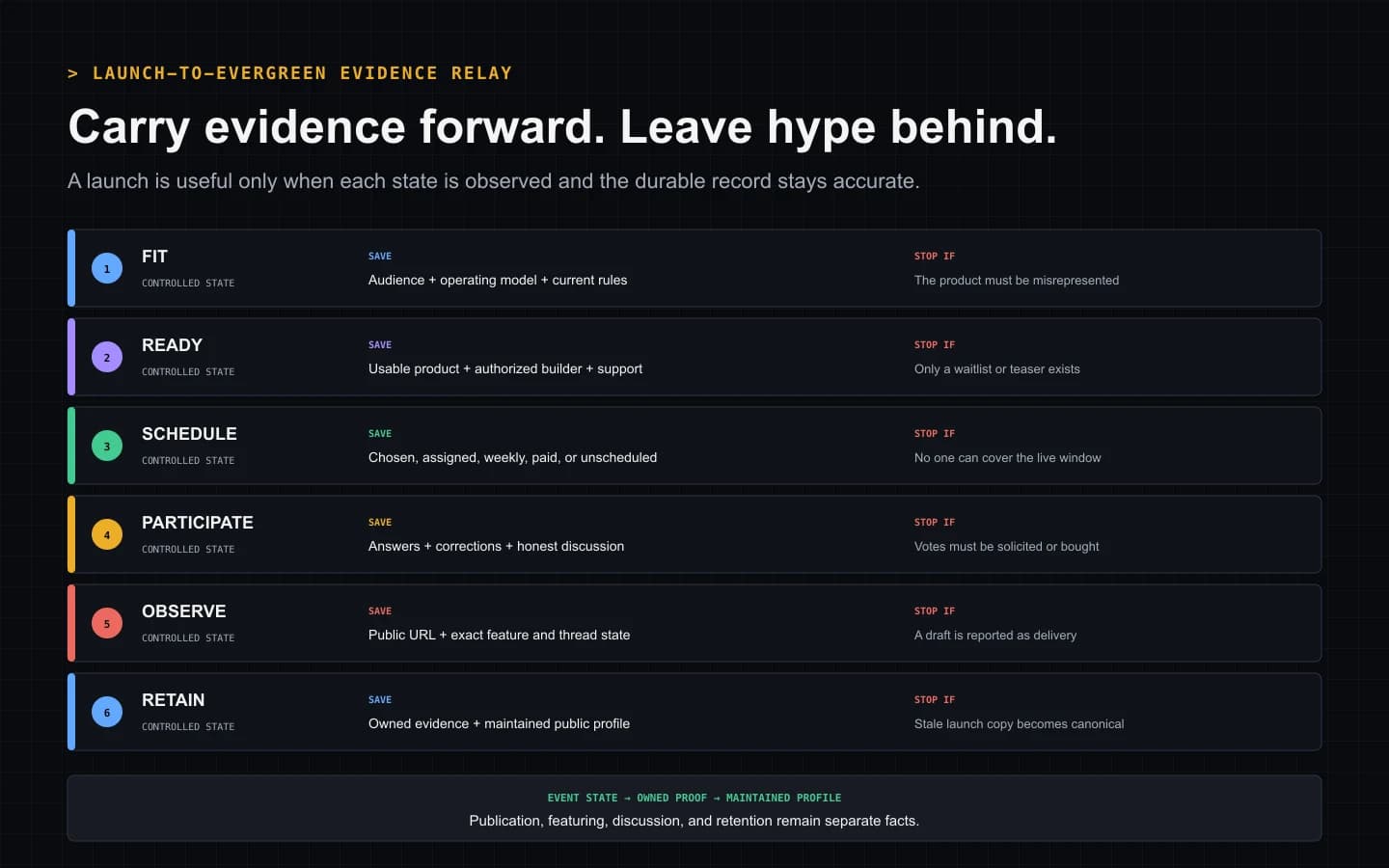
How to Control a SaaS Launch Platform Sequence
A 22-second process for checking platform fit, launch readiness, timing, participation rules, and retained evidence.
Video transcript
Classify the surface as a scheduled post, curated publication, voting launch, verified-maker launchpad, discussion thread, or evergreen profile. Confirm a usable product, authorized builder, accurate URL, clear value, media, and capacity to answer users. Record whether the date is selected, assigned, weekly, paid, unscheduled, or editorially controlled. Answer questions, disclose relationships, and invite honest discussion without requesting or incentivizing votes. Save the public URL and exact publication, featuring, discussion, vote, and profile states, then move durable facts into maintained assets.
Sources and verification
Product behavior was checked against the current implementation and automated tests. External policy sources are linked directly.
- Product Hunt posting guide — checked July 30, 2026
- BetaList submission support — checked July 30, 2026
- Uneed launch process — checked July 30, 2026
- Peerlist Launchpad introduction — checked July 30, 2026
- Hacker News Show HN guidance — checked July 30, 2026
- Google SEO starter guide — checked July 30, 2026
- SubmitForBacklinks submission guidelines — checked July 30, 2026
Put the workflow into practice
Use the guided terminal flow or review the supporting documentation before submitting a product.
Related resources
How to Promote a SaaS Product Without Betting on One Channel
Promote a SaaS product across owned, community, partner, directory, lifecycle, and paid channels with clear roles, attribution, and no growth guarantees.
Open resourceBacklinks for a New SaaS: What to Pursue First
Prioritize realistic backlinks for a new SaaS using launch readiness, relationship proximity, reviewed profiles, verification, and policy-aware limits.
Open resourceBest SaaS Directories: A Current, Sourced Shortlist
Compare current SaaS directories by audience, eligibility, review path, profile evidence, and maintenance—without invented traffic or authority scores.
Open resourceThe SaaS Directory Submission Checklist
Prepare a SaaS directory submission with accurate copy, categories, tags, media, URLs, ownership, launch timing, and a policy-aware final preflight.
Open resource