Current AI directory shortlist
Best AI Tool Directories: Current Fit and Review Paths
Prove what the AI does, classify the customer's real job, and match the product to a current audience, eligibility path, review model, and correction owner—without adopting directory promotion claims as outcomes.
- Reviewed by
- SubmitForBacklinks Editorial Team
- Published
- Updated
- Checked
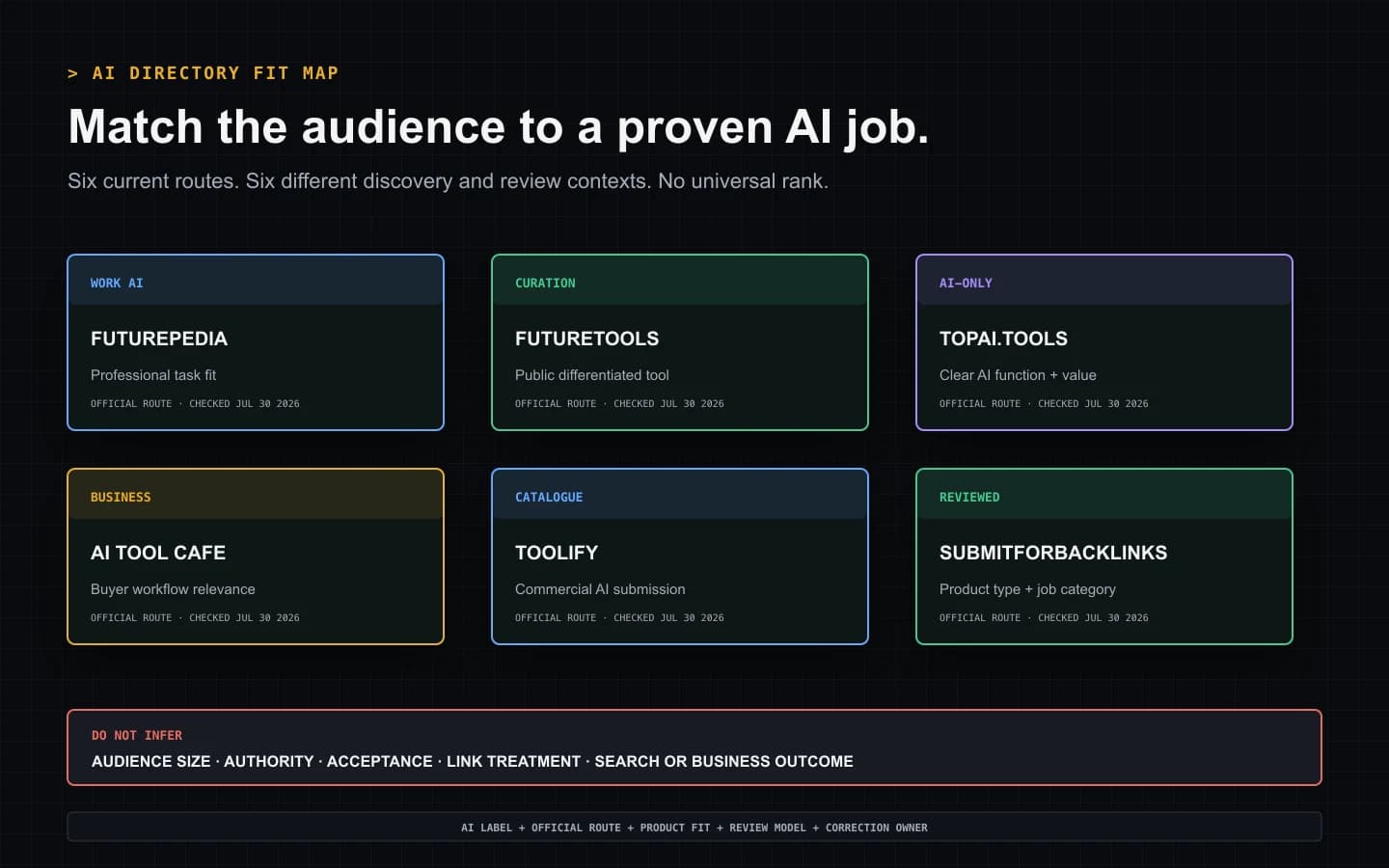
Match the AI product to the directory’s editorial job
The best AI tool directory is not the one with the largest self-reported audience or strongest backlink claim. It is the one whose readers, categories, eligibility rules, and review model match a real, working product.
This shortlist names six current options checked against first-party pages on July 30, 2026: Futurepedia, FutureTools, TopAI.tools, AI Tool Cafe, Toolify, and SubmitForBacklinks. They are not ordered by traffic, authority, price, acceptance, or link treatment. Each represents a different route: AI tools for work, personal curation, AI-only discovery, business-software comparison, a commercial AI catalogue, or a reviewed general product profile.
Being named here means a current official discovery surface and submission or review path could be verified. It does not mean every AI product qualifies, that a submission will be published, or that a profile will produce crawling, indexing, rankings, traffic, customers, authority, or link equity.
Use an AI-specific inclusion test
A product should not enter an AI directory merely because its homepage contains the letters “AI.” Before selecting a destination, document four facts:
- AI role: the exact input, model-assisted operation, and output a user can observe.
- User job: the task and audience the product serves without a generic “AI tools” label.
- Availability: a public product someone can use or evaluate now, not an unsupported concept.
- Evidence owner: a person who can correct features, categories, screenshots, limitations, and commercial disclosures.
Then verify that the official directory still serves that audience and accepts that product type. A custom GPT, waitlist, newsletter, developer model, consumer app, business workflow, and AI-enabled SaaS may face different rules.
| Directory | Best fit when | Current first-party gate | Check | | --- | --- | --- | --- | | Futurepedia | The tool supports a clear work use case | AI-tools-for-work audience; current commercial submission; editorial approval | Jul 30, 2026 | | FutureTools | A public software tool fits a personally curated AI collection | Working public tool; current exclusions and human selection | Jul 30, 2026 | | TopAI.tools | AI is a clear functional part of the product | AI-powered features, accessible product, user value, editorial review | Jul 30, 2026 | | AI Tool Cafe | The AI tool serves a defined business user and workflow | Business relevance, clear use case, useful product, editorial consideration | Jul 30, 2026 | | Toolify | The founder consciously chooses its current commercial AI submission route | Tool name, public website, and generated or founder-supplied listing information | Jul 30, 2026 | | SubmitForBacklinks | A real AI tool can support an accurate reviewed product profile | AI-tool product type, primary category, tags, accurate copy, and moderation | Jul 30, 2026 |
This is a routing matrix, not a recommendation to submit everywhere.
Futurepedia: AI tools for work
Futurepedia describes its collection as AI tools, GPTs, and apps for work. Its current submission page presents commercial listing choices and says every submission remains subject to editorial approval. It also says a tool may be denied or removed when its features are inappropriate for the audience.
The useful screening question is therefore not “Does it use AI?” but “Can a professional understand and perform a real work task with it?” Prepare the specific job, intended user, current capabilities, public destination, and category before entering the current submission flow.
Do not carry the page’s audience, publication-speed, or promotional claims into your forecast. Save the commercial terms and editorial condition as separate evidence. Payment describes the relationship; it does not prove editorial endorsement or a search result.
FutureTools: selective personal curation
FutureTools provides a public form for an AI tool’s name, URL, short description, category, pricing state, and contact. Its FAQ makes the curation boundary unusually explicit: submissions are manually reviewed, inclusion is not guaranteed, and the collection reflects its publisher’s selection.
The current FAQ says waitlist-only products, custom GPTs, newsletters, aggregators, blogs, and links that are not software tools do not fit. It also identifies product availability, user experience, duplicate concepts, content safety, and trust signals as review considerations.
This route fits a public tool with a concrete, differentiated use case. Do not resubmit repeatedly, disguise a waitlist as a product, or send a directory to another directory. Read the live FAQ immediately before contributing because accepted product types can change.
FutureTools also says it creates tool summaries from the homepage with AI and manually reviews them, while acknowledging that nuances can still be wrong. That makes the published-page check essential: compare the live summary and image with the product, then use the page’s current change-suggestion route when needed.
TopAI.tools: explicit AI eligibility
TopAI.tools states that it focuses exclusively on AI-powered tools and applications. Its current qualification guidance asks for clear AI-powered features, a fully functional and accessible product, and clear value to users. The submission is commercial and remains subject to editorial review.
This is a useful gate for products where AI is observable in the workflow. Show what the user provides, what the system does, and what useful output returns. A standard SaaS with an AI-themed headline but no identifiable AI function does not satisfy that evidence test.
Prepare a task-focused description, relevant category, working destination, current screenshots, and a correction owner. Ignore the directory’s own traffic, SEO, permanence, and promotional assertions when judging fit; those claims do not verify a product or predict your outcome.
AI Tool Cafe: business workflow relevance
AI Tool Cafe describes itself as an AI directory and comparison service for businesses choosing software by category, industry, use case, and workflow. Its current submission page invites AI software companies serving business users to request editorial review.
The page says it considers usefulness, relevance, pricing clarity, business fit, and editorial quality, and that submission does not guarantee inclusion. This route is therefore strongest when the founder can name a business user, repeated workflow, decision, and current buying state without generic productivity language.
Prepare one specific before-and-after task, supported capabilities, limits, current commercial state, and the category a buyer would actually browse. Possible consideration for a directory, comparison, or article is not the same as publication in any of those surfaces.
Toolify: separate the catalogue from the promotion
Toolify’s current “Submit AI” page asks for a tool name and website URL, then lets the submitter choose between Toolify-generated information and founder-supplied English information that Toolify translates. The current route is commercial and appears beside separate advertising, update, GPT, guest-post, and link-insertion offers.
That separation matters. Evaluate the AI catalogue’s audience and category fit first. Treat the submission purchase, advertising, content placement, and later update route as distinct commercial decisions. Do not repeat Toolify’s traffic, ranking, SEO, permanence, or link assertions as your own forecast.
If Toolify generates the listing, inspect every capability, category, translation, commercial fact, screenshot, and destination after publication. Generated copy can be fluent and still misstate the product.
SubmitForBacklinks as a disclosed first-party option
SubmitForBacklinks accepts AI_TOOL as a current product type, but that label
does not replace category fit. The submission also requires a primary category,
one to five tags, structured descriptions, current URLs, owner confirmation,
and guideline acceptance.
The guidelines require a real safe product or public preview, people-first copy, accurate optional media, authorization, reviewed generated content, and moderation. Featured never bypasses review. Only published records appear in public discovery, and current profiles expose a self-canonical and a server-visible destination anchor.
Link treatment depends on the reviewed listing's current entitlement. An approved Free record stays nofollow without an active verified reciprocal badge; an approved, successfully paid Featured record uses the product's standard-link policy. The owner selected those commercial rules, and neither one represents approval or a recommendation from Google.
Use current profiles to inspect the taxonomy. If the AI tool
cannot fit an accurate primary customer-job category, do not use AI_TOOL as a
catch-all.
Build an AI evidence pack before any form
The SaaS directory submission checklist covers the reusable field preflight. Add an AI-specific evidence layer:
- one real user input, the AI-assisted operation, and observable output;
- intended user, workflow, category, and supported platform;
- current availability, onboarding route, and commercial state;
- model or provider only when publicly supported and useful to the decision;
- important limitations, required review, and data-handling documentation;
- current logo, interface evidence, support route, and correction owner.
Do not claim a model, accuracy rate, privacy property, customer count, certification, or automation capability without current evidence. Keep prompts, customer data, credentials, proprietary system instructions, and private model configuration out of directory forms.
Categorize by the user job, not the mechanism
“AI” is a product type, not a complete discovery category. A meeting-summary tool may belong in transcription or collaboration. A code-review agent may belong in developer tools. An image editor may belong in design even when its core operation uses a generative model.
Review the directory’s current categories and choose the primary job a user would browse. Record one sentence:
A [user] uses this tool to [complete a task] by providing [input] and reviewing [output].
If the sentence cannot be supported on the live product, fix the product page or skip the submission. Do not select every adjacent AI category to gain more surfaces.
Inspect generated and editorial copy
Directory copy can come from the founder, an editor, an automated extraction, or a generative system. None should be trusted without comparing the public profile with the current product.
Check the product name, audience, category, feature tense, model references, commercial state, screenshots, limitations, and destination. Remove invented superlatives and capabilities that are planned but unavailable. Record who wrote or generated the profile when that affects your correction workflow.
Google’s people-first questions emphasize original value, clear sourcing, first-hand expertise, factual reliability, and an intended audience. Use those questions to improve accuracy, not to predict ranking.
Verify delivery and maintain the listing
A submitted form, payment, or review notice is not proof of a live profile. Open the delivered page and record:
| Evidence | Inspect |
| --- | --- |
| Product | Name, use case, category, capability, limitation, and image |
| Destination | Public URL, redirects, final page, and current onboarding step |
| Link | Anchor, href, every rel token, and surrounding context |
| Relationship | Editorial, user-submitted, paid, reciprocal, generated, or combined |
| Maintenance | Correction route, owner, source date, and last profile review |
Google says a generally crawlable link uses an <a> element with an href.
That technical check does not prove how Google will treat either page. Its
link-spam examples include paid ranking links, excessive exchanges, automated
link creation, and low-quality directory links.
Search Console’s Links report is sampled, may retain historical links, groups
data by canonical URL and root domain, and does not indicate nofollow. Keep a
separate current ledger and measure referral actions only where they are
actually instrumented.
Recheck a profile when the AI workflow, model, output, limitations, commercial state, category, brand, destination, or directory rules change. The best AI directory portfolio is the smallest set whose readers and categories still fit the product and whose claims someone can maintain. If SubmitForBacklinks meets that standard, submit an accurate AI tool as one reviewed discovery opportunity—not a guaranteed outcome.
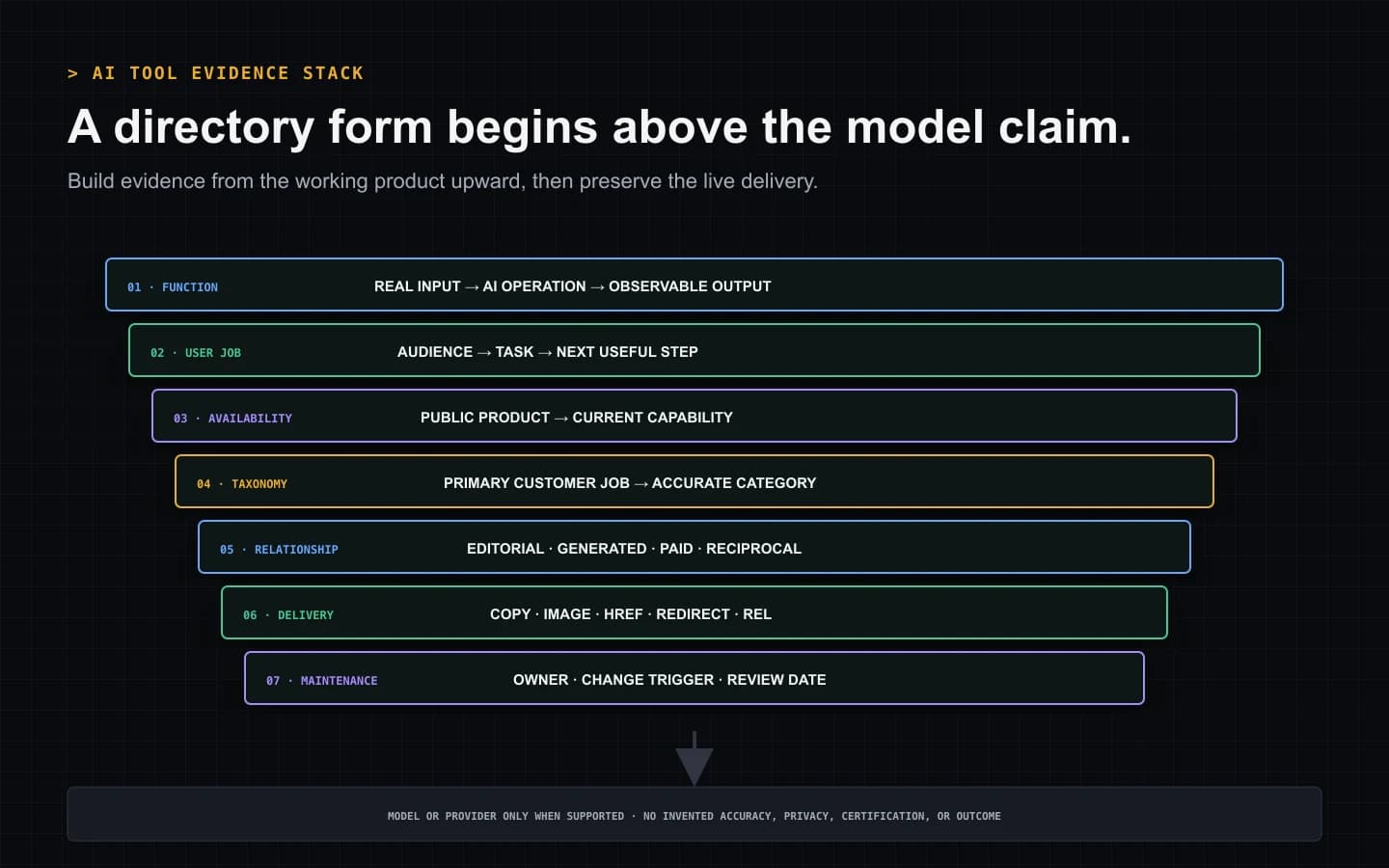
How to Select an AI Tool Directory
A 23-second process for proving an AI function, choosing its customer-job category, matching a directory, reviewing the live profile, and maintaining current evidence.
Video transcript
Prove the observable input, AI-assisted operation, and output of a working product. Classify the customer's real job and audience without hiding behind a generic AI label. Match that evidence to a current directory audience, eligibility rule, category system, review model, and commercial boundary. Review generated or editorial copy, then inspect the live URL, category, destination, redirects, anchor, rel tokens, and relationship. Refresh the source and profile when the model, output, product, directory, or policy changes. No directory name guarantees acceptance or an outcome.
Sources and verification
Product behavior was checked against the current implementation and automated tests. External policy sources are linked directly.
- Futurepedia tool submission and review — checked July 30, 2026
- FutureTools tool submission form — checked July 30, 2026
- TopAI.tools submission criteria — checked July 30, 2026
- AI Tool Cafe editorial review request — checked July 30, 2026
- Toolify AI tool submission route — checked July 30, 2026
- Google guidance for creating helpful content — checked July 30, 2026
- SubmitForBacklinks submission guidelines — checked July 30, 2026
Put the workflow into practice
Use the guided terminal flow or review the supporting documentation before submitting a product.
Related resources
Best SaaS Directories: A Current, Sourced Shortlist
Compare current SaaS directories by audience, eligibility, review path, profile evidence, and maintenance—without invented traffic or authority scores.
Open resourceFree SaaS Directories: Current Paths and Their Tradeoffs
Compare current free SaaS directory paths by eligibility, review, queue, profile limits, paid upgrades, and maintenance—checked July 30, 2026.
Open resourceHow AI Agent Directory Submission Works
See how an AI agent discovers capabilities, uses scoped authorization, saves an owner draft, submits reviewed fields, and handles each result.
Open resourceThe SaaS Directory Submission Checklist
Prepare a SaaS directory submission with accurate copy, categories, tags, media, URLs, ownership, launch timing, and a policy-aware final preflight.
Open resource