Reciprocal link decisions
Reciprocal Backlinks: When an Exchange Helps or Hurts
Two pages linking to each other is an observable relationship, not a universal benefit or violation. Review why each link exists, what each page adds for readers, and how both sides will be maintained.
- Reviewed by
- SubmitForBacklinks Editorial Team
- Published
- Updated
- Checked
Direct answer: reciprocal links are a relationship, not a result
Reciprocal backlinks are links between two sites that point to each other. They can arise because two pages independently cite one another, because two businesses have a real partnership, or because one party requires a link in exchange for another. Those situations may produce the same two arrows in a backlink tool, but they do not carry the same reader value or policy risk.
A reciprocal link is not automatically harmful, and it is not automatically an SEO benefit. Google identifies excessive link exchanges and partner pages created exclusively for cross-linking as link-spam examples. The practical question is therefore why each link exists. Would each publisher still show its link if ranking credit were removed from the arrangement?
Evaluate both pages independently. A useful link helps a visitor continue a real task, names the destination accurately, and fits the surrounding content. An exchange created mainly to manufacture ranking signals has a different purpose even when both pages are polished. No reciprocal agreement can guarantee crawling, indexing, rankings, traffic, Domain Rating, or authority.
Three arrangements that should not be conflated
Start by naming the actual relationship.
Independent editorial overlap occurs when two publishers cite each other because each has something relevant to add. A software vendor might link to an integration partner's setup guide, while that partner links to the vendor's API reference. Each link has a reason that survives without a bargain.
A disclosed commercial or operational partnership may also create links in both directions. The pages might identify a compatible product, implementation partner, sponsor, association member, or marketplace listing. The relationship and any compensation determine what context and link qualification are appropriate.
A required exchange makes one link conditional on the other. Badges, directory programs, partner swaps, and “link to me and I will link to you” requests fit this category. The requirement does not tell you whether a person will find either page useful. It does increase the need to inspect policy, qualification, scale, placement, and removal terms before agreeing.
Do not use the word “partnership” to blur those differences. Record whether each link is editorial, compensated, user placed, or required. That fact is more useful than a generic backlink label.
Benefits should make sense without ranking credit
A relevant reciprocal link can help a visitor move between products, documentation, research, or services that genuinely work together. It can make a source easier to verify, clarify where an integration is supported, and send direct referral visits. Google also says links help it find pages and are used as a relevancy signal, but that does not turn any individual exchange into a promised search outcome.
Use a reader-first test:
- Does the source page have a purpose beyond listing exchange partners?
- Does the destination complete the task described near the link?
- Is the anchor concise, descriptive, and accurate?
- Is the link visible and useful to a normal visitor?
- Would you keep it if the other site changed its outbound link to nofollow?
If the final answer is no, the arrangement depends on the exchange rather than the information. Declining it may be simpler than building a maintenance obligation around a weak page.
The same test prevents a common mistake: treating every nofollow reciprocal link as worthless. A qualified link can still be a useful route for visitors. Likewise, a standard link hidden on an unrelated partner page is not made valuable by its HTML alone.
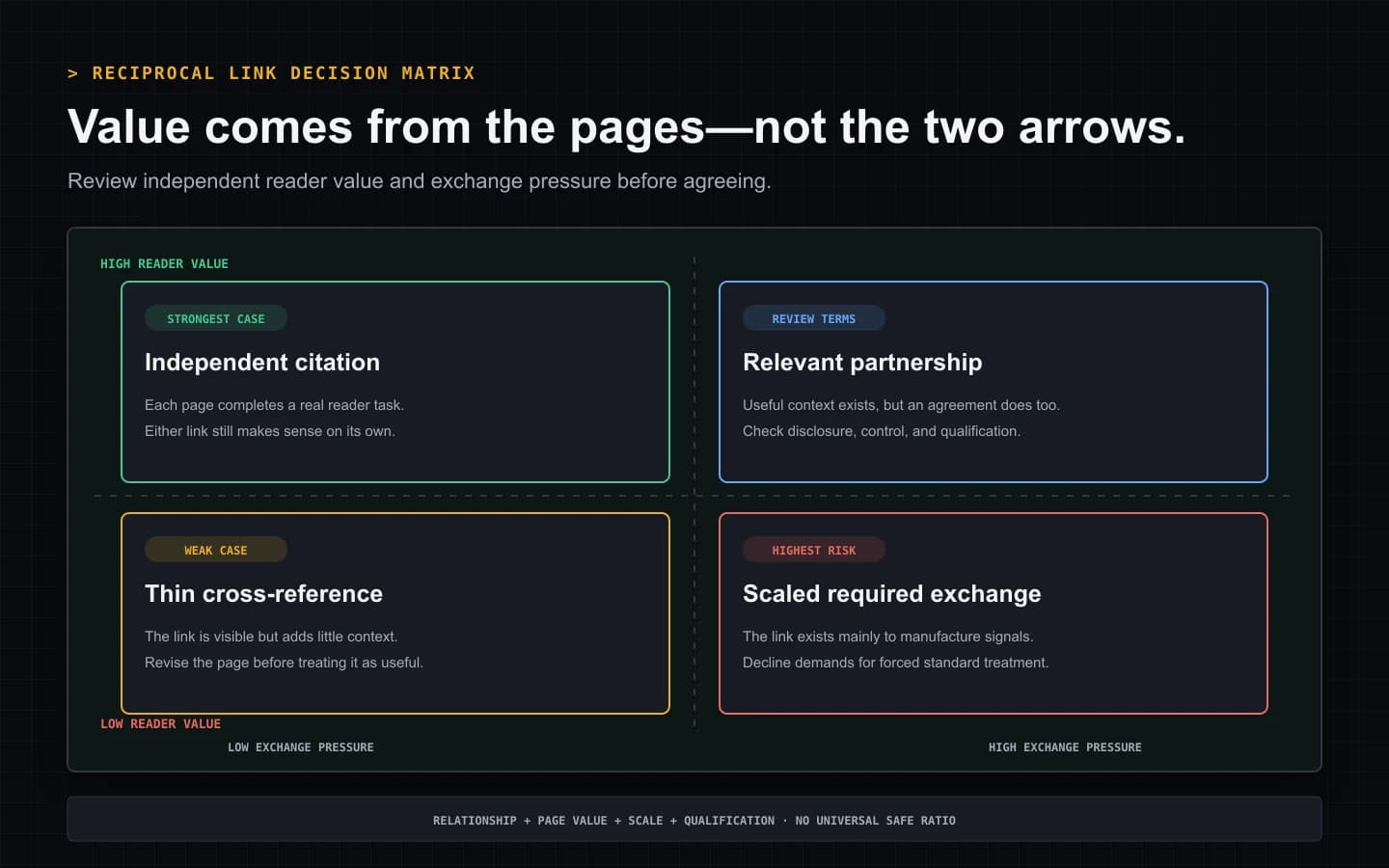
Map reader value against exchange pressure
The safest zone has strong independent reader value and little or no exchange pressure. Examples include mutually relevant documentation and editorial citations that each publisher chose separately.
A real partnership can still sit in a reasonable zone when the connection is clear, the pages help users, the anchors are natural, and the publishers retain control over their own markup. Add disclosure or qualification when the commercial relationship requires it.
Risk rises when the other party dictates the anchor, exact placement, or standard-link treatment as a condition. Google specifically lists required links that do not allow the third-party content owner to qualify the outbound link among its link-spam examples.
The highest-risk zone combines low reader value with high exchange pressure: large swap networks, partner pages built exclusively to cross-link, automatically created links, keyword-heavy anchors, hidden badges, or a sitewide footer distributed mainly for ranking. Google's examples also call out low-quality directory links and widely distributed footer or template links.
There is no documented “safe” number or reciprocal-link percentage that turns those facts into a formula. Purpose, quality, control, and scale must be reviewed together.
Ask both publishers before agreeing
A useful agreement can be described without SEO euphemisms. Before publishing anything, write down:
- The exact source and destination page for each direction.
- Why each link helps someone using that source page.
- Whether money, access, placement, or another service is exchanged.
- Who controls the anchor,
relvalues, page location, and future edits. - How either party can end the arrangement and what happens next.
Reject vague requests for “a high-authority dofollow link.” That phrasing skips the page, visitor, and reason for the reference. Also reject a requirement to use an exact keyword repeatedly across unrelated pages.
Inspect the proposed destination before linking. Confirm that it is the real site, uses HTTPS, represents the stated business, and still contains the information your surrounding copy promises. A reciprocal arrangement creates an ongoing editorial dependency: when the destination changes, your page can become misleading even if the anchor still works.
Qualify the relationship accurately
An ordinary crawlable link usually uses an <a> element with an href.
Descriptive anchor text tells people what to expect and gives the link useful
context. Avoid empty images, “click here,” forced exact-match keywords, and
anchors that overstate the destination.
The relationship determines the relevant rel value. Google says a regular
link needs no qualification. Paid placements should use sponsored (with
nofollow still accepted), while nofollow applies when other values do not
fit and the publisher would rather not associate with or crawl the destination.
The separate guide to dofollow and nofollow
backlinks explains the markup in
detail.
Reciprocity itself is not a special HTML token. Adding rel="reciprocal" or
rel="dofollow" does not create a standard search relationship. Inspect the
delivered anchor and document the actual tokens.
Most importantly, qualification does not repair a useless page or misleading agreement. It communicates a relationship to a crawler; it does not replace editorial judgment.
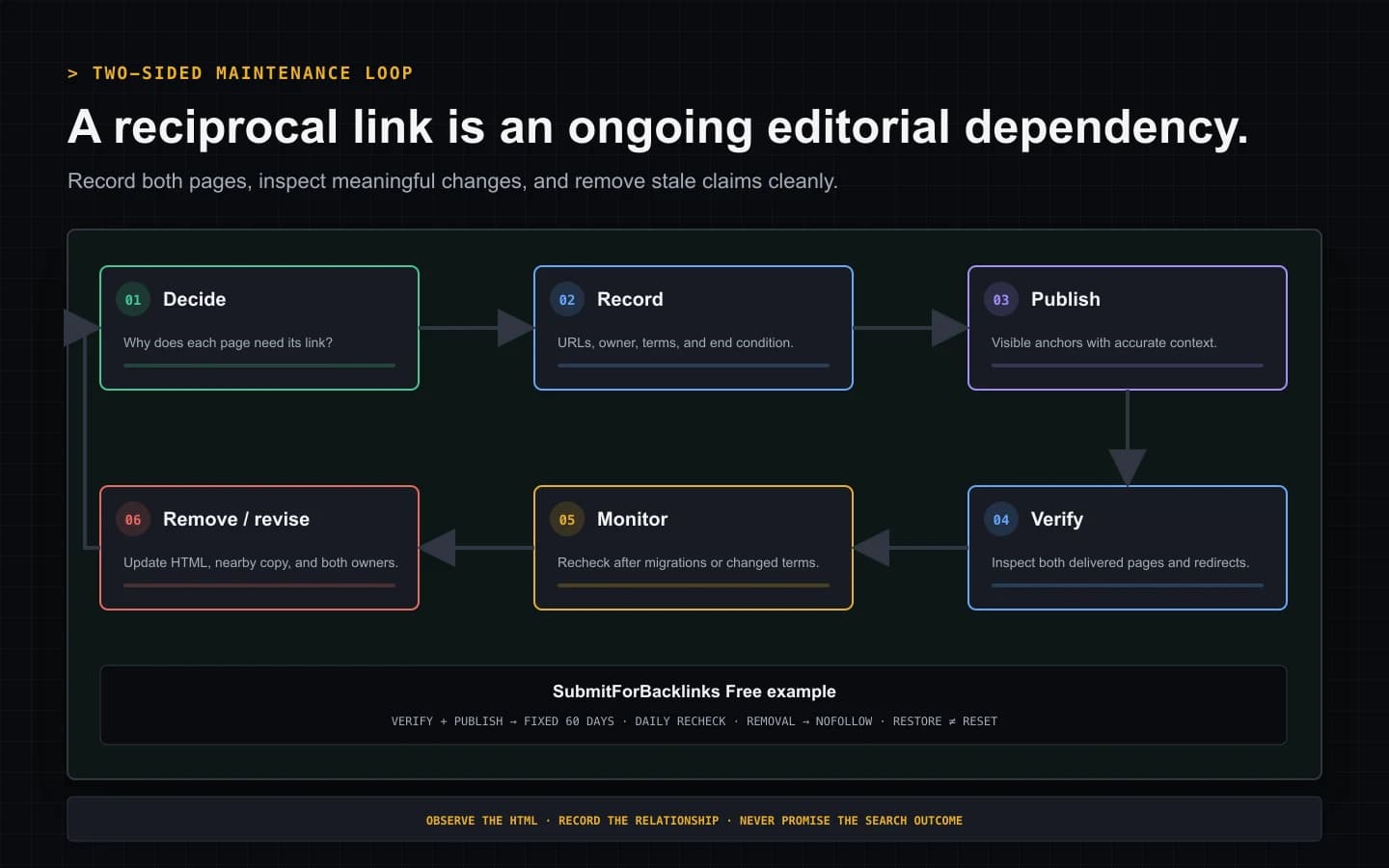
Keep a two-sided evidence record
Backlink dashboards show only part of the arrangement. Maintain one record with both directions:
- source URL, destination URL, and final redirect destination;
- visible anchor or image alternative text and delivered
reltokens; - reason for each link, relationship type, and responsible owner;
- date published, date last inspected, and expected end condition;
- removal contact and the action required on both sites.
Save the agreement beside the observed HTML. A message saying that a partner will add a link is not evidence that the current page contains it. Likewise, a Search Console row is not proof of the live relationship: Google's Links report is sampled, can include links found in the past that were later removed, and does not state whether a link is nofollow.
Trigger a fresh inspection after a redesign, CMS migration, redirect change, domain move, partnership change, or removal request. Those events are more meaningful than checking on an arbitrary daily schedule. Automated link checking can identify a missing page or changed anchor, but a person must still decide whether the relationship and context remain accurate.
How the SubmitForBacklinks badge exchange works
SubmitForBacklinks offers one concrete required exchange for a Free listing.
The owner receives a badge tied to that submission. The badge links to the
public product listing with attribution parameters. To verify it, the live page
must contain the issued token, an accepted destination, the matching badge
image, visible markup, and no nofollow, sponsored, or ugc token on that
reciprocal anchor.
Verification plus publication starts one fixed 60-day window during which the Free listing's product link uses standard treatment. The service schedules verified badges for another check approximately every 24 hours. A definitive missing badge, ineligible page, or blocking response changes the badge state to failed and returns the listing's product link to nofollow. Temporary fetch problems receive bounded retries instead of immediately revoking a previously verified state.
Restoring a valid badge can recover only the time remaining in the original window. It does not restart or extend the 60 days. For exact markup, installation, status, and troubleshooting, use the badge verification guide.
This standard-link treatment is an owner-selected product policy, not a claim that Google considers the exchange compliant. Google's spam policy explicitly addresses excessive exchanges and required links without a qualification choice. Review that policy and decide whether the arrangement fits your own risk tolerance. A Featured listing is the current non-reciprocal product path; compare the Free and Featured link options before choosing.
Remove or revise both sides cleanly
An expired campaign, ended partnership, changed destination, inaccurate claim, or policy decision can make removal appropriate. Do not merely hide the link with CSS. Remove or revise the anchor in the published HTML and update nearby copy so visitors are not left with a broken promise.
Tell the other owner what changed and identify the exact URLs. If only one direction no longer makes sense, each publisher can still decide independently whether its remaining citation helps readers. Reciprocity is not a reason to delete an otherwise useful source.
For a SubmitForBacklinks Free badge, removing the verified evidence can cause a definitive recheck failure and return the listing link to nofollow. The listing itself can remain published, and the original follow-window expiration remains fixed. Use the submission dashboard to inspect the saved badge state before and after a change.
After removal, recheck the final HTML and redirect chain. Keep the dated record instead of treating a backlink tool's historical row as a live result.
Decide: accept, revise, or decline
Accept when both pages independently help their readers, the relationship is accurately described, each publisher controls its own page, and the maintenance and removal terms are workable.
Revise when the connection is useful but the anchor, location, disclosure, qualification, destination, or duration needs to change. Record the revised terms before publishing.
Decline when the request is mainly about ranking credit, demands a particular unqualified link, scales the same exchange across unrelated sites, or cannot explain why a visitor needs either direction.
Then separate observed facts from hoped-for outcomes. You can prove which URLs
linked, what the anchors said, which rel tokens were delivered, and when the
pages were checked. You cannot promise that the exchange will be crawled,
indexed, counted, or rewarded. For SubmitForBacklinks-specific editorial
boundaries, review the submission guidelines before creating or
maintaining a listing.
Maintain a Reciprocal Backlink
A 22-second decision sequence for evaluating, recording, monitoring, and removing reciprocal links without assuming a search outcome.
Video transcript
Start by naming why two pages link: independent relevance, a disclosed partnership, or an exchange. Check both source pages for real reader value, descriptive anchors, visible crawlable markup, and the appropriate relationship token. Google identifies excessive exchanges and partner pages created only to cross-link as spam patterns, so purpose and scale matter. Record both URLs, the owners, the check date, and the removal condition. For a SubmitForBacklinks Free listing, publish the issued badge, verify it, and keep the page live. Daily rechecks can return the listing to nofollow if evidence disappears. Restoring a badge never resets the original 60-day window.
Sources and verification
Product behavior was checked against the current implementation and automated tests. External policy sources are linked directly.
- SubmitForBacklinks submission guidelines — checked July 30, 2026
- SubmitForBacklinks Free and Featured terms — checked July 30, 2026
- Google Search spam policies: link spam — checked July 30, 2026
- Google guidance for crawlable links and anchor text — checked July 30, 2026
- Google guidance for qualifying outbound links — checked July 30, 2026
- Google Search Console Links report — checked July 30, 2026
Put the workflow into practice
Use the guided terminal flow or review the supporting documentation before submitting a product.
Related resources
How to Verify a Dofollow Backlink for a Free Listing
Install the reciprocal badge, verify the live page, diagnose failures, and understand the fixed 60-day dofollow window and daily rechecks.
Open resourceDofollow vs Nofollow Backlinks: What Actually Changes
Compare dofollow and nofollow backlink HTML, sponsored and UGC values, Google’s hint model, and a repeatable way to inspect real links.
Open resource